
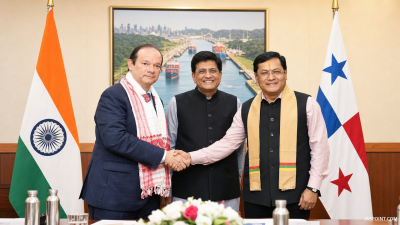
Panama’s Minister for Foreign Affairs visited India from 19–23 July 2026 for high‑level talks with External Affairs Minister Dr. S. Jaishankar, Commerce Minister Piyush Goyal and Ports Minister Sarbananda Sonowal. Discussions targeted a bilateral maritime transport agreement, port modernisation, green ship recycling, logistics linkages and use of India’s Digital Public Infrastructure (DPI) including UPI.
Current developments
Bilateral talks prioritised: accelerating a maritime transportation and port development agreement; cooperation on green ship recycling, warehousing and seafarer welfare; technical dialogues on integrating India’s DPI and UPI with Panamanian systems; and an invitation for Panama to participate in India Maritime Week 2026 in New Delhi.
Why this matters
Panama controls the Panama Canal and functions as a principal logistics, financial and trans‑shipment hub for the Americas. Closer ties expand India’s access to Latin American markets, improve logistics for export routes, export Indian digital governance models, and advance maritime environmental and security standards.
Geopolitical and strategic dimensions
- Gateway to Latin America: Engagement with Panama offers India an institutional foothold in Central America and improved access to Atlantic–Pacific trade routes.
- Diplomatic signalling: High‑level participation by EAM and Commerce Minister signals diversification of India’s partnerships beyond traditional partners.
- Flag state and registry: Panama’s status as a major open registry creates avenues for regulatory dialogue on shipping standards and seafarer issues.
Economic and logistics implications
- Maritime transport agreement: Expected gains—reduced transit times, lower logistics costs, improved port connectivity and enhanced warehousing near canal approaches.
- Port modernisation: Collaboration on cargo handling, digitised port operations and capacity building can integrate Indian shipping more efficiently into trans‑Atlantic routes.
- Trade facilitation: UPI‑enabled low‑cost payments and coordinated customs/port procedures can boost market access for Indian exporters to the Americas.
Digital Public Infrastructure and payments
- DPI components: Identity, payments (UPI), and data services proposed for technical cooperation to support trade and digital governance.
- UPI interoperability: Feasibility studies, regulatory alignment and pilot projects with Panamanian banks required for cross‑border real‑time transfers.
- Regulatory and technical needs: Data protection rules, AML/CFT compliance, APIs and cybersecurity measures must be harmonised.
Environmental and sustainability dimension
- Green ship recycling: Cooperation on environmentally safer dismantling, hazardous waste management and resource recovery. India’s yards can offer standards and training aligned with Hong Kong Convention norms.
- Port environmental practices: Joint projects on shore power, emissions control and circular economy approaches for ship waste and recycling.
Security, labour and institutional cooperation
- Maritime security: Collaboration on protection of sea lanes, information‑sharing, counter‑piracy operations and cybersecurity for shipping and port systems.
- Seafarer welfare and training: Agreements on certification, labour standards and welfare services for seafarers flagged under Panama.
- Institutional linkages: India Maritime Week 2026 to strengthen policy dialogue, joint working groups and technical exchanges.
Challenges and risk factors
- Regulatory divergence: Differences in data protection, financial supervision and shipping regulations require bilateral legal alignment.
- Technical interoperability: UPI integration faces banking legacy systems, differing clearing mechanisms and AML/CFT constraints.
- Climate and operational risks: Canal water stress, extreme weather and regional geopolitics can disrupt transit; contingency planning required.
- Distance and trade volumes: Geographic distance limits the scale of direct trade; partnerships must focus on niche logistics and value‑chain nodes.
Way forward: pragmatic steps
| Area | Immediate action | Medium‑term deliverable |
|---|---|---|
| Maritime agreement | Form joint working group between ministries of shipping and commerce | Signed MoU on maritime transport and port cooperation |
| UPI / DPI | Technical feasibility and pilot linking Indian payment rails with Panamanian banks | Operational cross‑border payment corridor and regulatory MoU |
| Green ship recycling | Capacity‑building workshops and exchange of best practices | Joint certification framework and sustainable recycling pilot |
| Security & labour | Information‑sharing protocols and seafarer training programmes | Mutual recognition of certifications and maritime security cooperation plan |
Model Questions
1. Analyse how strengthening bilateral ties with Panama can enhance India’s strategic reach in Latin America and the Caribbean through maritime and digital public infrastructure diplomacy. [GS-II: International Relations]
Closer ties with Panama provide India access to Atlantic–Pacific trade lanes via the Panama Canal and a logistics hub for the Americas. DPI and UPI cooperation project India as a technology partner. Institutional links, port agreements and participation in India Maritime Week build diplomatic presence. Combined maritime and digital engagement diversifies India’s partnerships, supports trade connectivity and advances soft‑power in the region.
2. Examine the economic implications of a bilateral India‑Panama agreement on maritime transportation and port development for India’s global trade logistics. [GS-III: Economic Development]
A maritime agreement can reduce transit times and logistics costs for India‑Americas trade, improve port efficiency and expand warehousing near canal approaches. Port modernisation and coordinated customs procedures increase throughput and lower friction. Benefits include enhanced competitiveness for exporters, scale for Indian shipping lines and integration into Western Hemisphere supply chains, provided infrastructure and regulatory gaps are addressed.
3. Discuss the prospects and challenges of exporting India’s Digital Public Infrastructure, specifically UPI, to Panama and similar Latin American countries. [GS-III: Science & Technology]
Prospects: low‑cost cross‑border payments, improved market access and export of governance tools. Challenges: regulatory divergence (data protection, AML/CFT), legacy banking systems, API and clearing interoperability, and cybersecurity readiness. Mitigation requires bilateral regulatory MoUs, pilot projects, capacity building for Panamanian banks and joint technical teams to align standards and compliance frameworks.
4. Explain green ship recycling and evaluate its role in India’s sustainable maritime transition and as a collaborative area in India‑Panama relations. [GS-III: Environment & DM]
Green ship recycling refers to dismantling vessels with environmental safeguards, hazardous waste control and material recovery per international norms. For India it supports circular economy, jobs and cleaner coastal practices. With Panama as a major registry, collaboration can ensure compliance, promote certified recycling yards, share technical standards and create sustainable decommissioning pathways aligned with the Hong Kong Convention.
Last Modified: July 23, 2026