
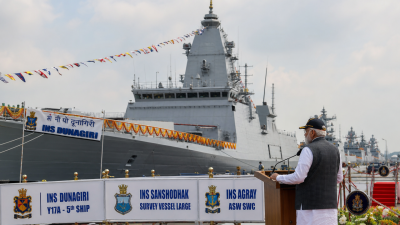
On 21 June 2026 Prime Minister Narendra Modi commissioned three indigenously built frontline naval warships at Kolkata — INS Dunagiri (stealth frigate), INS Sanshodhak (survey vessel large) and INS Agray (ASW shallow water craft). The vessels were designed by the Navy’s Warship Design Bureau and built by GRSE with over 75% indigenous content.
Current issue and significance
What is current
Three surface platforms were tri-commissioned from a single builder (GRSE). The Navy plans to induct 19 warships in 2026 and has over 45 large platforms under construction. More than 200 MSMEs contributed to the recent builds.
Why it matters
- Security: Enhances anti-submarine, air-defence and strike capabilities relevant to coastal and regional threats.
- Governance: Tests procurement, quality control and lifecycle management systems in public shipyards and suppliers.
- Economy: Strengthens domestic defence manufacturing and MSME participation.
- International relations: Affects India’s role as a security provider in the Indian Ocean Region (IOR).
Strategic imperatives for indigenous warship construction
- Self-reliance: Reduce operational risk from foreign supply constraints; ensure sustainment of platforms during conflict or sanctions.
- Maritime security: Protect coastline, EEZ and sea lines of communication against state and non-state threats.
- Deterrence and power projection: Field stealth frigates (Project 17A), long-range missiles (BrahMos) and ASW platforms for layered defence.
- Regional stability: Provide a persistent ability to conduct HADR, counter-piracy and cooperative operations across the IOR.
Key pillars: ‘Make in India’, MSMEs and shipyards
- Design capability: Warship Design Bureau handles indigenous designs (Project 17A, Arnala-class ASW-SWC).
- Shipbuilding base: GRSE as public sector integrator; private yards increasingly engaged in parallel projects.
- Supply chain: Over 200 MSMEs supplied components for the recent builds, enabling higher domestic content (≈75%).
- Policy levers: Procurement preferences for domestic industry, capital support, and offset-like measures that favour local sourcing.
Economic and employment impact
- Direct employment: Shipyards, prime contractors and system integrators expand skilled and semi-skilled jobs.
- Indirect employment: MSMEs, suppliers of steel, electronics, propulsion components and testing services gain contracts.
- Technology absorption: Systems integration, stealth fabrication techniques and weapons integration raise domestic engineering capability.
- Balance of payments: Reduced capital outflow through lower import dependence for hulls and many systems; potential for defence exports in the medium term.
Institutional framework and design capabilities
- Warship Design Bureau: Nodal authority for conceptual and detail design; responsible for Project 17A class and Arnala-class SWC designs.
- Integration agencies: Indian Navy cells manage weapons integration (BrahMos, air-defence suites), sensors and combat-management systems.
- Testing and certification: Naval docks and trials regimes validate platform performance and sea-keeping before commissioning.
Naval modernisation and operational capabilities
- INS Dunagiri (Project 17A): Fifth stealth frigate in the series; fitted with BrahMos supersonic cruise missiles and advanced air-defence systems for multi-domain threat engagement.
- INS Sanshodhak: Large survey vessel to support hydrography, charting and undersea mapping for naval and civilian maritime planning.
- INS Agray (Arnala-class ASW-SWC): Designed for littoral ASW: mine avoidance, submarine detection, tracking and neutralisation in shallow waters.
- Fleet expansion: Target to commission 19 warships in one year represents accelerated tempo in force generation and readiness posture.
Geopolitical and strategic implications
- Strategic autonomy: Indigenous platforms reduce external constraints on deployment and operational decision-making.
- Regional posture: Greater capacity to act as a net security provider across the IOR through persistent deployments and exercises.
- Partnerships: Improved capabilities support higher-value cooperation — logistics support, joint patrols and interoperability with friendly navies.
- Deterrence: Stealth frigates with cruise missiles and ASW assets complicate adversary planning in the maritime domain.
Challenges and way forward
| Challenge | Implication | Recommended action |
|---|---|---|
| Critical technology gaps (naval radars, specialised semiconductors, certain propulsion sub-systems) | Continued import dependence for niche items; schedule and cost risks. | Fund targeted R&D, incentives for localisation, and technology partnerships with academia and industry. |
| Supply-chain resilience and quality control across MSMEs | Variability in part quality and delivery schedules; lifecycle sustainment risks. | Establish supplier development programmes, accredited testing facilities and production clusters near shipyards. |
| Skilled workforce shortage for advanced naval systems | Limits capacity to scale complex builds and maintain platforms. | Expand naval engineering courses, apprenticeships, and industry-led skill certification schemes. |
| Integration and systems-of-systems complexity | Higher trial periods and retrofitting; interoperability challenges. | Strengthen systems integration cells, invest in simulation rigs and digital twin capabilities. |
| Private sector engagement and competition | Concentration risk if public yards carry most load; innovation pace may lag. | Open more contracts to private yards, promote public–private partnerships and transparent procurement timelines. |
Model Questions
1. Analyse the strategic imperatives driving India’s indigenous warship construction programme and its implications for national maritime security in the Indian Ocean Region. [GS-III: Internal & External Security]
Indigenous shipbuilding advances self-reliance, ensures sustainment under supply disruption and strengthens deterrence through stealth, ASW and missile capabilities (e.g., Project 17A, BrahMos). It secures sea lines of communication, supports EEZ and island defence, and enables persistent presence in the IOR. Resulting force posture enhances crisis response, HADR and maritime-domain awareness, thereby raising operational readiness and regional influence.
2. Examine how the ‘Make in India’ initiative, as seen in recent warship construction, fosters a defence industrial ecosystem and contributes to economic growth and employment. [GS-III: Economic Development]
High indigenous content (≈75%) and participation of over 200 MSMEs deliver direct and indirect employment in shipyards, suppliers and services. Local sourcing reduces imports and foreign exchange outflow. Technology transfer through systems integration and trials builds domestic engineering capacity. Public shipyards (GRSE) plus policy incentives create demand-pull, stimulate ancillary industries and enable export potential in the medium term.
3. Discuss the impact of India’s accelerated naval modernisation, driven by indigenous commissioning of warships, on its strategic autonomy and geopolitical standing in the Indo-Pacific. [GS-II: International Relations]
Indigenous modernisation increases strategic autonomy by reducing dependence on foreign platforms and support. Enhanced blue-water and littoral capabilities strengthen India’s role as a security provider in the Indo-Pacific. Improved fleet readiness supports partnerships, interoperability and collective security initiatives. The capability to deploy stealth frigates and ASW vessels raises deterrence and bargaining power in regional diplomacy and multilateral frameworks.
4. Critically evaluate the role of the Indian Navy’s Warship Design Bureau and related industrial infrastructure in achieving higher indigenisation of advanced naval platforms. What challenges remain and how should they be addressed? [GS-III: Science & Technology]
The Warship Design Bureau provides in-house conceptual and detail designs (Project 17A, Arnala-class), enabling national control of specifications and systems integration (BrahMos, sensors). Industrial infrastructure (GRSE, MSMEs) executes builds. Remaining gaps include niche technologies, R&D funding, skilled labour and supply-chain quality. Address these via targeted R&D grants, industry–academe partnerships, supplier development, skill programmes and strengthened systems-integration test facilities.
Last Modified: June 23, 2026