
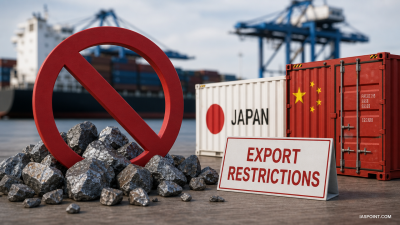
China has suspended exports of several critical minerals to Japan since January 2026, including rare earths and rare metals used in defence, automotive, electronics and aerospace. Export controls, company blacklists and zero-export customs data have intensified concerns about supply-chain coercion and strategic dependencies.
What is the current issue
China has halted shipments of gallium, dysprosium, terbium, yttrium and related materials to Japan. The Ministry of Commerce imposed export controls in early January and expanded dual‑use controls and company blacklists in February. Chinese customs data show zero exports of key items to Japan by June 2026.
Why it matters
Rare earths and rare metals are integral to EV motors, wind turbines, aerospace alloys, lasers and defence systems. Concentrated refining capacity gives a supplier state leverage over downstream industrial and military supply chains. Trade restrictions can delay green transitions, raise manufacturing costs and force geopolitical realignments.
Geography, geology and environmental bottlenecks
Rare earth elements are relatively abundant but rarely form high‑grade, economically viable deposits. Extraction requires processing large ore volumes and complex chemical separation. Refining produces acidic effluents and radioactive by‑products (thorium, uranium). Lower environmental standards and early state support enabled China to scale refining capacity. As a result, refining and magnet production are geographically concentrated despite wider ore distribution.
Scientific properties and substitution challenges
- Material properties: Dysprosium and terbium increase magnetic anisotropy and thermal stability in NdFeB permanent magnets. Yttrium and scandium enhance high‑temperature alloys and laser materials.
- Substitution limits: Ferrite or iron‑nitride magnets reduce performance and increase weight and volume in motors and generators. Thermal stability and compactness required in defence and EV applications are hard to replicate without rare‑earth additives.
- R&D horizon: Viable substitutes or redesigns require multi‑year development and retooling, increasing capital and time costs for manufacturers.
Geopolitics and economic statecraft: the China–Japan case
- Trigger: Diplomatic tensions linked to remarks by Japan’s prime minister on a Taiwan contingency led to trade measures.
- Tools used: Export suspensions, formal export controls, dual‑use regulations, company blacklists and watch lists.
- Precedent: China used rare‑earth export measures against Japan in 2010 during the Senkaku/Diaoyu dispute.
- Countermeasures: The United States and Japan established a Critical Minerals Action Plan to create coordinated trade mechanisms and mitigate single‑supplier dependence.
Economic and security vulnerabilities for India
- Import dependence: India imports significant quantities of lithium, cobalt, rare earth oxides and downstream permanent magnets. Dependency exposes defence, space and clean‑energy sectors to supply shocks.
- Supply‑chain risks: Single‑supplier concentration raises prices, delays projects and creates strategic leverage for supplier states.
- Industrial impact: Higher input costs affect EV rollout, renewable capacity additions and indigenous high‑tech manufacturing.
India’s policy responses and institutional measures
- National frameworks: National Critical Mineral Mission and MMDR amendments to classify critical minerals and open exploration to private players.
- Domestic capacity: Rare Earth Permanent Magnet (REPM) Scheme and proposals for refining/processing parks with common effluent treatment to reduce environmental costs.
- Overseas acquisitions: Khanij Bidesh India Limited secured lithium blocks in Argentina; GAIL and KABIL signed a MoU to jointly explore and process critical minerals.
- Recycling and circularity: Extended Producer Responsibility for batteries and e‑waste, and incentives for magnet and battery recycling to recover critical metals.
- International engagement: Participation in the Mineral Security Partnership and bilateral supply agreements with Australia, the United States and Latin American producers.
Operational and regulatory levers
| Dimension | Instrument | Expected effect |
|---|---|---|
| Supply diversification | Bilateral purchase agreements; MSP membership | Reduce single‑supplier risk; secure long‑term offtake |
| Domestic refining | Processing parks; REPM Scheme; common effluent treatment | Local value addition; manage environmental externalities |
| Strategic stockpiles | Buffer reserves for defence and critical industries | Absorb short‑term export shocks |
| Circular economy | EPR, recycling subsidies | Secondary supply, lower import dependence |
| Overseas assets | KABIL acquisitions; joint ventures | Secure upstream resources |
Policy trade‑offs and implementation challenges
- Environmental cost vs capacity: Scaling refining raises pollution risks. Common effluent facilities and strict standards increase capital cost.
- Time lag: Building refining capacity and substitutes takes years; short‑term shocks persist.
- Finance and incentives: Subsidies and price supports are needed to attract private investment into low‑margin, high‑capex refining.
- Strategic coordination: Industry, defence and foreign policy must align procurement, stockpiling and diplomatic engagement.
Model Questions
1. Explain the geographical and environmental factors that determine the global distribution and refining concentration of rare earth elements. How do these factors constrain national strategies for supply security? [GS-III: Environment & DM]
India and other states must consider ore grade, deposit type and processing intensity. Rare earths occur broadly but high‑grade, concentrated deposits are uncommon. Refining is chemical‑intensive and produces acidic and radioactive waste, favouring locations with lower regulatory cost and state support. Constraints include long lead times for cleaner refineries, high capital and environmental management costs, and the need for international partnerships and recycling to secure supply.
2. “Economic statecraft is increasingly defined by the weaponisation of critical mineral supply chains.” Analyse with reference to recent China–Japan export restrictions and countermeasures. [GS-II: International Relations]
China’s export controls and company blacklists show how mineral dominance can coerce policy. The measures disrupted Japanese supply of gallium and certain rare earths. Japan and the US responded with a Critical Minerals Action Plan to diversify suppliers, coordinate trade defence and set mechanisms such as price floors. The episode illustrates that strategic alliances, stockpiles and alternative supply lines are essential counters to coercive economic statecraft.
3. Describe the material properties of dysprosium and terbium that make them indispensable in high‑performance permanent magnets. Assess the main technological challenges in finding substitutes. [GS-III: Science & Technology]
Dysprosium and terbium provide high magnetic anisotropy and thermal stability to NdFeB magnets, preventing demagnetisation at high temperatures. Substitutes like ferrites or iron‑nitride reduce magnet strength and increase motor size and weight. Challenges include matching thermal performance, maintaining energy density, redesigning machines, and long R&D and retooling cycles that raise costs and delay deployment of EVs and defence systems.
4. Evaluate India’s supply vulnerabilities for critical minerals and the domestic and diplomatic measures available to reduce strategic dependence. [GS-III: Economic Development]
India faces import dependence for lithium, rare earths and downstream magnets, affecting defence and clean‑energy goals. Measures include domestic exploration, processing parks with effluent treatment, REPM incentives, KABIL overseas acquisitions, GAIL‑KABIL MoU, recycling and EPR. Diplomatic measures include MSP engagement and bilateral offtake pacts. Implementation requires capital, environmental safeguards and coordinated industry‑state planning to shorten lead times.
Last Modified: July 20, 2026