
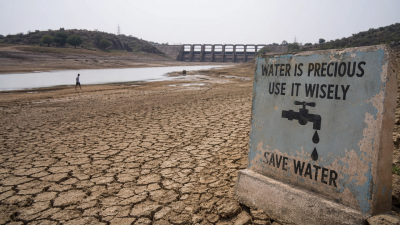
India faces acute water governance stress. Recent assessments point to a fragmented management framework, highly subsidised pricing, rising industrial demand (notably from data centres), weak monsoon rains and renewed inter-state and international tensions that together raise risks for agriculture, industry, fiscal stability and regional security.
What is the current issue?
Moody’s described India’s water management as “fragmented or inflexible,” citing dispersed authority across states, limited pricing flexibility, slow reallocation between sectors and uncertain investment pathways. Rapid growth in water use by data centres and a severe monsoon shortfall have added pressure on supply and budgets. Political disputes and transboundary tensions compound governance stress.
Why it matters for governance, economy, society and security
- Governance: State-centred jurisdiction creates coordination gaps for basin-level planning and dispute resolution.
- Economy & Fiscal: Subsidised water pricing and rising demand strain state finances and reduce incentives for efficiency.
- Society & Livelihoods: Monsoon failure disrupts sowing, raises groundwater dependence and heightens rural distress.
- Security & Diplomacy: Inter-state disputes and transboundary risks can escalate political and diplomatic tensions.
Governance and institutional framework
Fragmentation: Water is primarily a State subject under the Constitution. Multiple agencies at central and state levels produce plans with limited enforcement. Basin governance structures are weak or absent for many rivers. Policy inflexibility: Pricing mechanisms and allocation rules do not permit rapid reallocation between agriculture, industry and urban uses. Investment planning lacks credible long-term financing and project pipeline alignment.
Economic and fiscal dimensions
Subsidised pricing: Low or free irrigation water encourages inefficient use and delays adoption of efficient technologies. States carry subsidy burdens that reduce fiscal space for infrastructure and resilience. Fiscal risk: Repair, augmentation and emergency measures after deficits raise recurrent costs. Poor tariff design reduces revenue for O&M and capital replenishment.
Environmental and climate impacts
Monsoon variability: A major nationwide rainfall deficit has curtailed sowing and intensified heat stress, increasing dependence on irrigation and groundwater extraction. Resource depletion: Groundwater over-extraction persists where surface supplies are unreliable. Surface-water infrastructure often fails to deliver environmental flows or ecosystem services.
Demand-side pressures
- Agriculture: Still the largest water consumer; inefficient methods (flood irrigation) predominate in many regions.
- Urbanisation: Cities need assured supply and sewage treatment; non-revenue water remains high.
- Industrial growth: New sectors, especially data centres driven by cloud computing and AI, are rising water consumers, increasing competition in water-stressed regions.
Inter-state water disputes
Federal arrangements and the legal framework for river disputes have long delays and contested technical bases. Political decisions at state assemblies can harden positions and stall negotiation. Recent opposition to proposed balancing reservoirs in the Cauvery basin has revived tensions and project uncertainty.
International water diplomacy and security
Transboundary river management requires predictable arrangements. Statements that suggest altering flows on treaty rivers can escalate diplomatic strain. Existing treaties and bilateral mechanisms remain the primary channels, but rhetoric can raise security concerns and reduce cooperative space.
Policy interventions and technological solutions
Recent initiative: MAHA Water Mission launched with a ₹200 crore outlay to promote innovation, technology, research and sustainable solutions implemented by the Anusandhan National Research Foundation and the Ministry of Jal Shakti. Existing schemes: Jal Jeevan Mission, Atal Bhujal Yojana and central funding for surface storage and rural piped water are relevant but need better integration with basin planning. Technology and management options: Remote sensing and real-time monitoring, IoT for leak detection, AI for demand forecasting, micro-irrigation, treated wastewater reuse, managed aquifer recharge and decentralised treatment reduce demand and augment supply.
Table: Governance gaps and reform options
| Dimension | Gap | Reform option |
|---|---|---|
| Institutional | State-centric control, weak basin bodies | Legally empowered basin institutions; clear central-state roles; performance-linked funding |
| Pricing & allocation | Highly subsidised, sectoral inertia | Gradual tariff reform, volumetric metering, targeted support for vulnerable farmers |
| Investment | Uncertain long-term pipelines | Public–private partnerships, water-credit instruments, ring-fenced O&M funds |
| Data & planning | Fragmented data and limited real-time monitoring | National water data system, open-access basin dashboards, standardised metrics |
| Dispute resolution | Litigation and political standoffs | Strengthen negotiation forums, time-bound technical reviews and mediation mechanisms |
Priority actions for a resilient framework
- Basin-first approach: Legislate or empower river-basin organisations for allocation, environmental flows and infrastructure coordination.
- Demand management: Scale micro-irrigation, adopt volumetric supply for urban and industrial users, incentivise wastewater reuse.
- Fiscal realignment: Reform subsidies toward efficiency-linked support and create predictable financing for O&M and climate resilience.
- Data and technology: Create a unified water-data platform, promote AI/remote sensing for allocation and early warning, support pilots under missions like MAHA Water Mission.
- Diplomacy and dispute mechanisms: Use technical bilateral forums for transboundary rivers and strengthen internal mediation to prevent politicisation of projects.
Model Questions
1. “India’s fragmented water governance, characterised by dispersed authority and inflexible mechanisms, poses hurdles to water security. Critically examine these challenges and suggest institutional reforms for an integrated approach.” [GS-II: Governance]
Answer: Fragmentation arises from state-level control, weak basin institutions, limited pricing flexibility and uncertain investment pathways. Reforms: establish empowered basin authorities with statutory status; delineate central and state roles; adopt performance-linked fiscal transfers; create a national water-data system; implement volumetric supply and phased tariff reform; promote stakeholder forums for inter-state negotiation; and mobilise mixed financing for long-term infrastructure and O&M.
2. “Analyse the economic and environmental implications of rising industrial demand—especially from data centres—and increasing climate variability on India’s water resources.” [GS-III: Economic Development]
Answer: Rising industrial demand increases competition for scarce water, raising allocation conflicts and state fiscal burden due to subsidies. Data centres concentrate demand in specific regions, stressing local supplies. Climate variability reduces surface flows and increases groundwater extraction, threatening agricultural output and livelihoods. Policy response needs demand-side management, efficiency measures, wastewater reuse mandates, region-specific allocation rules and financing for resilient storage and recharge.
3. “Discuss the federal and geopolitical dimensions of recent inter-state and transboundary water tensions and pathways for resolution.” [GS-II: Governance]
Answer: Federal tensions stem from competing state interests, weak basin governance and politicised decision-making. Transboundary issues add diplomatic risk when treaty arrangements are questioned. Resolution requires strengthened technical arbitration, time-bound mediation, institutionalised basin councils including central facilitation, transparent data sharing, and sustained diplomacy for treaty rivers. Confidence-building measures and joint infrastructure studies can reduce escalation.
4. “Evaluate the potential of initiatives like MAHA Water Mission 2026 and identify technological interventions crucial for sustainable water management.” [GS-III: Science & Technology]
Answer: Mission-level funding for research and tech can accelerate pilots and scale practical solutions. Key interventions: remote sensing and basin monitoring, IoT leak detection, AI for demand forecasting, precision irrigation, decentralised wastewater treatment and reuse, managed aquifer recharge, and sensor-based volumetric metering. Success requires public funding for early deployment, regulatory standards, data platforms and integration with state water plans.
Last Modified: June 22, 2026