
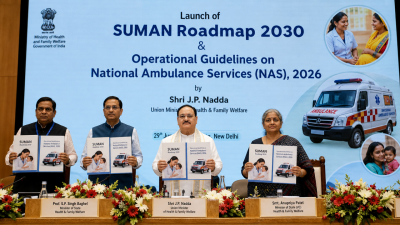
On 29 June 2026 the Union government launched the SUMAN Roadmap 2030 and the Operational Guidelines on National Ambulance Services (NAS), 2026 at the 16th Central Council of Health and Family Welfare.
Core targets and coverage
- MMR target: Reduce Maternal Mortality Ratio to below 70 per 100,000 live births by 2030 (aligns with SDG 3.1).
- Geographic focus: Targeted interventions in 130 districts across 13 high‑focus states including Uttar Pradesh, Bihar, Madhya Pradesh, Rajasthan, Odisha, Assam and West Bengal.
Clinical and community interventions
- Risk management framework: Four‑stage framework for identification, tracking and management of high‑risk pregnancies.
- Home-based surveillance: Bi‑weekly ASHA visits during late pregnancy for monitoring and early referral.
- Nutrition and supplementation: Pre‑pregnancy folic acid supplementation and nutrition support to address maternal anaemia.
- Facility preparedness: Establishment of Birth Waiting Homes and High Dependency Units in referral facilities.
- Access supports: Strengthened referral transport and provision of financial support for caregivers to facilitate facility access.
- Local governance: SUMAN Panchayats to ensure universal antenatal care, institutional deliveries and complete immunisation.
National Ambulance Services, 2026
- Uniform standards: Guidelines prescribe national standards for ambulance infrastructure, staffing, equipment and response protocols.
- Command and dispatch: Integrated Command and Dispatch Centres with GPS tracking and integration with emergency number 112.
- AIS‑125 compliance: Mandates adherence to AIS‑125 automotive standards for ambulance safety and quality.
IASPOINT Booster Facts
- Emergency number: 112 is India’s single‑number emergency response line under the Emergency Response Support System (ERSS).
- SDG linkage: SDG target 3.1 requires global MMR reduction to below 70 per 100,000 live births by 2030.