
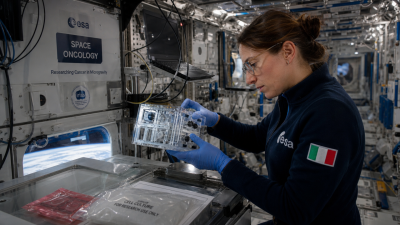
Space oncology uses microgravity and cosmic radiation to study cancer biology and drug manufacture. Recent developments include tumour organoids and more uniform nanoparticles produced in microgravity, FDA approval of an ISS-derived pembrolizumab formulation, and the first space-tested drug entering clinical trials—implications for India’s cancer burden are substantial.
What is the issue and why it matters
Space oncology examines how near-weightless conditions alter cell mechanics, signalling and drug chemistry to improve tumour models, drug crystallinity and delivery systems. It matters for public health, health economics, industrial policy, and international collaboration in science and regulation.
Scientific principles and mechanisms in microgravity
- Cell mechanics: Microgravity alters cytoskeleton organisation and cell–matrix interactions, reducing migration and invasiveness in several cancer cell types.
- Signalling pathways: Gravity-dependent modulation of signalling networks changes proliferation, apoptosis and metastatic traits, revealing therapeutic targets.
- Three-dimensional growth: Absence of sedimentation promotes formation of organoids and spheroids that better mimic in vivo tumours.
- Protein crystallography: Improved crystal quality in microgravity can refine biologics and biosimilar development (example: pembrolizumab formulation).
- Materials and nanoparticles: Particle assembly in microgravity yields greater uniformity, aiding targeted delivery and controlled release.
- Cosmic radiation: Dual role — experimental variable for radiation biology and a constraint requiring mitigation for long-duration manufacturing.
Recent advancements in cancer treatment
Tumour modelling and organoids
- Tumour organoids produced in microgravity more closely recapitulate patient tumour architecture and heterogeneity. They enable faster, more predictive in vitro efficacy and resistance testing.
- Breast cancer cells in microgravity show reduced motility and metastatic potential, useful for studying mechanisms of dormancy and spread.
Drug discovery and delivery
- A biotech firm reported nanoparticles 40% more uniform when manufactured in microgravity, improving potential for precise tumour targeting and dose control.
- Protein crystal growth on the ISS contributed to a subcutaneous formulation of pembrolizumab approved by the FDA, indicating translational pathways from space research to approved therapies.
Targeted therapies and immunotherapy
- Microgravity alters signalling pathways that may be exploited to develop therapies selective for cancer cells while sparing healthy tissue.
- Studies of T‑cell behaviour in microgravity inform immunotherapy design, including CAR‑T cell durability, trafficking and effector function.
Clinical translation
- Rebecsinib became the first space‑tested cancer drug to receive FDA Investigational New Drug status after ISS‑linked testing, showing a regulatory pathway for space-derived candidates.
Socio‑economic implications for India
- Burden: Projected 1.87 million new cancer cases in 2026 and annual direct and indirect costs of about ₹3,400 crores place large demands on health systems and household finances.
- Cost and access: More predictive testing and improved formulations could reduce ineffective treatments, decrease hospital stays and lower overall expenditure per patient.
- Market opportunity: The microgravity pharmaceutical manufacturing market is estimated at USD 1.5 billion in 2025 and projected to reach USD 9.8 billion by 2034, indicating commercial potential for Indian industry.
- Industrial policy: Investment in space‑biotech could generate high‑value exports, skilled jobs and public–private R&D clusters.
Institutional and policy framework
- Space agencies and partners: ISRO, NASA and the UK Space Agency support research access and platform services. Public–private partnerships accelerate commercial experiments.
- Regulators: FDA approvals and IND clearances demonstrate existing regulatory routes. National regulators (CDSCO in India, MHRA in UK) must develop harmonised guidance for space‑manufactured therapeutics.
- Policy levers: Grant funding, experiment cadet programmes, dedicated payload capacity, technology incubators, and regulatory sandboxes can lower entry barriers for Indian firms and researchers.
| Stakeholder | Roles | Priority action |
|---|---|---|
| ISRO | Provide microgravity platforms, launch access, mission facilitation | Allocate payload slots for biomedical experiments; support translational partnerships |
| CDSCO / MHRA / FDA | Regulatory assessment and approvals | Develop guidelines for evidence standards and manufacturing audits for space-based products |
| Industry & academia | R&D, scale-up, clinical translation | Form consortia for payload development, data sharing and clinical pipelines |
Advantages of space-based research
- Faster, more representative tumour models for drug screening.
- Improved biologic drug crystallinity enabling new formulations and routes of administration.
- More uniform nanoparticles for targeted delivery and lower off‑target toxicity.
- Unique perturbations of cell signalling and immune function revealing novel therapeutic targets.
Challenges and way forward
| Challenge | Implication | Policy response / technical remedy |
|---|---|---|
| High access and operating costs | Limits scale and increases therapy price | Subsidised payloads, shared platforms, demand aggregation through public procurement |
| Regulatory uncertainty | Slows clinical translation | Harmonised international guidance, adaptive approval pathways, regulatory sandboxes |
| Ethical and equity concerns | Risk of unequal access and patent concentration | Price control mechanisms, compulsory licensing frameworks, public R&D investments |
| Radiation and process variability | Safety and reproducibility risks | Standardised manufacturing protocols, qualification studies, ground‑simulated controls |
| Capacity gap in domestic industry | Dependence on foreign partners | Skill development, funding for startups, international partnerships with IP safeguards |
Model Questions
1. Examine the scientific principles underpinning space oncology and critically analyse its recent advancements in cancer treatment, especially concerning drug discovery and targeted therapies. [GS-III: Science & Technology]
Space oncology exploits microgravity effects on cytoskeleton, cell–matrix interactions and signalling, and improved protein crystallinity to refine biologics. Recent advances include tumour organoids that better mimic patient tumours, 40% more uniform nanoparticles for targeted delivery, altered signalling pathways revealing selective targets, T‑cell studies for immunotherapy optimisation, and translation examples such as an ISS‑derived pembrolizumab formulation and a space‑tested drug entering clinical trials.
2. Assess the socio-economic implications of advancements in space oncology for India, given its projected cancer burden and the microgravity pharmaceutical market. What role can ISRO play? [GS-III: Economic Development]
With 1.87 million new cases projected and annual cancer costs near ₹3,400 crores, India stands to gain from predictive testing, improved formulations and targeted delivery reducing treatment failures and costs. The microgravity pharma market’s growth to USD 9.8 billion suggests export potential. ISRO can provide payload access, foster public–private consortia, fund translational studies, and host regulatory sandboxes to build domestic capacity and lower entry costs for industry.
3. Discuss the regulatory, ethical, and international cooperation challenges in translating space oncology research into accessible and affordable cancer treatments. [GS-II: Governance]
Key regulatory challenges include evidence standards for space‑manufactured products and cross‑jurisdiction approvals. Ethically, high costs and IP concentration risk inequitable access. International cooperation is needed for harmonised guidelines, shared data standards and joint funding. Policy remedies include adaptive approval pathways, price‑containment measures, technology transfer terms in partnerships, and multilateral agreements on safety, manufacturing audits and clinical validation protocols.
4. Space oncology holds the promise to revolutionise cancer treatment. Elaborate on the unique advantages offered by microgravity environments and the practical challenges that must be addressed for widespread adoption. [GS-III: Science & Technology]
Advantages: accelerated, more predictive tumour models; higher quality protein crystals enabling alternative formulations; uniform nanoparticles for precise delivery; new targets from altered signalling and immune responses. Challenges: high launch and operation costs, regulatory clarity, radiation effects on processes, scale‑up from flight to commercial production, and equity of access. Addressing these requires public funding, regulatory harmonisation, ground controls and industry capacity building.
Last Modified: July 3, 2026