
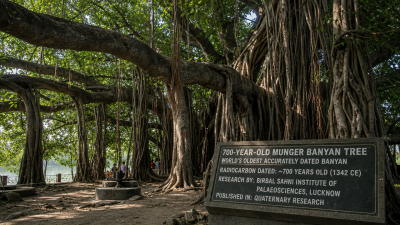
A Ficus benghalensis in Munger, Bihar, was radiocarbon-dated on 3 July 2026 to about 700 years, making it the oldest accurately dated banyan tree globally.
Key findings
- Age and chronology: Calibrated dates place origin around 1342 CE; primary branch yielded 652 years, secondary trunk 276 years; older branch gives minimum-tree age ~700 years.
- Comparative record: Exceeds the previously radiocarbon-dated Indian banyan minimum age of 462 years.
- Physical extent: Canopy area ≈ 2,500 m².
- Historical assumption revised: Disproves earlier assignment to late Mughal–early British period (~300–350 years).
- Publication: Results published in Quaternary Research.
Methodology
- Technique: Accelerator Mass Spectrometry (AMS) radiocarbon dating of wood samples.
- Calibration: Calibrated with IntCal20 and processed using OxCal software.
- Sampling strategy: Dated exposed secondary trunk and a primary branch to establish minimum age.
- Protocol significance: Provides an approach for dating tropical broadleaf trees that lack distinct annual growth rings.
- Institutional lead: Study led from Birbal Sahni Institute of Palaeosciences (autonomous, DST).
IASPOINT Booster Facts
- Species: Ficus benghalensis (family Moraceae), a strangler/hemiepiphytic fig with aerial prop roots.
- AMS principle: Directly counts 14C atoms to estimate sample age from 14C/12C ratio.
- IntCal20: International calibration curve for converting radiocarbon years to calendar years.
- OxCal: Bayesian calibration software commonly used in archaeological and palaeoenvironmental dating.