
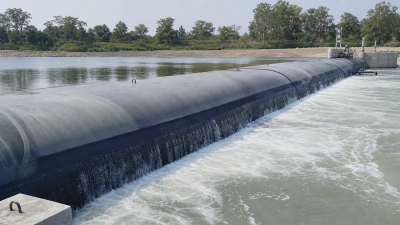
Gujarat is constructing its first two air-filled rubber dams on the Heran River (Chhota Udepur) and the Ambika River (Tapi) at a combined cost exceeding ₹162 crore to provide assured irrigation, groundwater recharge and flood management.
Project Overview
- Sites and names: Rajvasana Rubber Dam on Heran (Rajvasana, Chhota Udepur) and Pathakwadi Rubber Dam on Ambika (Pathakwadi, Tapi).
- Cost: Rajvasana >₹82.97 crore; Pathakwadi >₹79.13 crore; combined >₹162 crore.
- Progress (as of 6 July 2026): Rajvasana ~75% complete; Pathakwadi ~90% complete.
- Irrigation benefit: Rajvasana — 3,420 hectares across 25 villages; Pathakwadi — ~650 hectares.
- Storage: Rajvasana raises storage to 3.5 million cubic metres (3.5 MCM).
- Commissioning timeline: Rajvasana expected by September 2027 (reported schedule).
Technical Features
- Technology: Air-filled inflatable rubber bladders mounted on concrete bases; South Korean rubber-bladder technology with reported Japanese design inputs.
- Material specs: Bladder thickness 18–32 mm; rated to withstand temperatures above 50°C; design life ~30 years.
- Operation: Inflatable/deflatable to pass high monsoon flows and silt; Pathakwadi includes SCADA-based automation for inflation/deflation control.
- Site suitability: Designed for flat terrain and low riverbanks where conventional high-head dams are impractical.
Operational & Maintenance
- Flood control: Deflation during floods allows passage of floodwater and silt, reducing overtopping risk.
- Ancillary works: Flood-protection walls included; 10-year maintenance contracts planned.
- Hydro‑resource impact: Expected to aid groundwater recharge and provide water for Kharif and summer crops; potential tidal-regulation benefit in downstream reaches.
IASPOINT Booster Facts
- Firsts: Gujarat’s inaugural rubber-dam projects for state-level surface-water management.
- SCADA: Supervisory Control and Data Acquisition enables remote, automated bladder control and monitoring.
- Silt management: Inflatable dams reduce silt accumulation relative to fixed weirs by allowing periodic full-flow passage.