
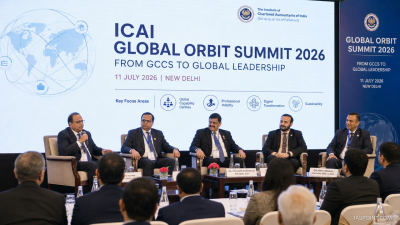
The Institute of Chartered Accountants of India inaugurated the ICAI Global Orbit Summit 2026 in New Delhi on 11 July 2026. The summit links professional mobility and skilling to India’s Global Capability Centres (GCCs); India hosts over 2,100 GCCs employing about 2.36 million professionals and generating close to USD 100 billion annually.
What is current and why it matters
GCCs are captive offshore units of multinational firms handling finance, IT, R&D, analytics, HR and customer support. The ICAI summit promotes cross-border professional standards and digital skills for chartered accountants to support GCC operations. Policy interest spans economy (service exports, FDI), governance (data rules, taxation), technology (AI, cloud), and urban planning (city capacities and regional spread).
Scale and economic footprint
Facts: India hosts more than 2,100 GCCs, employs ~2.36 million professionals and generates close to USD 100 billion annually. Earlier projections estimate the GCC sector could contribute up to USD 200 billion to India’s GDP by 2030. Implications: GCC revenues strengthen services exports, attract inward investment, and expand high-skilled employment. GCCs also create vendor ecosystems in IT, consulting, real estate and corporate services.
Institutional and regulatory environment
ICAI: A statutory body established under the Chartered Accountants Act, 1949. It promotes digital, analytical and cross-border competencies among Indian chartered accountants relevant to GCC roles. Regulatory context: GCCs operate amid domestic and international rules — data protection and cross-border data transfer norms (including DPDP provisions), BEPS and transfer-pricing frameworks, and trade-in-services rules such as GATS Mode 4. Mutual Recognition Agreements ease professional mobility.
Structural shift: from cost-arbitrage to high-value functions
GCCs are moving from transactional back-office work to strategic tasks: advanced analytics, product R&D, cybersecurity, treasury and global finance operations. Higher-value functions increase per-capita revenue and require deeper skill sets. Economic effects include higher service export value, better current-account resilience, stronger linkages to global supply chains, and upward pressure on wages in specialised roles.
Skills, talent pipeline and retention
Skill demand: AI, machine learning, cloud platforms, advanced data analytics, IFRS, international taxation, and cyber security. Domain knowledge must combine with technical proficiency and global compliance awareness. Gaps: Large graduate numbers do not equate to immediate employability for high-end GCC roles. Attrition and wage inflation are persistent issues. Policy and institutional responses: national certifications in emerging technologies by NSDC and professional bodies; structured apprenticeships and internships; regional skill centres through public‑private partnerships; continuous professional development by ICAI and similar bodies.
Spatial distribution and regional development
GCCs remain concentrated in Tier‑1 metros but are expanding into Tier‑2 cities and special zones such as GIFT City. Ahmedabad, Pune, Bengaluru, Hyderabad and Chennai are part of the ICAI summit circuit, reflecting geographic diversification. Benefits of dispersion: reduced pressure on megacity infrastructure, local employment generation, growth of allied services and real‑estate demand. Preconditions: reliable power, public transport, international connectivity and commercial real-estate supply.
Risks and challenges
- Geopolitical and trade risks: protectionist trends and regulatory barriers in client jurisdictions.
- Cost competitiveness: rising wages in tech hubs may erode cost advantage.
- Infrastructure gaps: secondary cities need better transport, power and broadband.
- Data security and compliance: sensitive processes demand strong cyber security and adherence to global privacy norms.
Challenges and policy responses
| Challenge | Policy response |
|---|---|
| Skill shortage for high-end roles | National certifications, curriculum reform, industry internships, regional skill centres |
| Infrastructure constraints in Tier‑2 cities | Targeted investment in transport, power, broadband; single-window clearances; state incentives |
| Regulatory friction (data, tax) | Clear data-localisation rules, BEPS-compliant tax guidance, MRAs to ease mobility |
| Cost pressure and attrition | Incentives for setting up in non-metros; support for employee upskilling and retention schemes |
Policy measures and operational steps
- Standardised skilling: joint certification programmes by ICAI, NSDC and industry for AI, analytics and international finance.
- Infrastructure push: public investment and PPPs to develop office parks, digital highways and air connectivity for emerging GCC hubs.
- Regulatory clarity: harmonise DPDP rules with cross‑border transfer needs; provide clear transfer‑pricing guidelines for GCC activities.
- Incentives: state-level fiscal and non‑fiscal incentives; simplified approvals and single-window facilitation.
Model Questions
1. Examine the structural shift in India’s Global Capability Centres from cost-arbitrage back-offices to centres of global leadership. What are the economic implications for India’s service‑sector exports? [GS-III: Economic Development]
India’s GCCs now execute analytics, R&D, cybersecurity and global finance, raising per-employee revenue and export value. Higher-value services improve current-account resilience, attract FDI, and strengthen vendor ecosystems. Risks include wage inflation and skill shortages. Policy responses: national skilling, R&D incentives, and infrastructure support to sustain competitiveness and convert revenue gains into broader GDP contribution by 2030.
2. Analyse the role of statutory professional bodies, such as the ICAI, in aligning domestic human capital with international service standards and facilitating professional mobility. [GS-II: Governance]
Statutory bodies set education and practice standards, certify competencies, and negotiate MRAs that ease cross-border recognition. ICAI’s programmes on digital skills, IFRS and international taxation raise employability for GCC roles. Collaboration with government and industry enables curriculum alignment, internships and continuous professional development, thereby supporting trade in services under Mode 4 and improving professional mobility.
3. While GCC expansion generates high-value employment, skill gaps persist. Recommend policy measures to address the mismatch between industry needs and available talent. [GS-III: Economic Development]
Combine curriculum reform with industry-led apprenticeships and mandatory internships. Launch national certifications in AI, analytics, cloud and international finance via NSDC and professional bodies. Establish regional skill hubs in partnership with GCCs for on-the-job training. Provide fiscal incentives for firms investing in employee reskilling and tie public funding to measurable placement and retention outcomes.
4. Assess how spreading GCCs to Tier‑2 cities and special zones like GIFT City can support balanced regional urban development. What enabling measures are required? [GS-II: Governance]
Decentralising GCCs reduces metro congestion and creates local jobs, expanding secondary service economies. Enablers: reliable power, mass transit, broadband, international air links, commercial real-estate and single-window clearances. Fiscal incentives and land policies attract firms. Municipal capacity building and coordinated state-centre support are necessary to ensure sustainable urban services and long-term private investment.
Last Modified: July 13, 2026