
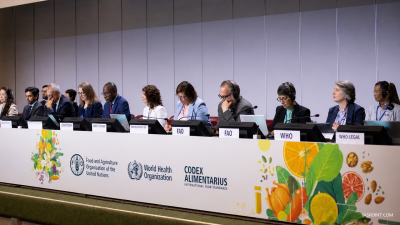
At the 49th Codex Alimentarius Commission (CAC49) in Geneva (6–10 July 2026), India led the adoption of seven Codex standards and guidelines.
Adopted standards at CAC49
- Number adopted: Seven Codex texts were adopted during CAC49.
- Direct chairmanship (India): Standards for dried coriander seeds and fresh curry leaves.
- Co‑chairmanship (India): Texts on vanilla, large cardamom, safe water use in food processing, control measures for Campylobacter and Salmonella in chicken meat, and prepackaged food labelling.
India’s procedural gains
- Cashew kernels: Proposal to begin work on a dedicated Codex Standard for cashew kernels was approved.
- EWG role: India elected Co‑Chair of the Electronic Working Group on New Food Sources and Production Systems (NFPS).
- FSSAI leadership: The Indian delegation was led by the Food Safety and Standards Authority of India (FSSAI).
IASPOINT Booster Facts
- Codex origin: Established in 1963 by FAO and WHO as the international food standards body.
- Legal relevance: Codex standards are referenced in the WTO SPS Agreement and used in trade dispute settlement.
- Scope: Standards cover food safety, quality, labelling, additives, contaminants, residues and hygiene.
- Campylobacter & Salmonella: Bacteria commonly associated with poultry; interventions target on‑farm, processing and hygiene controls.
- Cashew kernel trade: A Codex standard provides uniform quality parameters, labelling norms and limits for contaminants and residues for international trade.