
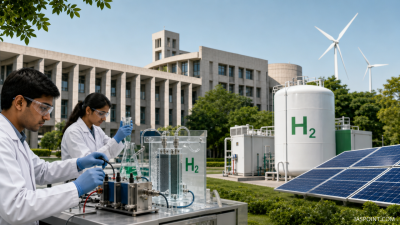
On 20 July 2026 IIT Kanpur announced establishment of the Centre of Excellence on Innovative and Integrated Ecosystem for Green Hydrogen (ECOGEN). The proposal is approved by the Uttar Pradesh government and sanctioned by Uttar Pradesh New and Renewable Energy Development Agency (UPNEDA) under the Uttar Pradesh Green Hydrogen Policy 2024.
ECOGEN: Mandate
- Primary scope: Research, testing, demonstrations and innovation across the green hydrogen value chain.
- Value-chain components: Hydrogen production, storage, transportation, safety standards, testing and industrial applications.
- Cost objective: Workstreams include lowering electrolyser and system-level production costs.
- Location linkage: Based at IIT Kanpur; linked to state renewable energy planning in Uttar Pradesh.
Green hydrogen: Technical essentials
- Definition: Hydrogen produced by water electrolysis using electricity from renewable sources.
- Electrolysers: Main types are alkaline, proton exchange membrane (PEM) and solid oxide electrolysers (SOEC).
- Storage & carriers: Compressed gas, liquefied hydrogen and chemical carriers (ammonia, liquid organic hydrogen carriers).
- Classification by production route: Grey (fossil without capture), blue (fossil with carbon capture) and green (renewable-based electrolysis).
Policy & institutional framework
- UPNEDA: Uttar Pradesh New and Renewable Energy Development Agency — state-level implementing agency.
- Policy anchor: Uttar Pradesh Green Hydrogen Policy 2024 provides approval and sanctioning framework.
- State linkages: Separate joint CoE involving IIT Kanpur and Harcourt Butler Technical University was approved in Dec 2025 under same policy framework.
IASPOINT Booster Facts
- Key date: ECOGEN announcement — 20 July 2026.
- Why electrolysis matters: Uses electricity to split H2O into H2 and O2; carbon emissions depend on electricity source.
- International relevance: Green hydrogen is central to decarbonisation strategies for hard-to-electrify sectors and long-haul transport.