
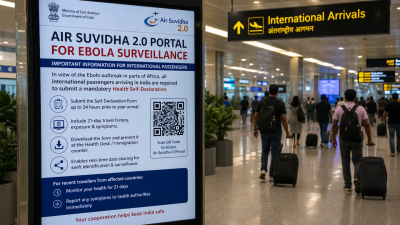
India launched the Air Suvidha 2.0 portal on 25 June 2026 as an upgraded contactless passenger health self-declaration system after WHO declared the Ebola/Bundibugyo outbreak a PHEIC on 17 May 2026.
Key Features
- Purpose: Contactless Health Self-Declaration for international arrivals for Ebola surveillance.
- Mandatory data: 21-day travel history, exposure history and current symptoms.
- Submission window: Self-Declaration Form (SDF) may be completed up to 24 hours before arrival; recommended during web check-in; downloaded SDF to be presented at International Travel Health Desk or Immigration.
Operational Protocols
- Real-time sharing: SDF data routed to Airport Health Officer, Bureau of Immigration, IDSP and State Surveillance Officers.
- Development partners: Portal developed with DGHS and Ministry of Health & Family Welfare; launched by Ministry of Civil Aviation with DIAL.
- Pre-clearance function: Enables risk identification prior to immigration clearance and targeted public-health action.
Epidemiological Context
- WHO PHEIC: Ebola/Bundibugyo virus disease declared a Public Health Emergency of International Concern on 17 May 2026.
- Reported counts (25 June 2026): DRC — 1,094 confirmed cases, 277 deaths; Uganda — 20 cases, 2 deaths.
- India status: No confirmed Ebola cases reported as of 2 June 2026; surveillance intensified by MoHFW.
IASPOINT Booster Facts
- IDSP: Integrated Disease Surveillance Programme is the national epidemic detection and reporting network under MoHFW.
- IHR (2005): Requires member states to develop core capacities at points of entry for detection and notification of public-health events of international concern.
- Airport Health Officer: Operational role for on-site public-health screening and coordination at international airports.