
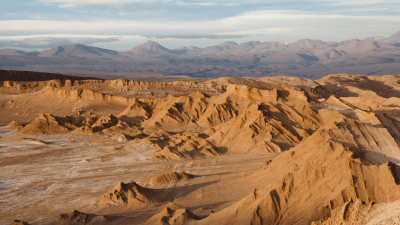
The Atacama Desert, situated in South America, is a vast and arid expanse of land spanning across a 1,600 km strip on the Pacific coast. It is the world’s driest nonpolar desert and is situated west of the Andes Mountains. Despite being one of the harshest environments on the planet, the Atacama Desert is an area of unique beauty and scientific interest.
Geography and Climate
The Atacama Desert is known for its extreme dryness, receiving less than 15mm of rainfall annually. The desert’s dryness is due to the combination of its location on the Pacific coast, the cold Humboldt Current, and the presence of the Andes Mountains. The moisture-laden air that flows over the ocean cools over the desert, condensing into a fog that rarely reaches the ground. The mountain range blocks the passage of clouds, and the desert’s high altitude causes the air to be thin and dry. The Atacama Desert’s landscape is dominated by salt flats, stony terrain, sand dunes, and felsic lava flows.
Scientific Importance
The Atacama Desert is an area of significant scientific importance due to its dryness, high altitude, and remote location. The lack of precipitation and minimal cloud cover make it an ideal location for astronomical observations, leading to the construction of the Atacama Large Millimeter/submillimeter Array (ALMA). This radio telescope is situated in the Chajnantor plateau at an altitude of 5,000 meters and consists of 66 high-precision antennas, spanning up to 16 km. ALMA observes distant galaxies and stars using millimeter and submillimeter wavelengths that can penetrate through dust clouds, providing unique insight into the early universe.
The Atacama Desert’s aridity and remoteness also make it an ideal location for Mars exploration missions. The desert is used as an experimentation site for testing instruments, equipment, and rovers intended for use on Mars. The desert’s high altitude and dry air are similar to Mars’s conditions, and the area’s extreme environment presents a suitable test for developing equipment that can survive on the red planet.
Tourism
The Atacama Desert’s unique landscape and geological formations attract many tourists interested in exploring the desert’s natural beauty. Visitors can explore salt flats, hot springs, and geysers. The Valle de la Luna, a lunar-like landscape located in the Atacama Desert, is a popular destination for stargazing, trekking, and observing unique rock formations. The desert’s remote location and lack of infrastructure make tourism challenging, but efforts are being made to create sustainable tourism practices that promote environmental conservation and cultural preservation.
Last Modified: February 20, 2024