
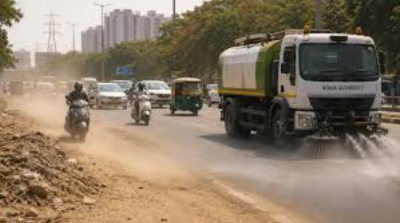
The CSIR-Central Road Research Institute (CSIR-CRRI) has signed a Memorandum of Agreement (MoA) with the Government of Haryana to implement the Commission for Air Quality Management (CAQM) framework for urban road modifications. This initiative aims to reduce airborne dust—a major contributor to PM10 and PM2.5 pollution—in the National Capital Region (NCR) through systemic design, paving, and greening of urban roads.
Key Project Components and Methodology
- Right-of-Way (RoW) Engineering: Developed with the School of Planning and Architecture (SPA), New Delhi, the project reconfigures road cross-sections to seal unpaved shoulders and open utility trenches.
- Bio-engineering Measures: Mandates multi-layered vegetative barriers and grass turfing on barren surfaces to lock topsoil and trap particulate emissions.
- Road Asset Management System (RAMS): A digital matrix for real-time evaluation of pavement health, enabling preventive maintenance before surface deterioration releases mineral dust.
- Sustainable Infrastructure: Utilizes permeable blocks, recycled industrial materials, and geotextiles (coir/jute) to stabilize embankments and facilitate groundwater recharge.
IASPOINT Booster Facts
- CAQM: A statutory body established under the 2021 Act for air quality coordination across Delhi-NCR and adjoining states (Punjab, Haryana, Rajasthan, UP). It replaced the SC-mandated EPCA.
- Dust Impact: Studies by IIT Kanpur and NEERI identify crustal road dust as responsible for 25%–40% of non-combustion PM10 emissions in Delhi-NCR.
- NCAP Alignment: Supports the National Clean Air Programme (NCAP) goal of a 20%–30% reduction in particulate matter in non-attainment cities.
- GRAP vs. Structural Fixes: While GRAP provides reactive, short-term emergency measures (e.g., water sprinkling), this project offers a permanent structural solution.
- CSIR-CRRI: Established in 1952, it is a premier R&D laboratory under the Council of Scientific and Industrial Research (CSIR).