
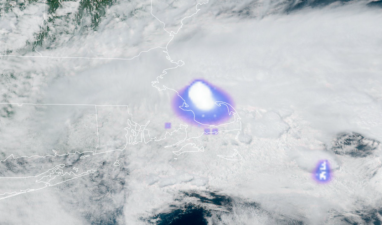
On the afternoon of May 30, 2026, residents across Southern New England experienced a powerful double sonic boom and ground tremors. While many initially feared seismic activity, the U.S. Geological Survey confirmed the event was an atmospheric bolide—an exceptionally bright meteor that disintegrates in a violent airburst.
Physics of the Airburst
- Atmospheric Entry: The object, a natural asteroid fragment measuring 3–5 feet (1–1.5 meters), entered the atmosphere at 75,000 mph.
- Thermal Energy: At these hypersonic speeds, the air in front of the object cannot move away, creating a high-pressure pocket that generates extreme heat through friction.
- The Airburst: At an altitude of 31–40 miles (50–64 km), the rock shattered. This release of energy (equivalent to 230–300 tons of TNT) created a shockwave that reached the ground as a sonic boom.
Detection and Evidence
- Geostationary Lightning Mapper (GLM): Captured an anomalous, massive flash over Cape Cod Bay. In the absence of thunderstorms, this confirmed the bolide.
- Weather Radar: Confirmed the presence of a debris cloud descending over the region.
- Acoustic Data: While no seismic tectonic activity occurred, the atmospheric shockwave caused widespread reports of rattling windows and buildings.
Comparative Analysis: 2026 New England vs. 2013 Chelyabinsk
| Metric | 2026 New England Bolide | 2013 Chelyabinsk Event |
| Diameter | 3–5 feet | ~66 feet |
| Explosive Yield | 230–300 tons of TNT | ~400–500 kilotons of TNT |
| Impact | Minor rattling; no injuries | Widespread damage; 1,500+ injuries |
IASPOINT Booster Facts
- Terminology: A meteoroid (in space) becomes a meteor (entering the atmosphere). If it explodes, it is a bolide. If any part reaches the ground, it is a meteorite.
- Sonic Booms: Occur when an object exceeds the speed of sound (v > c), creating a Mach cone of overlapping shockwaves.
- Detection Challenges: Objects under 5 meters, like the 2026 bolide, are notoriously difficult to track via systems like ATLAS or Pan-STARRS due to their small size and rapid transit.