
Daily Activities

UPSC Prelims Current Affairs

UPSC Mains Current Affairs

Current Affairs

Eurozone Inflation Trends 2026

Eurozone Inflation Trends 2026

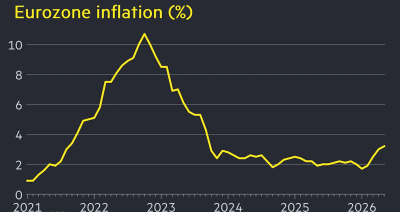
Annual headline inflation in the eurozone accelerated to 3.2% in May 2026, marking an upward movement from the 3.0% recorded in April. According to data released by Eurostat, the statistical office of the European Union, this price increase marks the third consecutive month that consumer price growth has exceeded the European Central Bank’s medium-term target of 2%. The upward trajectory is primarily driven by persistent supply chain strains from geopolitical tensions in the Middle East, which led to a sharp increase in energy costs alongside sticky services sector prices.

Sectoral Components and Price Drivers

Energy and Industrial Goods

The energy sector registered the highest annual price growth within the currency bloc, climbing to 10.9% in May 2026 compared to 10.8% in April. Geopolitical disruptions, including the effective closure of critical maritime trade routes like the Strait of Hormuz, directly pressured global oil and feedstock markets. Non-energy industrial goods experienced a minor upward adjustment, moving to 0.9% in May from 0.8% in the preceding month.

Services and Food Sectors

Services inflation showed a noticeable acceleration, surging to 3.5% in May 2026 from 3.0% in April. This acceleration points to resilient domestic demand and rising wage pressures across European service providers. In contrast, aggregate food, alcohol, and tobacco inflation provided a partial downward counterweight, cooling to 2.0% in May from the 2.4% observed in April.

Core Inflation Pressures

Core inflation, which strips out volatile components including energy, food, alcohol, and tobacco, rose to 2.5% in May 2026, up from 2.2% in April. This measure exceeded consensus market expectations of 2.4%. The expansion in core prices demonstrates that inflationary pressures have spread beyond raw import costs and are embedding into underlying domestic goods and services.

Divergence Across Eurozone Economies

Inflation Rates in Key Member States

Price stability varies across the individual members of the 21-nation currency bloc. Germany was the only major economy to report a deceleration in its annual rate.

  • Germany: Decreased to 2.7% in May 2026 from 2.9% in April.
  • France: Rose to 2.8% in May 2026 from 2.5% in April.
  • Italy: Accelerated to 3.3% in May 2026 from 2.8% in April.
  • Spain: Rose to 3.6% in May 2026 from 3.5% in April.
Extreme Inflationary Variances

Bulgaria, which joined as the 21st member of the Eurozone zone on January 1, 2026, registered the highest annual consumer price index expansion in the bloc at 6.3%. Conversely, the island nation of Malta recorded the lowest localized inflation rate at 2.1%.

Monetary Policy and European Central Bank Response

Policy Dilemma

The continuous rise in consumer prices complicates the monetary path for the European Central Bank Governing Council. Central bank officials must manage structural price stability without suppressing macroeconomic growth, as Eurozone gross domestic product grew by a modest 1.5% year-on-year at the end of 2025.

Anticipated Interest Rate Action

As a direct consequence of the headline and core inflation overshoot, financial market analysts project that the central bank will announce an upward adjustment in benchmark borrowing costs at its next policy meeting on June 11, 2026. This potential interest rate hike serves as an insurance measure to anchor long-term inflationary expectations.

Breakdown of Eurozone HICP Components (May 2026)

HICP ComponentWeight in Basket (2026)April 2026 RateMay 2026 RateTrend Direction
Services46.7%3.0%3.5%Upward
Non-Energy Industrial Goods25.3%0.8%0.9%Upward
Food, Alcohol & Tobacco19.0%2.4%2.0%Downward
Energy9.0%10.8%10.9%Upward
Headline HICP100.0%3.0%3.2%Upward
Core Inflation72.0% (Excl. volatile items)2.2%2.5%Upward

IASPOINT Booster Facts for UPSC

  • Eurostat: The statistical office of the European Union situated in Luxembourg. It is responsible for publishing high-quality Europe-wide statistics and indicators, including harmonized inflation metrics.
  • Harmonised Index of Consumer Prices (HICP): The specific consumer price index compiled by Eurostat to ensure statistically comparable inflation measurements across all EU member states. It forms the primary metric used by the European Central Bank for quantitative price stability assessments.
  • Eurozone Composition (2026): The Eurozone expanded to 21 member nations on January 1, 2026, with the official admission of Bulgaria. Croatia was the 20th member, entering the monetary union in 2023.
  • Core vs. Headline Inflation: Headline inflation reflects total inflation within an economy, covering volatile commodities like food and energy. Core inflation eliminates these short-term volatile items to track structural, long-term price trends.
  • Inflation Targeting: The European Central Bank maintains a symmetric medium-term inflation target of 2.0%. This target means that deviations both above and below the 2% mark are viewed as equally undesirable.
  • Net Importer Vulnerability: The European Union operates as a structural net energy importer, particularly for crude oil and natural gas. Consequently, global supply disruptions directly shock its domestic production and transportation costs.
Last Modified: June 4, 2026

Leave a Reply

Your email address will not be published. Required fields are marked *

Archives