
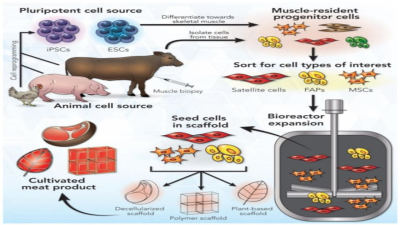
In recent years, the concept of cell-cultivated meat has emerged as a groundbreaking solution to address the environmental challenges posed by traditional animal agriculture. With the approval granted to two California-based companies to produce and market lab-grown chicken, the path to reducing carbon emissions associated with the global food industry has taken a significant leap forward.
Understanding Cell-Cultivated Meat
- Cell-cultivated meat, also known as lab-grown meat or cultured meat, refers to meat produced by culturing animal cells in a laboratory setting. In the case of chicken, these companies isolate the cells that make up the meat we consume. These cells are then combined with a nutrient-rich broth in a bioreactor, creating an environment conducive to cell growth.
- The bioreactor, or cultivator, acts as a container that provides the necessary conditions for the cells to multiply. With the right temperature, essential nutrients, and other factors, the cells develop into a mass of minced meat. This cultured meat is then processed and treated with additives to enhance its texture and appearance, making it suitable for various culinary applications.
Forms of Cell-Cultivated Meat
Chicken is the second most consumed meat globally, following pork, according to the U.N. Food and Agriculture Organization (FAO). Given its high demand, companies like Good Meat and Upside Foods have initially focused on producing cell-cultivated chicken. However, their ambitions extend beyond chicken, with ongoing research for cell-cultivated versions of beef, sea bass, tuna, and shrimp.
The Potential Benefits of Cell-Cultivated Meat
There are several compelling reasons to explore and promote the development of cell-cultivated meat:
- Environmental Impact: The livestock industry is a significant contributor to greenhouse gas emissions, accounting for 14.5% of all anthropogenic emissions, according to the FAO. By producing meat in a lab, cell-cultivated meat has the potential to reduce emissions associated with traditional animal agriculture significantly.
- Land Use Efficiency: Traditional animal agriculture requires vast amounts of land for rearing livestock and growing animal feed. Lab-grown meat has the potential to use significantly less land, conserving natural resources and reducing deforestation and habitat destruction.
- Animal Welfare: Cell-cultivated meat offers a promising solution to the ethical concerns associated with traditional animal farming. By eliminating the need for animal slaughter, it presents a more humane approach to meat production.
- Food Security: With a growing global population and increasing food demands, cell-cultivated meat has the potential to enhance food security. By providing a sustainable and scalable alternative to traditional meat production, it can help meet the protein needs of a growing population.
- Customization: One of the remarkable aspects of cell-cultivated meat is its potential for customization. It can be designed to be healthier than conventionally produced meat, with lower fat content and specific nutritional profiles, contributing to improved public health outcomes.
The Future of Cell-Cultivated Meat
- The development and commercialization of cell-cultivated meat represent a significant step towards a more sustainable and environmentally friendly food system. The global alternative meat market, including cell-cultivated meat, is projected to reach $20-25 billion in sales by 2030, according to McKinsey.
- As technology advances and production processes become more efficient, the cost of cell-cultivated meat is expected to decrease, making it more accessible to consumers. Continued research and innovation in this field will pave the way for a future where sustainable and ethical meat production becomes the norm.