
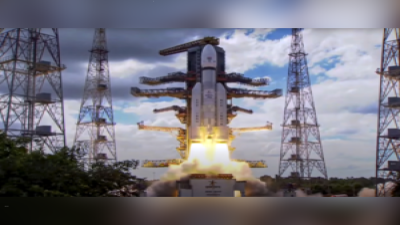
The Indian Space Research Organisation (ISRO) has announced that the much-anticipated lunar mission, Chandrayaan-3, is scheduled for launch on July 14 at 2:35 P.M. The spacecraft will be launched from the Satish Dhawan Space Centre in Sriharikota, marking an important milestone in India’s space exploration endeavors.
Chandrayaan-3: Building on Success
Chandrayaan-3 is a follow-on mission to Chandrayaan-2, which captured global attention with its ambitious attempt to land on the lunar surface in September 2019. Although the lander Vikram experienced a hard landing, the mission achieved significant milestones and valuable data. Chandrayaan-3 is designed to build upon the success of its predecessor and demonstrate end-to-end capabilities in safe landing and roving on the lunar surface.
Components and Objectives:
Chandrayaan-3 comprises a Lander and Rover configuration, which will be launched using the Launch Vehicle Mark-III (LVM3). The mission aims to develop and demonstrate new technologies required for interplanetary missions. It consists of a Lander Module (LM), a Propulsion Module (PM), and a Rover. The Lander and Rover will carry scientific payloads to conduct experiments on the lunar surface, advancing our understanding of Earth’s celestial neighbor.
Scientific Payloads:
The Rover of Chandrayaan-3 is equipped with two scientific instruments, or payloads, to facilitate scientific investigations on the lunar surface. The Alpha Particle X-ray Spectrometer (APXS) and the Laser Induced Breakdown Spectroscope (LIBS) will provide valuable data on the composition and geological characteristics of the lunar terrain. These payloads will enhance our understanding of the moon’s geological evolution and aid in mapping its resources.
Launch Vehicle and Location:
Chandrayaan-3 will be launched using the Geosynchronous Satellite Launch Vehicle-Mark 3 (GSLV-MK3), known for its capability to carry heavy payloads. The launch will take place from the Satish Dhawan Space Centre in Sriharikota, which has been the focal point of India’s space missions. The center’s state-of-the-art facilities and infrastructure enable the successful execution of complex space missions.
Technological Advancements:
The Chandrayaan-3 mission plays a vital role in driving technological advancements in the Indian space program. It aims to develop expertise in safe landing and roving on the lunar surface, which will be crucial for future interplanetary missions. The mission’s success will validate and enhance India’s capabilities in designing and executing complex space exploration projects.
International Collaboration and Impact:
ISRO’s lunar missions have garnered global attention and admiration. Chandrayaan-3’s launch is expected to foster further collaboration with international space agencies and strengthen India’s position in the global space exploration community. The mission’s scientific data and findings will contribute to global knowledge about the moon’s geology, resources, and potential for future human exploration.
Last Modified: February 22, 2024