
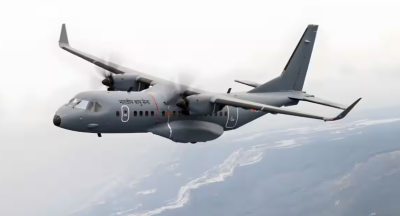
India is nearing the delivery of its first domestically assembled C-295 military transport aircraft from the Tata Advanced Systems Limited facility in Vadodara, Gujarat. This progress follows the formal rollout of the first Made-in-India unit in May 2026, positioning the aircraft for scheduled delivery by September 2026. Procured under a ₹21,935 crore contract signed in September 2021 for 56 aircraft, the C-295 program marks the first time a private-sector consortium is manufacturing a complete military aircraft within the country. The initiative will fully replace the aging British-origin Avro-748 fleet of the Indian Air Force.
Strategic Architecture of the C-295 Deal
The acquisition follows a structured procurement model designed to inject global aerospace manufacturing capabilities into the domestic private sector.
Production and Delivery Split
The contract divides the supply of the 56 tactical transport aircraft into two distinct phases:
- Fly-Away Inductions: Airbus Defence and Space delivers 16 aircraft in fly-away condition directly from its San Pablo manufacturing facility in Seville, Spain.
- Domestic Manufacturing: The remaining 40 aircraft are being completely manufactured, integrated, and tested at the Tata Aircraft Complex in Vadodara under an industrial partnership. All 40 domestic units are scheduled for completion by August 2031.
Indigenous Value Addition and MSME Integration
The domestic manufacturing phase focuses heavily on component indigenization and supply chain depth:
- Structural Localization: Over 85 percent of structural assembly work for the 40 Indian-built units occurs domestically.
- Component Fabrication: The project involves the local manufacturing of 13,000 detailed parts out of the 14,000 parts required per aircraft, sourced directly from raw materials.
- Industrial Footprint: The manufacturing network integrates 37 separate companies, of which 33 are domestic Micro, Small, and Medium Enterprises (MSMEs) spread across seven states.
- Indigenous Sub-systems: Every single one of the 56 aircraft will feature an Electronic Warfare Suite developed and manufactured by Bharat Electronics Limited (BEL) and Bharat Dynamics Limited (BDL).
Operational and Technical Capabilities of C-295
The C-295 is a new-generation, twin-engine tactical turboprop aircraft designed for medium-range transport operations. It provides a massive upgrade over the legacy Avro-748 fleet in load capacity, range, and operational flexibility.
| Operational Parameter | Specification Details |
| Powerplant | Twin Pratt & Whitney Canada PW127G turboprop engines |
| Maximum Payload | 9.5 tonnes |
| Troop Capacity | 71 soldiers or 44 paratroopers |
| Medical Evacuation | 24 stretchers with 3 attending medical personnel |
| Runway Requirement | Short Take-Off and Landing (STOL) capability from semi-prepared / soft surfaces |
| Tactical Mobility | Auto-reverse capability; can execute 180-degree turns on runways 12 meters wide |
Evolution of Domestic Military Aviation Manufacturing
The operationalization of the Vadodara Final Assembly Line alters the landscape of Indian military aviation, which historically depended entirely on state-owned enterprises.
Transition from Public Monopoly to Private Entry
For over six decades, military aircraft manufacturing remained the exclusive domain of public sector undertakings, primarily Hindustan Aeronautics Limited (HAL). HAL has managed indigenous programs like the Light Combat Aircraft (LCA Tejas), Advanced Light Helicopter (ALH Dhruv), Light Combat Helicopter (LCH Prachand), and license-manufactured platforms like the Su-30MKI. The C-295 project establishes the first private sector Final Assembly Line for a complete military platform in India, creating a parallel aerospace industrial ecosystem.
Skill Transfer and Life-Cycle Support
The program introduces a comprehensive transfer of manufacturing workflows. The total man-hours required by Airbus to build the platform will transition systematically to the Indian workforce, scaling from 78 percent for the first five domestic aircraft to 96 percent for the final 35 units. The Vadodara hub will also manage the complete lifecycle requirements, including testing, qualification, maintenance, repair, and overhaul (MRO) functions.
IASPOINT Booster Facts for UPSC
- First Air Force Unit: The Indian Air Force raised its first C-295 squadron, No. 11 Squadron (The Rhinos), based at Vadodara, Gujarat.
- Simulator Facility: A state-of-the-art C-295 Full Mission Simulator has been established at the Agra Air Force Station to train pilots under realistic operational environments.
- Aviation Ecosystem Expansion: Beyond transport aircraft, India and Airbus are collaborating to set up a Final Assembly Line for H125 civilian helicopters, expanding the private aerospace manufacturing footprint.
- Global Precedent: Apart from Seville (Spain), Indonesia is the only other country that has manufactured variations of this platform (CN-295) under license through Indonesian Aerospace.
- Strategic Diplomatic Ties: The industrial cooperation coincides with India and Spain celebrating 2026 as the ‘Dual Year’ of Culture, Tourism, and Artificial Intelligence, marking 70 years of formal diplomatic ties. Spain has also joined the India-backed Indo-Pacific Oceans Initiative (IPOI).