
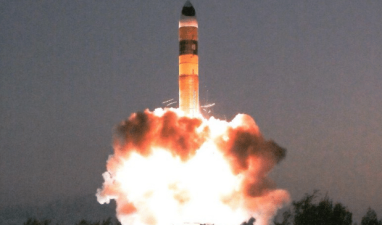
India successfully flight-tested an advanced Agni variant ballistic missile equipped with Multiple Independently Targetable Re-entry Vehicle (MIRV) technology from Dr. APJ Abdul Kalam Island off the coast of Odisha on 8 May 2026. Developed indigenously by the Defence Research and Development Organisation (DRDO) with domestic industrial collaboration, the weapon system successfully deployed multiple payloads across spatially distributed coordinates in the Indian Ocean Region. This trial represents the second successful validation of India’s land-based MIRV architecture following the maiden flight test of the Agni-5 configuration under Mission Divyastra in March 2024. The operationalization of this tech platform directly reinforces India’s credible minimum nuclear deterrence posture and its institutional second-strike capability.
Mechanics and Operational Profile of MIRV Technology
MIRV represents an advanced payload configuration where a single ballistic missile carries several separate nuclear or conventional warheads, allowing a single launch vehicle to strike multiple geographically dispersed targets simultaneously.
Technical Architecture and Flight Profile
- The Post-Boost Vehicle (PBV): Often referred to as the “missile bus”, the PBV detaches from the final rocket stage in the exo-atmosphere. It uses small on-board liquid-propellant thrusters to perform high-precision maneuvers in space.
- Sequential Deployment: The PBV changes its velocity vector and orientation sequentially to release individual Re-entry Vehicles (RVs) along distinct ballistic paths toward pre-programmed coordinates.
- Countermeasure Integration: Alongside active warheads, the missile bus can release complex radar-reflecting decoys, chaff, and heat-generating flares to saturate and deceive tracking systems.
Strategic Advantages over Monopayload Systems
- Penetration of Ballistic Missile Defences (BMD): By deploying multiple warheads and accompanying decoys simultaneously, MIRV systems overwhelm the tracking, processing, and intercept capacities of modern air defense networks like THAAD or S-500.
- Target Maximization: A single missile launch can neutralize multiple high-value infrastructure assets or military installations separated by hundreds of kilometers.
- Arsenal Optimization: It reduces the total number of physical missile transport-erector-launchers (TELs) required to maintain a high-density strike threat, streamlining logistics and lowering overall fleet maintenance overheads.
The Agni Missile Program and Evolution
The Agni series forms the core land-based component of India’s nuclear triad, managed operationally by the Strategic Forces Command (SFC).
Structural Overview of the Agni Fleet
- Agni-I to Agni-IV: These platforms utilize solid-fuel propulsion systems across single or two-stage configurations, with operational ranges extending from short-range (700 km) up to intermediate-range (4,000 km).
- Agni-5 Specifications: Operating as a three-stage, solid-fueled system, it possesses an officially declared strike range exceeding 5,000 kilometers, capable of target engagement across the Eurasian landmass.
- Canisterization Infrastructure: Advanced variants utilize factory-sealed, hermetically protected maraging steel canisters. This ensures environmental isolation for extended storage, allows rapid road-mobile transportation via heavy duty TEL trucks, and drastically shortens final launch preparation windows.
- Avionics and Guidance: Primary flight correction relies on an indigenous Ring Laser Gyroscope-based Inertial Navigation System (RLG-INS), supported by a Micro Inertial Navigation System (MINGS) that interfaces with NavIC satellite constellations.
Geopolitical Implications and Deterrence Architecture
The integration of MIRVs alters the strategic balance in the Indo-Pacific region by modifying established deterrence equations.
Strategic Alignment with Credible Minimum Deterrence
- No-First-Use (NFU) Compatibility: India’s nuclear doctrine commits to a strict NFU policy, making a highly survivable, retaliation-ready second-strike capability mandatory.
- Second-Strike Credibility: MIRVs ensure that even if a surprise first strike disables a portion of India’s fixed installations, the surviving mobile canisters can deliver an overwhelming, multi-targeted retaliatory response.
- Regional Balancing: This advancement establishes technology parity with existing regional nuclear powers, countering the rapid deployment of missile defense shields and sophisticated early-warning networks by adversarial nations.
Comparative Profile of Global MIRV Holders
The acquisition of operational MIRV capability is restricted to a small group of countries possessing advanced miniaturization capabilities for nuclear warheads and highly precise guidance mechanisms.
| Nation | Primary Delivery Platforms | Baseline Propulsion | Operational Genesis |
| United States | LGM-30 Minuteman III, Trident II D5 | Solid Fuel | 1970 (Minuteman III) |
| Russia | RS-24 Yars, RS-28 Sarmat, Bulava | Liquid & Solid Fuel variants | 1975 (Soviet Era SS-19) |
| United Kingdom | Trident II D5 (US-supplied missiles) | Solid Fuel | 1970s (Polaris modifications) |
| France | M51 (Submarine-launched) | Solid Fuel | 1985 (M4 SLBM) |
| China | DF-41, DF-5B/C, JL-3 | Solid & Liquid Fuel variants | 2015 (DF-5B operationalization) |
| India | Advanced Agni Variants (Agni-5) | Solid Fuel | 2024 (Maiden Test via Mission Divyastra) |
Test Infrastructure: Dr. APJ Abdul Kalam Island
Located off the coast of Odisha in the Bay of Bengal, this specialized site serves as the primary technical facility for India’s Integrated Test Range (ITR).
Technical and Logistics Assets
- Telemetry and Tracking Networks: The facility coordinates with a series of long-range electro-optical tracking systems, radar stations, and mobile telemetry instrumentation points positioned along the coast.
- Downrange Instrumentation: For long-range trials extending deep into the Indian Ocean, specialized ocean-range research vessels and naval warships equipped with satellite communication terminals deploy downrange to record final re-entry dynamics and impact precision.
- Strategic Isolation: The geographical separation from the mainland ensures a secure maritime corridor for testing experimental high-velocity missile systems, minimizing domestic civil aviation and commercial shipping disruptions.
IASPOINT Booster Facts for UPSC
- Mission Divyastra: The official code name designated for the maiden flight trial of the indigenously developed Agni-5 missile configured with MIRV technology on March 11, 2024.
- Manoeuvrable Re-entry Vehicle (MaRV): Unlike standard MIRVs which follow fixed ballistic trajectories upon release, MaRVs carry onboard aerodynamic control surfaces or thrusters allowing active flight path alterations during the atmospheric re-entry phase to bypass terminal air defenses.
- Nuclear Triad Components: India achieved operational triad status via land-based Agni systems, air-delivered gravity weapons via IAF strike aircraft, and the naval component led by the INS Arihant SSBN class deploying K-series submarine-launched ballistic missiles (SLBMs).
- Integrated Guided Missile Development Programme (IGMDP): Conceived by Dr. APJ Abdul Kalam and managed by DRDO, this program laid the baseline foundation for India’s domestic missile technology, yielding five distinct systems: Prithvi, Agni, Trishul, Akash, and Nag.