
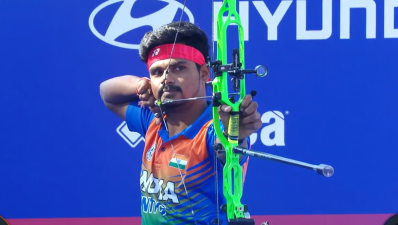
Indian archer Sahil Jadhav secured his first senior Archery World Cup medal on 9 May 2026 at Stage 2 of the tournament held in Shanghai, People’s Republic of China. Competing in the men’s individual compound event, the 25-year-old archer won the bronze medal by defeating veteran Danish archer Martin Damsbo with a final scoreline of 147-144. This victory recorded India’s sole podium finish in the compound archery division at the Shanghai leg. Jadhav staged a steady comeback in the multi-end contest after trailing by one point in the opening end to ensure the victory.
Tournament Progression and Key Matches
Road to the Podium
Sahil Jadhav entered the tournament as the eighth seed after scoring a personal best of 711 points in the initial ranking round. His journey through the elimination brackets involved defeating higher-ranked international players and national teammates:
- Third Round: Eliminated Indian archery veteran Abhishek Verma with a match score of 149-147.
- Round of 16: Defeated Ruven Flüß of Germany with a score of 149-146.
- Quarter-finals: Faced Austria’s Nico Wiener, the 2021 world champion. The match ended in a 147-147 tie, forcing a shoot-off where Jadhav won 10-9.
- Semi-finals: Lost narrowly by a single point (147-145) to the reigning world champion, Nicolas Girard of France, which placed him in the bronze medal playoff.
International Career Graph
Jadhav made his senior World Cup debut in April 2026 at Stage 1 in Puebla, Mexico. Prior to his senior breakout, he established his profile by becoming the reigning individual champion at the 2025 Summer World University Games (Universiade) held in the Rhine-Ruhr region of Germany, where he won the gold medal by defeating Great Britain’s Ajay Scott 149-148.
Technical and Institutional Framework of Archery
Distinction Between Recurve and Compound Archery
World Archery, the international governing body for the sport, recognizes two distinct equipment categories for global championships:
| Feature | Recurve Archery | Compound Archery |
| Bow Design | Traditional design where limbs curve away from the archer; utilizes muscle power to hold full draw weight. | Mechanics include a system of pulleys, cams, and cables to manage mechanical energy. |
| Holding Weight | Requires continuous physical exertion; the archer holds 100% of the draw weight at maximum extension. | Features a mechanical “let-off” that reduces the holding weight by 65% to 85% at full draw. |
| Sighting Mechanisms | Simple pin sights without magnification; rear peep sights are prohibited. | Magnifying scopes, leveling bubbles, and mechanical release aids are legally permitted. |
| Target Distance | Standard outdoor competition distance is 70 meters. | Standard outdoor competition distance is 50 meters on a smaller target face. |
Olympic and Multi-Sport Status
Recurve archery has been a regular discipline at the Summer Olympic Games. Compound archery is integrated into the World Archery Championships, the Archery World Cup circuit, the Asian Games, and the World University Games. The International Olympic Committee has approved the inclusion of the compound mixed team event to make its official Olympic debut at the Los Angeles 2028 Summer Olympic Games.
Performance Analysis of the Indian Contingent
Shanghai Stage 2 Outcomes
While India secured five compound medals at the Shanghai event in the previous season, the 2026 edition saw early exits for several top-ranked Indian athletes in the compound division:
- Men’s Individual: Kushal Dalal reached the quarter-finals before elimination by Martin Damsbo, while former world champion Ojas Deotale exited in the round of 16.
- Men’s Team: The defending gold-medalist Indian men’s compound team lost their quarter-final match.
- Women’s Individual: Top-ranked Jyothi Surekha Vennam lost in the round of 16 to Estonia’s Lisell Jaatma (148-147). Aditi Swami was eliminated in the quarter-finals by the same opponent.
- Women’s Team: The Indian squad was knocked out in the quarter-finals by Turkiye with a score of 233-227.
- Mixed Team: The duo of Aditi Swami and Ojas Deotale lost their quarter-final match against the American pair of Alexis Ruiz and James Lutz.
IASPOINT Booster Facts for UPSC
World Archery Federation (WA)
Founded in 1931 as the Fédération Internationale de Tir à l’Arc (FITA), the organization rebranded to World Archery in 2011. Headquartered in Lausanne, Switzerland, it is the governing body recognized by the International Olympic Committee for regulating international archery rules, ranking cycles, and the annual Archery World Cup stages.
Structure of the Archery World Cup
The Archery World Cup was initiated in 2006 to increase global coverage of the sport. It consists of four distinct stages hosted in different nations annually, culminating in the Archery World Cup Final. Only the top eight archers in each individual category across the four qualification stages earn selection to compete in the season-ending grand finale.
Physics of the Compound Bow Cams
The core technology of a compound bow relies on the “Cam” system, which functions as an asymmetrical pulley system. As the bowstring is pulled back, the cams rotate, altering the mechanical advantage. Once the string reaches the end of its draw cycle, the draw weight drops sharply, allowing the archer to aim with minimized muscle fatigue, maximizing structural stability and shot precision.
Last Modified: May 19, 2026