
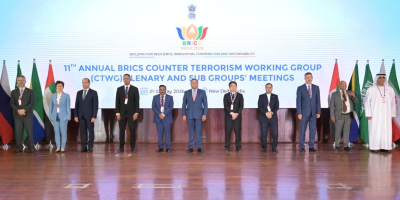
India hosted the 11th Annual BRICS Counter Terrorism Working Group (CTWG) Plenary and Sub Groups’ Meetings in New Delhi on May 21-22, 2026, under its BRICS Chairship. The high-level assembly marked the 10th anniversary of the establishment of the CTWG. Senior counter-terrorism officials from all ten member countries attended to deliberate on emerging global security threats. During the plenary, member nations strongly condemned the April 2025 terrorist attack in Pahalgam, Jammu and Kashmir. India reiterated its strict policy of zero tolerance against terrorism and called for objective, result-oriented collaborations within the bloc.
Core Agenda and Outcomes of the 11th Plenary
Focus Areas of the Group
The security officials evaluated the entire spectrum of global terrorism and mapped out actionable strategies to mitigate modern security vulnerabilities. The primary focus areas included:
- Countering Radicalisation: Devising localized and online countermeasures to block the spread of extremist ideologies.
- Terror Financing Networks: Strengthening real-time information exchange to disrupt funding channels and money laundering mechanisms.
- Misuse of Emerging Technologies: Developing joint frameworks to counter the exploitation of drones, encrypted messaging apps, and artificial intelligence by terror groups.
- Border Security: Enhancing institutional capabilities to track and restrict the cross-border movement of foreign terrorist fighters.
Structural Framework of the Meetings
The main plenary session was preceded by technical meetings of five dedicated thematic sub-groups. These sub-groups specialize in separate operational mandates, ensuring a detailed technical review before strategic agreements are passed at the plenary level. Dr. Vinod Bahade, Joint Secretary (Counter Terrorism) in India’s Ministry of External Affairs, chaired the institutional sessions.
Evolution and Institutional Framework of BRICS Counter-Terrorism
The BRICS Counter-Terrorism Action Plan
Adopted during India’s chairship in 2021, the Action Plan serves as the foundational blueprint for executing the BRICS Counter-Terrorism Strategy. It aims to streamline institutional cooperation among security agencies, financial intelligence units, and law enforcement frameworks across the member nations.
Chronology of Key BRICS Security Formations
| Milestone Year | Event / Adoption | Strategic Significance |
| 2016 | Establishment of the BRICS CTWG | Initiated under India’s chairship to build consensus on shared security challenges. |
| 2020 | Counter-Terrorism Strategy Adoption | Formalized the guiding principles, including respect for sovereignty and international law. |
| 2021 | Counter-Terrorism Action Plan | Provided an operational framework for targeted sub-groups. |
| 2024 | Expansion of the Bloc | Incorporated five new members, broadening the scope of regional intelligence sharing. |
India’s Position on Global Counter-Terrorism
Zero-Tolerance Framework
Ambassador Sibi George, Secretary (West) in the Ministry of External Affairs, delivered the keynote address emphasizing that geopolitical differences must not weaken the collective fight against terror networks. India called on the bloc to hold accountable those states that provide sanctuary and material support to terrorist groups, addressing the problem of cross-border terrorism directly.
Outcome-Oriented Mechanism
India pushed to make the CTWG a more innovative, inclusive, and outcome-oriented mechanism. The delegation emphasized that traditional methods must be upgraded to address the rapid digitalization of terror infrastructure.
Profile of the Expanded BRICS Bloc
Original Founding Members
The grouping began as a loose coalition of major emerging economies, formalizing its summit structure to foster political and economic coordination.
- Brazil: Represents the Latin American economic zone.
- Russia: A major transcontinental security and energy power.
- India: A primary South Asian geopolitical and economic anchor.
- China: The largest economy within the bloc, located in East Asia.
- South Africa: Joined the core group in 2010 to represent the African continent.
Expanded Members (Since 2024)
The membership doubled in size following the historic expansion phase, bringing diverse regional dynamics into the counter-terrorism fold:
- Egypt: Strategically bridges North Africa and the Middle East.
- Ethiopia: A major political and security anchor in the Horn of Africa.
- Iran: Adds distinct security and energy dimensions from Western Asia.
- Saudi Arabia: One of the largest economies and political influencers in the Arab world.
- United Arab Emirates (UAE): A major global financial and logistical hub.
IASPOINT Booster Facts for UPSC
- Comprehensive Convention on International Terrorism (CCIT): India proposed the CCIT at the United Nations General Assembly (UNGA) in 1996. It seeks to provide a universal definition of terrorism, ban all terror groups, and shut down their financial and logistical networks.
- The “Zero-Tolerance” Origin: In international diplomacy, this phrase mandates that no political, ideological, or religious justification can be used to excuse or tolerate acts of terrorism.
- Financial Action Task Force (FATF) Linkages: BRICS counter-terrorism declarations regularly emphasize compliance with FATF standards to combat money laundering and terror financing.
- No Permanent Secretariat: Unlike organizations like the Shanghai Cooperation Organisation (SCO), which features the Regional Anti-Terrorist Structure (RATS) in Tashkent, BRICS operates entirely on a rotating chairship model without a centralized permanent secretariat.
- The Global Security Initiative (GSI): During the 2026 meeting, member states like China aligned their inputs with the GSI principles, which advocate for indivisible security and peaceful resolution of state conflicts through dialogue.