
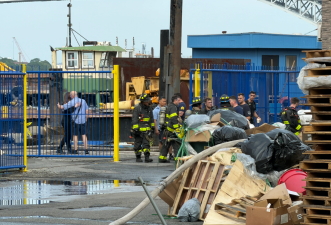
A fatal fire and a sequence of two industrial explosions struck a shipyard in the Mariners Harbor neighborhood on the north shore of Staten Island, New York City, on May 22, 2026. The incident resulted in one civilian fatality and left 36 people injured, primarily consisting of firefighters and emergency medical personnel. The disaster began with an afternoon report of smoke and trapped personnel inside a confined basement area, which rapidly escalated into a multi-alarm rescue operation. New York City Mayor Zohran Mamdani described the event as a complex, fast-developing emergency that drew approximately 200 first responders to the active waterfront scene.
Chronology of the Incident
Initial Emergency Call
At approximately 3:30 p.m., the Fire Department of New York (FDNY) received multiple emergency calls reporting heavy smoke and a structural fire at a dockside repair facility located at 3075 Richmond Terrace. The initial dispatch indicated that two shipyard workers were trapped inside a confined basement space of a large industrial building.
First Responders Arrival
FDNY companies arrived at the scene within six minutes of the dispatch. Rescue crews immediately encountered thick smoke and initiated technical search-and-rescue operations inside a 46-meter-by-46-meter (150-foot-by-150-foot) metal-framed structure located at the rear of the shipyard property.
Dual Blast Sequence
Roughly 50 minutes after the initial response, a powerful explosion rocked the structure while emergency personnel and civilians were inside, causing immediate injuries. As backup units stepped up firefighting and rescue efforts, a second explosion occurred. The secondary blast produced a massive energy shockwave that severely compromised the interior environment and inflicted blast-related trauma on the rescuers operating on top of, inside, and adjacent to the metal structure.
Operational Impact and Casualty Profile
Fatalities and Civilian Injuries
One civilian shipyard worker died at the scene from the direct impacts of the initial blast. Another civilian sustained injuries and received medical transportation to a regional hospital.
First Responder Casualties
A total of 34 fire and EMS personnel sustained injuries during the rescue operation. The breakdown of responder casualties includes:
- Critical Injuries: One FDNY fire marshal suffered a fractured skull and a brain bleed from the primary shockwave, requiring intubation and intensive care.
- Serious Injuries: One firefighter sustained serious blast-related trauma without penetrating organ damage.
- Minor to Moderate Injuries: Twenty-nine firefighters suffered minor to moderate injuries, including smoke inhalation and thermal burns.
- EMS Casualties: Four emergency medical personnel sustained minor injuries during the secondary blast sequence.
Emergency Mobilization
The FDNY elevated the incident to a multi-alarm status, deploying approximately 70 fire and EMS units. More than 200 first responders participated in suppressing the active fire and securing the perimeter. The fire was brought under controlled conditions by Friday evening, though personnel remained stationed overnight as a safety precaution.
Structural and Environmental Context
The Facility Profile
The industrial site is situated along Richmond Terrace on the waterfront of Staten Island’s north shore. The surrounding area features a mix of commercial operations, including a coffee roasting enterprise and a self-storage facility.
Historical Significance
The shipyard property previously operated under the ownership of the Bethlehem Steel Company. During World War II, the historic facility was utilized to construct and repair warships for the United States Navy.
Confined Space Hazards
The incident occurred within an enclosed basement area of a metallic industrial building. Chief of Department John Esposito noted that operations in confined spaces pose extreme structural and atmospheric dangers to rescue personnel due to restricted egress routes, rapid heat accumulation, and potential pocketing of volatile industrial gases.
Investigation and Regulatory Oversight
Official Inquiry
The FDNY Bureau of Fire Investigation, led by fire marshals, initiated a comprehensive investigation into the exact cause of the initial fire and subsequent twin explosions. Investigators are reviewing the exact nature of the industrial work performed at the dockside repair facility leading up to the 3:30 p.m. call.
Safety Inspections
Federal and local regulatory agencies are analyzing the chemical inventory and structural integrity of the facility. The investigation focuses on identifying whether flammable materials, welding gases, or inadequate ventilation systems triggered the sequence of blasts.
Comparative Industrial Accidents and Hazards
| Incident / Hazard | Type | Key Driving Factors | Impact Metrics |
| Staten Island Shipyard (2026) | Shipyard / Confined Space | Basement fire followed by secondary dust or gas explosion. | 1 Dead, 36 Injured |
| Texas City Disaster (1947) | Port / Maritime Explosion | Detonation of ammonium nitrate fertilizer cargo on a ship. | ~581 Dead, 5,000+ Injured |
| USS Forrestal Fire (1967) | Aircraft Carrier Fire | Accidental rocket discharge triggering fuel and bomb explosions. | 134 Dead, 161 Injured |
| Confined Space Gas Build-up | Generic Industrial Hazard | Accumulation of toxic or flammable gases like methane or carbon monoxide. | High risk of sudden asphyxiation or flash fires. |
IASPOINT Booster Facts for UPSC
- Geography of Staten Island: Staten Island is one of the five boroughs of New York City. It is separated from New Jersey by the Arthur Kill and the Kill Van Kull tidal straits, and from Brooklyn by New York Bay.
- The Physics of a Blast Wave: Explosions generate a supersonic shockwave characterized by an instantaneous rise in pressure (positive phase) followed by a drop below atmospheric pressure (negative phase). Blast injuries are classified into primary (barotrauma from pressure changes affecting air-filled organs), secondary (flying debris), tertiary (physical displacement of the body), and quaternary (burns or toxic inhalation).
- Confined Space Regulations: In industrial safety frameworks globally, a confined space is defined as an area large enough for an employee to enter and perform work, has limited or restricted means for entry or exit, and is not designed for continuous employee occupancy.
- Bethlehem Steel Shipbuilding Division: This historic entity was one of the major American shipbuilders during World War II. It operated multiple yards across the United States, producing over 1,100 vessels including destroyers, cruiser warships, and Liberty ships as part of the Emergency Shipbuilding Program.
- Double-Alarm and Multi-Alarm Systems: The term “alarm” refers to the pre-designated package of equipment and personnel dispatched to an emergency. A second or higher-tier alarm multiplies the arriving assets automatically as the structural severity increases.