
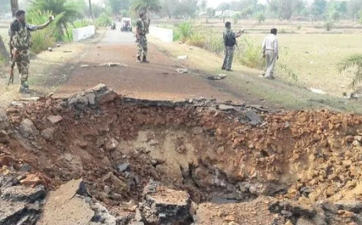
Three personnel of the District Reserve Guard were killed in an Improvised Explosive Device blast in Kanker district, Chhattisgarh, near the Kanker-Narayanpur boundary on 2 May 2026. The personnel were conducting a de-mining operation to neutralise explosives planted by Maoist insurgents when the blast occurred. This incident marks the first Naxalite-related explosion after the state was declared Maoist-free on 31 March 2026. The event highlights the persistent threat of hidden explosives and the security challenges that remain in the forested regions of the Bastar division during anti-insurgency operations.
Understanding Improvised Explosive Devices in Left Wing Extremism
Definition and Mechanism of IEDs
An Improvised Explosive Device is a non-standard bomb constructed from readily available military or commercial components. In Left Wing Extremism affected zones, Maoist insurgents deploy these devices to target security forces, disrupt infrastructure, and restrict the movement of police patrols. An IED typically consists of five core components:
- Switch (Actuator): Triggers the blast via pressure plates, tripwires, or remote command wires.
- Initiator (Detonator): A small explosive charge that sets off the main explosive material.
- Main Charge: The bulk explosive material, often made from commercial gelignite, ammonium nitrate, or stolen mining explosives.
- Power Source: Batteries used to provide the electrical impulse to the detonator.
- Container: Pipes, tiffin boxes, or pressure cookers that hold the components together and maximize fragmentation.
Tactical Usage by Maoist Insurgents
Maoists utilize the dense canopy and undulating terrain of central India to camouflage these devices. They deploy various types of IEDs depending on the target and location:
| Type of IED | Mechanism of Action | Primary Target/Location |
| Pressure Plate IEDs | Triggered when a vehicle or foot patrol steps on a concealed plate. | Forest tracks, footpaths, and near water sources. |
| Command Wire IEDs | Detonated manually by an insurgent hiding at a distance using electrical wires. | Metalled roads, culverts, and bridges. |
| Directional Mines (Claymore type) | Packed with shrapnel and directed toward a specific kill zone. | Ambient ambush sites in high-altitude passes. |
| Tiffin Box / Cooker Bombs | Explosives packed inside household containers to maximize fragmentation. | Buried under soil or hidden inside abandoned buildings. |
District Reserve Guard and Anti-Naxal Operations
Origin and Composition of DRG
The District Reserve Guard is a specialized unit of the Chhattisgarh State Police. It was raised specifically to counter the Maoist guerrilla tactics in the Bastar region.
- Local Recruitment: The force recruits heavily from the local tribal youth of the region. These personnel possess innate knowledge of the local dialects, culture, and geographic terrain.
- Surrendered Naxalites: The unit includes surrendered Maoist cadres who understand the operational tactics, communication codes, and psychological profiling of the insurgent groups.
- Operational Edge: Due to their local roots, DRG units gather real-time human intelligence more effectively than central paramilitary forces.
Challenges in De-mining and Counter-IED Operations
De-mining operations involve detecting and clearing explosive hazards from routes designated for security movements. The challenges include:
- Low-Metal Content: Insurgents frequently use carbon batteries, wooden switches, and plastic containers, making detection via standard mine detectors difficult.
- Deep Burial: IEDs are sometimes buried three to five feet beneath the road surface, rendering standard ground-penetrating radar ineffective.
- Anti-Handling Devices: Maoists lace IEDs with secondary triggers that detonate the bomb when a disposal squad attempts to defuse it.
Government Framework to Combat Left Wing Extremism
National Policy and Action Plan
The Government of India implements a multi-pronged strategy to address Left Wing Extremism, combining security measures with development interventions.
- SAMADHAN Doctrine: This framework guides anti-Naxal operations. The acronym stands for:
- S – Smart Leadership
- A – Aggressive Strategy
- M – Motivation and Training
- A – Actionable Intelligence
- D – Dashboard-based KPIs (Key Performance Indicators)
- H – Harnessing Technology
- A – Action Plan for Each Theatre
- N – No Access to Financing
- Greyhounds Paradigm: States like Andhra Pradesh and Telangana successfully minimized Maoist influence using Greyhounds, an elite commando unit specializing in jungle warfare. Other states adopted similar models, such as the CoBRA (Commando Battalion for Resolute Action) of the CRPF, and the DRG in Chhattisgarh.
Developmental Interventions
- Special Central Assistance (SCA): Funding provided to the most LWE-affected districts to create public infrastructure like roads, bridges, and health centers.
- Road Requirement Plan (RRP): A targeted program to construct critical road stretches in remote forest areas to improve connectivity and security mobility.
- Eklavya Model Residential Schools: Setting up quality education centers in tribal blocks to prevent youth radicalization.
IASPOINT Booster Facts for UPSC
- The Red Corridor: The term used to describe the region in the eastern, central, and southern parts of India that experiences regular LWE insurgency. It historically spanned across Andhra Pradesh, Bihar, Chhattisgarh, Jharkhand, Madhya Pradesh, Maharashtra, Odisha, Telangana, and West Bengal.
- Origin of Naxalism: The movement started as a peasant revolt in 1967 in the Naxalbari village of West Bengal under the leadership of Charu Majumdar and Kanu Sanyal.
- Left Wing Extremism Division: A dedicated division created within the Ministry of Home Affairs in 2006 to effectively monitor the LWE situation and implement counter-measures.
- Unlawful Activities (Prevention) Act, 1967: The Communist Party of India (Maoist) and all its front organizations are banned under this Act, listed as terrorist organizations.
- Operation Green Hunt: A term coined by the media to describe the parallel, coordinated deployment of central paramilitary forces and state police forces against Maoists starting in 2009.
- Project Sunrise: A joint military-paramilitary operation executed along the Indo-Myanmar border to target insurgent groups, preventing cross-border coordination among rebel factions.