
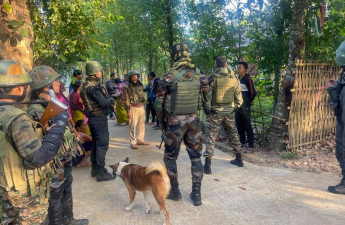
In April and May 2026, Indian security forces conducted a series of coordinated counter-insurgency operations in the hill districts of Ukhrul and Tengnoupal in Manipur. The operations targeted illegal infrastructure and weapons caches established by insurgent groups along the sensitive Indo-Myanmar border corridor. Security personnel successfully dismantled 50 illegal bunkers across several villages in Ukhrul, including Mongkot Chepu and Sikibung. In Tengnoupal district, forces recovered and neutralized 18 Improvised Explosive Devices (IEDs) in T Bongmol village, alongside a substantial cache of military-grade firearms, ammunition, and tactical communication devices near key border pillars.
Operational Overview and Tactical Recoveries
Structural Neutralization in Ukhrul
The operations in Ukhrul district focused on clearing fortified positions built by unlawful armed groups on strategic ridges. Security forces dismantled 50 fortified bunkers. These structures were located around the villages of Mongkot Chepu and Sikibung. Insurgent factions used these bunkers as observation posts and firing positions to control transit routes and launch attacks on rival groups and security convoys.
Arms and Explosives Interdiction in Tengnoupal
Operations in Tengnoupal district focused on interdicting cross-border arms smuggling and explosive materials. In T Bongmol village, a search operation led to the discovery of 18 fully assembled IEDs buried in cache points. The technical recoveries from the border sectors included:
- Assault Weapons: AK-47 rifles and automatic carbines.
- Sidearms: Semi-automatic pistols and country-made handguns.
- Ammunition: Hundreds of rounds of diverse calibers matching the seized weaponry.
- Logistical Equipment: Handheld VHF communication sets, military-grade web equipment, and camouflage gear found near international border pillars.
Strategic Geography of the Border Districts
Ukhrul District
Situated in the eastern part of Manipur, Ukhrul is a mountainous district bounded by Nagaland to the north and Myanmar to the east. It is primarily inhabited by the Tangkhul Naga tribe. The terrain features dense forests and deep valleys, which insurgent outfits historically utilize to establish covert training camps and transit lines.
Tengnoupal District
Tengnoupal was carved out of Chandel district in 2016. It occupies a critical position along the international boundary between India and Myanmar. The district topography consists of the hills that border the Imphal Valley, making it a critical choke point for controlling movement between the valley and the international border.
The Moreh Border Corridor
Moreh is a vital border town located within the Tengnoupal district. It serves as the primary commercial and transit gateway on the Indo-Myanmar frontier. Moreh sits directly opposite Tamu town in the Sagaing Region of Myanmar. It is the terminating point of the National Highway 102 (NH-102) and acts as a focal hub for India’s Act East Policy. The open and porous nature of the border near Moreh makes it highly vulnerable to illegal migration, drug trafficking via the Golden Triangle, and arms smuggling.
Geopolitical and Border Security Dynamics
The Indo-Myanmar Border Environment
India shares a 1,643-kilometer-long international border with Myanmar, stretching across four northeastern states: Arunachal Pradesh, Nagaland, Manipur, and Mizoram. Manipur shares approximately 398 kilometers of this boundary.
| Boundary Characteristic | Details and Security Implications |
| Terrain Type | High mountains, thick subtropical jungles, and seasonal rivers. |
| Fencing Status | Largely unfenced, allowing easy physical crossing through traditional jungle tracks. |
| Cross-Border Ethnic Links | Communities like the Nagas, Kukis, and Chins live on both sides of the border, maintaining close kinship ties. |
Suspension of the Free Movement Regime (FMR)
The Free Movement Regime (FMR) was a bilateral agreement between India and Myanmar that permitted residents living within 16 kilometers of the border on either side to cross over without a visa using a border pass. Due to rising insurgent movements, illegal immigration, and arms smuggling, the Government of India suspended the FMR in early 2024 and ordered the complete fencing of the Indo-Myanmar border to establish stricter border control.
Insurgent Dynamics and Safe Havens
The political instability in Myanmar following the 2021 military coup altered security dynamics along the border. Several valley-based insurgent groups (VBIGs) from Manipur, such as the UNLF, PLA, and PREPAK, alongside hill-based outfits, operate camps inside the un-administered sagaing division and Chin State of Myanmar. These groups utilize the porous border to execute hit-and-run attacks against Indian security forces before retreating into foreign territory.
IASPOINT Booster Facts for UPSC
- Assam Rifles: The premier paramilitary force responsible for guarding the Indo-Myanmar border. It is the oldest paramilitary force in India, raised originally in 1835 as the Cachar Levy. It operates under the dual control of the Ministry of Home Affairs (administrative control) and the Ministry of Defence (operational control).
- Border Fencing Authority: The Ministry of Home Affairs (MHA) is the nodal ministry executing the border fencing project along the Indo-Myanmar boundary through central construction agencies like the Border Roads Organisation (BRO) and NBCC.
- Asian Highway 1 (AH1): The Moreh-Tamu crossing is a part of the Asian Highway 1 network, which runs from Tokyo through Korea, China, Southeast Asia, India, and Pakistan to the border between Iran and Turkey.
- The Golden Triangle: A major illicit opium-producing area in Southeast Asia comprising the intersection of Myanmar, Laos, and Thailand. It sits adjacent to Northeast India, driving the illegal drug trade through Manipur and Mizoram.
- Constitutional Provision: Law and order is a State subject under Item 1 of List II (State List) of the Seventh Schedule to the Constitution of India. However, the deployment of Central Armed Police Forces (CAPFs) to assist state machinery falls under the purview of the Central Government.