
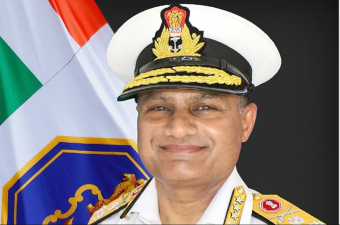
The Government of India appointed Vice Admiral Krishna Swaminathan as the next Chief of the Naval Staff (CNS) on 9 May 2026. He will officially assume office on 31 May 2026, succeeding the retiring Chief, Admiral Dinesh Kumar Tripathi. Operating out of the Integrated Headquarters of the Ministry of Defence (Navy) in New Delhi, the CNS is the highest professional position and the operational commander of the Indian Navy. Vice Admiral Swaminathan brings nearly four decades of maritime service to the post, which he is expected to hold until 31 December 2028.
Profile of Vice Admiral Krishna Swaminathan
Career and Operational Profile
- Commissioning: He entered service in the Executive Branch of the Indian Navy on 1 July 1987.
- Specialization: He is an expert in Communication and Electronic Warfare.
- Major Sea Commands: He has commanded the aircraft carrier INS Vikramaditya, the guided-missile destroyer INS Mysore, the missile corvette INS Kulish, and the missile vessels INS Vidyut and INS Vinash.
- Fleet Command: He served as the Flag Officer Commanding Western Fleet, commonly known as the “Sword Arm” of the Indian Navy.
- Recent Assignments: He served as the Vice Chief of the Naval Staff from May 2024 to July 2025 before taking charge as the 34th Flag Officer Commanding-in-Chief of the Western Naval Command on 31 July 2025.
Key Training and Advisory Roles
- Naval Training: He served as the Chief Staff Officer (Training) at the Southern Naval Command in Kochi, directing instructional programs across the service.
- Safety Framework: He led the establishment of the Indian Naval Safety Team, an entity created to monitor and enforce operational safety standards across all naval branches.
- Operational Readiness: He led the Navy’s Work Up Organisation as the Flag Officer Sea Training to evaluate fleet battleworthiness.
- Offshore Security: He served as the Flag Officer Offshore Defence Advisory Group, functioning as the chief advisor on offshore security and asset defense to the central government.
Educational Background
- Academies: He is an alumnus of the National Defence Academy in Khadakvasla and the Indian Naval Academy.
- Global Exposure: He completed advanced professional courses at the Joint Services Command and Staff College in Shrivenham, United Kingdom, and the United States Naval War College in Newport, Rhode Island.
- Academic Degrees: He holds a BSc from Jawaharlal Nehru University, an MSc in Telecommunications from Cochin University of Science and Technology, an MA in Defence Studies from King’s College London, an MPhil in Strategic Studies from Mumbai University, and a PhD in International Studies from Mumbai University.
Service Decorations
His naval career has been recognized with the following presidential military honors:
- Param Vishisht Seva Medal (PVSM)
- Ati Vishisht Seva Medal (AVSM)
- Vishisht Seva Medal (VSM)
Institutional Structure of Naval Leadership
Constitutional and Command Framework
The institutional hierarchy of the Indian armed forces places the professional chiefs within a specific constitutional grid.
| Component | Description and Institutional Hierarchy |
| Supreme Commander | The President of India holds the constitutional title of Supreme Commander of the Armed Forces. |
| Administrative Control | The Ministry of Defence handles administrative and budgetary management, headed by the Union Defence Minister. |
| Operational Command | The Chief of the Naval Staff exercises operational and executive control over the entire naval force. |
| Rank Status | The CNS is a Four-Star Admiral, holding equal status with the Army and Air Force Chiefs. |
Evolution of the Designation
The nomenclature of the naval head evolved through specific legislative and administrative steps after 1947.
- 1947–1948: The position was styled as the Commander-in-Chief, Royal Indian Navy, held by Rear Admiral John Talbot Savignac Hall.
- 1950: With India becoming a Republic, the title changed to Commander-in-Chief, Indian Navy.
- 1955: Parliament passed the Commanders-in-Chief (Change in Designation) Act. This statutory amendment changed the designation to Chief of the Naval Staff.
- 1958: Vice Admiral Ram Dass Katari became the first Indian officer to assume the office of the Chief of the Naval Staff.
Operational Commands of the Indian Navy
The Chief of the Naval Staff exercises administrative control over three operational commands, each headed by a Flag Officer Commanding-in-Chief holding the rank of Vice Admiral.
- Western Naval Command: Headquartered in Mumbai, Maharashtra, it acts as the primary operational command in the Arabian Sea.
- Eastern Naval Command: Headquartered in Visakhapatnam, Andhra Pradesh, it handles strategic operations in the Bay of Bengal.
- Southern Naval Command: Headquartered in Kochi, Kerala, it functions as the primary training command for naval personnel.
IASPOINT Booster Facts for UPSC
- Tri-Service Command: The Andaman and Nicobar Command (ANC) based in Port Blair is India’s only operational tri-service theater command. The naval elements here report to the Commander-in-Chief ANC, who rotates among the three services under the Chief of Defence Staff.
- The 1955 Act: The Commanders-in-Chief (Change in Designation) Act, 1955 simultaneously changed the titles of the heads of the Army, Navy, and Air Force from Commanders-in-Chief to Chiefs of Staff to assert civilian bureaucratic control.
- First Indian CNS: Vice Admiral Ram Dass Katari assumed office on 22 April 1958, ending the tenure of British naval officers leading the independent Indian Navy.
- INS Vikramaditya Origins: The aircraft carrier commanded by Vice Admiral Swaminathan during his career was originally commissioned into the Soviet Navy as Baku and later renamed Admiral Gorshkov, before being acquired and retrofitted by India.
- Chiefs of Staff Committee: The CNS is a member of the Chiefs of Staff Committee (COSC), which is chaired permanently by the Chief of Defence Staff (CDS).