
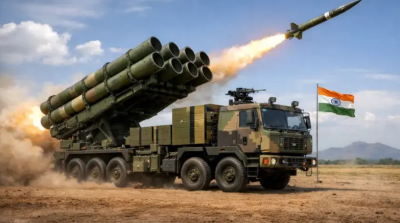
Pune-based private sector defence manufacturer Nibe Limited successfully conducted firing trials of its indigenous Suryastra long-range rocket system at the Integrated Test Range (ITR) in Chandipur, Odisha. The consecutive trials involved two variants with strike ranges of 150 km and 300 km. Both variants met all mission objectives with exceptional precision by hitting targets within a Circular Error Probable (CEP) of 1.5 metres and 2 metres, respectively. The successful demonstration marks a critical step forward in Indian defence preparedness, representing the first time a domestic private firm has developed and demonstrated long-range rocket artillery of this capability under an Indian Army procurement programme.
Overview of Suryastra Rocket System
The Suryastra system is India’s first indigenous, universal, multi-calibre rocket launcher system designed to conduct precision surface-to-surface deep strikes. It acts as a bridge between traditional battlefield field artillery and heavy ballistic missiles, providing a flexible and cost-effective precision weapon ecosystem.
System Variants and Performance Parameters
- 150-km Variant: Utilises EXTRA rockets designed for tactical battlefield support and deep-strike operations near conflict zones. It achieved a precision CEP of 1.5 metres during testing.
- 300-km Variant: Utilises Predator Hawk rockets to extend stand-off strike capabilities. This version enables forces to neutralise strategic enemy assets deep inside hostile territory without exposing launch crews to direct combat. It recorded a CEP of 2 metres during testing.
Technical Architecture and Capabilities
The system integrates several advanced hardware and software technologies to handle modern warfare requirements.
Modular and Universal Launch Architecture
Suryastra features interchangeable launch pods mounted on a high-mobility all-terrain tactical truck chassis. This universal design allows the same platform to support and deploy multiple types of rockets and ammunition without requiring physical hardware modifications.
Shoot-and-Scoot Capability
The platform incorporates highly automated systems via an integrated Ground Control System. This automation manages readiness and launch sequences, allowing the vehicle to fire a salvo and immediately relocate. This rapid mobility protects the unit from enemy counter-battery detection and radar tracking.
Expanded Operational Flexibility
Beyond conventional rockets, the launcher is engineered to deploy kamikaze drones or loitering munitions up to a distance of 100 km. This adds real-time surveillance, target acquisition, and flexible strike capabilities to the artillery unit.
Strategic Imperatives and Defence Procurement
The induction process is directly linked to the rapid modernisation efforts of the Indian Armed Forces.
Contract and Supply Details
- Procurement Authority: Order placed by the Indian Army under emergency procurement powers to upgrade deep-strike artillery capabilities.
- Financial Value: A contract worth ₹293 crore was signed with Nibe Limited for the supply of the universal rocket launcher systems and rockets.
- Technology Collaboration: In July 2025, Nibe Limited signed a Technology Collaboration Agreement with Israeli defence major Elbit Systems to manufacture the advanced universal rocket launcher system domestically.
Impact on Indigenous Defence Ecosystem
The project aligns with the Aatmanirbhar Bharat initiative by reducing reliance on imported long-range missile and rocket systems. It marks a shift from a public sector monopoly in strategic weapon manufacturing toward an ecosystem where private defence players develop advanced missiles, heavy artillery, and unmanned platforms.
Key Performance Indicators compared to Conventional Artillery
The following table highlights how the Suryastra system compares to standard conventional artillery assets currently in use.
| Parameter | Conventional Field Artillery | Suryastra Guided Rocket System |
| Maximum Operational Range | Typically 30 km to 60 km | 150 km and 300 km variants |
| Guidance System | Unguided / Ballistic trajectory | GPS-aided and autonomous guidance |
| Circular Error Probable (CEP) | Scores of metres at maximum range | 1.5 metres to 2 metres |
| Ammunition Flexibility | Fixed calibre shells | Multi-calibre universal pods, Loitering munitions |
| Primary Target Profile | Frontline tactical troop concentrations | High-value strategic hubs, radars, command centres |
IASPOINT Booster Facts for UPSC
- Circular Error Probable (CEP): A standard military metric used to measure the precision of a weapon system. It represents the radius of a circle within which half of the fired rounds or missiles are expected to land. Lower CEP values indicate higher accuracy.
- Integrated Test Range (ITR): Located at Chandipur in the Balasore district of Odisha, it provides the primary infrastructure for testing and evaluating Indian missiles, rockets, and airborne weapon systems.
- Stand-off Capability: Military operations conducted from a distance that allows personnel to strike an enemy target while remaining outside the range of counter-attacks from enemy defensive positions.
- Loitering Munition: Also known as a suicide drone or kamikaze drone, it is an aerial weapon category where the munition loiters around the target area for some time, searches for targets, and attacks once a target is located.