
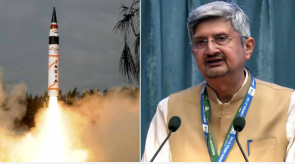
The Defence Research and Development Organisation announced its complete technological readiness to initiate the full-scale development of the Agni-VI intercontinental ballistic missile, following statements by the agency on April 30, 2026. The formal commencement of the project remains contingent upon final policy clearance and approval from the central government. Designed as India’s most advanced long-range strategic asset, the missile will transition the country’s deterrence capabilities from a regional scope to a global outreach. The development coincides with parallel advancements in indigenous defense technology, including upcoming trials for a hypersonic glide-based Long-Range Anti-Ship Missile.
Technical Architecture and Specifications
The Agni-VI represents a major structural and qualitative departure from the existing inventory of the strategic forces.
Propulsion and Stage Configuration
The missile is designed as a four-stage system utilizing solid propellant rocket motors across all phases of flight. The use of solid fuel ensures high structural stability, rapid response times, and long-term storage compatibility inside sealed environments.
Range and Payload Capacity
Open-source data and expert assessments indicate the following baseline technical parameters for the under-development platform:
- Operational Range: Estimated between 6,000 to 10,000 kilometers, with certain configurations capable of extending the strike envelope up to 12,000 kilometers.
- Launch Mass: Anticipated to weigh between 55,000 kg and 70,000 kg.
- Payload Weight: Engineered to carry a warhead payload of up to 3 tonnes, supporting both conventional and strategic nuclear configurations.
Advanced Strike and Penetration Technologies
The core utility of the platform rests on its capability to bypass sophisticated multi-layered ballistic missile defense shields deployed by global adversaries.
Multiple Independently Targetable Reentry Vehicle Technology
The platform will integrate advanced Multiple Independently Targetable Reentry Vehicle architecture. Unlike conventional missiles carrying a single warhead to a single destination, a missile with this platform carries a specialized post-boost vehicle or “bus.” This component maneuvers in space to release up to 10 to 12 independent nuclear warheads, directing them toward distinct, spatially separated geographic targets.
Maneuverable Reentry Vehicles and Countermeasures
To neutralize advanced interception networks such as THAAD or S-500 systems, the missile incorporates specialized penetration aids:
- Manoeuvrable Re-entry Vehicles: Payloads capable of altering their terminal flight paths after re-entering the atmosphere to deceive tracking radars.
- Radar-Absorbing Coatings: Specialized composite materials designed to minimize the radar cross-section of the descending warheads.
- Decoys and Chaff: Deployable false targets released mid-flight to overwhelm and saturate enemy interceptor reserves.
Strategic Deployment Matrix
The operational deployment strategy focuses on survivability and flexibility across different environments, completing the validation requirements of India’s nuclear triad.
| Deployment Platform | Launch Mechanism | Tactical Advantage |
| Land-Based Mobile Launchers | Canisterized road and rail-mobile systems. | Missiles remain hermetically sealed in transport tubes, reducing environmental degradation and enabling rapid launch readiness from anywhere. |
| Submarine Platforms | Under-development ballistic missile submarines (SSBNs). | Provides the ultimate second-strike capability by allowing covert deployment and launch closer to distant targets from the deep ocean. |
Evolution of the Agni Missile Family
The development of this platform is the latest phase in the Integrated Guided Missile Development Programme initiated in 1983.
- Agni-I: Short-range ballistic missile (700–900 km), solid-fueled, single-stage, operational for regional deterrence.
- Agni-II & Agni-III: Medium to intermediate-range systems (2,000–3,500 km), two-stage configuration, extending strategic reach.
- Agni-IV: Intermediate-range ballistic missile (4,000 km), introduced modern composite rocket motors, digital control systems, and road-mobility.
- Agni-V: Three-stage solid-fueled platform with a range exceeding 5,000 km. It introduced canisterized configurations and was recently tested with preliminary capability for multiple warhead delivery.
IASPOINT Booster Facts for UPSC
- First MIRV Demonstration: India officially demonstrated its initial capability for multiple warheads on March 11, 2024, under “Mission Divyastra” using an advanced variant of the Agni-V platform. A subsequent developmental flight trial confirming distributed targeting over the Indian Ocean Region was conducted on May 8, 2026.
- The Elite MIRV Club: With the validation of multiple targetable reentry technology, India joins a highly exclusive group of nations possessing functional capabilities, alongside the United States, Russia, China, the United Kingdom, and France.
- Hypersonic Distinction: The upcoming Long-Range Anti-Ship Missile uses a Hypersonic Glide Vehicle configuration. It differs from hypersonic cruise missiles because it uses a booster rocket to attain high altitude and velocity before gliding unpowered at speeds above Mach 5, whereas cruise missiles rely on scramjet engines for sustained powered flight.
- No First Use Doctrine: All long-range strategic assets under development fall under the operational command of the Strategic Forces Command, executing India’s nuclear doctrine centered on Credible Minimum Deterrence and a strict No First Use policy.