
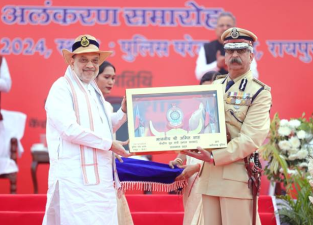
President Droupadi Murmu presented the prestigious President’s Police Colour to the Sikkim Police at Paljor Stadium in Gangtok. The award recognizes the force’s distinguished service, bravery, and professionalism in maintaining peace and internal security since its inception in 1897. During the Alankaran Parade, the President called for a complete transition away from colonial-era policing structures designed for population control. She advocated for a transparent, accountable, and citizen-friendly law enforcement apparatus that fosters public trust, prioritizes the safety of vulnerable demographic groups, and utilizes modern cybersecurity capabilities to handle rising digital threats.
Nature and Significance of the Award
The President’s Colour is the highest ceremonial honor bestowed upon any military unit, training establishment, or state and Union Territory police force in India.
- The Nishaan: The honor is popularly called the “Nishaan,” which manifests as a special ceremonial flag.
- Uniform Insignia: Following the conferment, all personnel belonging to the awarded force are authorized to wear a specially designed replica emblem on the left sleeve of their uniform.
- Basic Eligibility: To qualify for this recognition, an institution must generally complete a minimum of 25 years of outstanding and dedicated service to the nation during both peace and conflict.
- Core Symbolism: The award represents an official state acknowledgment of a unit’s operational excellence, institutional integrity, humanitarian contributions, and sacrifices in safeguarding national security.
Historical Genesis and Evolution
The tradition of presenting military colours originates from ancient combat practices and underwent a structured transition post-Independence.
- Ancient Concept: Historical armies carried a royal flag or “dhwaja” into active battle zones to signal the position of the sovereign. The capture of an enemy’s flag brought immense honor, while losing one’s own flag symbolized strategic defeat and institutional disgrace.
- Colonial Framework: During British rule, regiments carried the King’s or Queen’s Colours across the Indian subcontinent to project imperial authority.
- The 1950 Transition: On January 25, 1950, a day before India became a Republic, all traditional colonial King’s Colours belonging to the Royal Indian Army, Navy, and Air Force were officially retired and deposited at the Indian Military Academy in Dehradun.
- Inaugural Presentation: The honor was formally renamed the President’s Colours. The Indian Navy became the first branch of the Indian Armed Forces to receive the newly established President’s Colour from the first President of India, Dr. Rajendra Prasad, on May 27, 1951.
Sikkim Police Milestone and Regional Context
The presentation to the Sikkim Police marks a critical milestone for law enforcement agencies operational in North-East India.
| Metric | Details |
| National Rank | Sikkim Police is the 15th state police force in India to receive this distinction. |
| Regional Rank | It is the 3rd state police force in North-East India to achieve this honor. |
| Regional Predecessors | Assam Police was the first in the North-East, followed by Manipur Police as the second. |
| Strategic Domain | The force manages law, order, and internal stability along highly sensitive international border corridors. |
| Disaster Response | The award recognizes the force’s field coordination during the catastrophic Glacial Lake Outburst Flood of 2023. |
Structural Shifts in Modern Indian Policing
The conferment ceremony served as a policy platform to outline the necessary modernization and philosophical changes required within the state internal security architecture.
De-colonializing the Police Mindset
Colonial police forces were established under frameworks like the Police Act of 1861, which prioritized state control, revenue protection, and public suppression over community service. Modern governance requires personnel to act as allies, guides, and protectors of civil liberties rather than instruments of state coercion.
Enhancing Accountability and Inclusivity
Transitioning to citizen-centric policing demands total transparency in day-to-day operations. Police stations must become accessible spaces where common citizens can report grievances without systemic fear. Law enforcement must maintain enhanced institutional sensitivity when interacting with women, children, elderly citizens, and marginalized social groups.
Technological Adaptability
The rapid diversification of crime requires state police forces to build specialized capacities. Personnel must be continuously trained in digital forensics, cybersecurity protocols, and cryptographic investigations to effectively counter advanced systemic threats such as deepfakes, online financial frauds, network hacking, and cross-border cyber conspiracies.
IASPOINT Booster Facts for UPSC
- First CAPF Recipient: The Central Reserve Police Force became the first Central Armed Police Force to receive the President’s Colours. It was presented by the then Home Minister, Sardar Vallabhbhai Patel, on March 19, 1950.
- Constitutional Position: The President presents the award in their capacity as the Supreme Commander of the Indian Armed Forces under Article 53(2) of the Indian Constitution, though the honor can be extended to civil police forces operating under Ministry of Home Affairs guidelines or state jurisdictions.
- Sardar Vallabhbhai Patel National Police Academy: The premier training institution for Indian Police Service officers in Hyderabad was presented with the President’s Colours on September 15, 1888.
- Recent Paramilitary Inductions: The National Disaster Response Force was awarded the President’s Colours on May 14, 2026, by the Union Home Minister in Ghaziabad, Uttar Pradesh, acknowledging its role in domestic and global disaster relief.
- Special Variants: In cavalry units of the Indian Armed Forces, this specialized presidential honor is traditionally presented as ‘Standards’ to Heavy Cavalry units and as ‘Guidons’ to Light Cavalry units.