
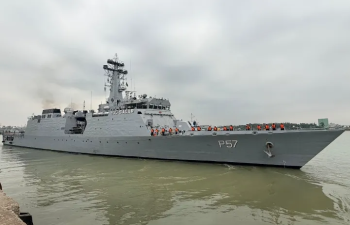
Indian Naval Ship INS Sunayna arrived at Colombo port, Sri Lanka, on 15 May 2026 for a three-day visit as part of the operational deployment under the Indian Ocean Ship – Security and Growth for All in the Region initiative. This deployment, which began its sea phase from Mumbai on 2 April 2026, marks the second edition of the multinational cooperative program. Commanded by Commander Siddharth Chaudhary, the vessel carries a combined contingent of personnel from India and sixteen friendly foreign countries. The tour serves India’s Neighbourhood First policy and its commitments under the MAHASAGAR framework to enhance maritime security, build operational readiness, and preserve regional peace.
IOS SAGAR Framework and Operational Details
The Indian Ocean Ship (IOS) SAGAR framework is a tactical translation of India’s larger maritime visions into actual joint operations.
The 2026 Deployment Phase
The mission completed its harbour-based preparation phase from 16 March to 29 March 2026, transitioning to its active sea phase on 2 April 2026. The deployment spans across the South-Eastern Indian Ocean Region and concludes at Kochi, India. The stop in Colombo marks the seventh port call of this specific mission.
Joint Core Training Objectives
The combined multinational crew undergoes rigorous professional training at sea to improve collective decision-making and operational standardization. The core syllabus includes:
- Advanced navigation and seamanship drills.
- Tactically coordinated communication protocols.
- Firefighting, damage control, and advanced bridgemanship.
- Visit, Board, Search, and Seizure (VBSS) operations for anti-maritime crime enforcement.
Combined International Representation
The personnel working jointly inside the warship represent a broad coalition of seventeen countries across South Asia, Southeast Asia, East Africa, and island territories.
| Region | Participating Friendly Foreign Countries (FFCs) |
| South Asia | Sri Lanka, Bangladesh, Maldives |
| Southeast Asia | Indonesia, Malaysia, Myanmar, Singapore, Thailand, Timor-Leste |
| East & Southern Africa | Kenya, Mozambique, South Africa, Tanzania |
| Indian Ocean Island Nations | Mauritius, Seychelles |
| West Asia | United Arab Emirates |
Geopolitical Frameworks: SAGAR and MAHASAGAR
India’s external maritime engagements follow a structured progression of doctrines designed to secure sea lines of communication and foster regional partnerships.
The SAGAR Doctrine
Launched in 2015, Security and Growth for All in the Region (SAGAR) focuses on the immediate Indian Ocean Region. It positions India as a preferred security partner and a net security provider. The doctrine rests on five operational pillars:
- Security: Enhancing capability to safeguard land and maritime territories.
- Economic Integration: Deepening economic and trade links, with particular focus on the blue economy.
- Disaster Response: Building capacity for collective humanitarian assistance and disaster relief.
- Sustainability: Ensuring collaborative and sustainable utilization of marine resources.
- Connectivity: Developing modern maritime infrastructure and port facilities.
The MAHASAGAR Vision
Announced in March 2025 during Prime Minister Narendra Modi’s state visit to Mauritius, the MAHASAGAR (Mutual and Holistic Advancement for Security and Growth Across Regions) initiative upgrades the regional SAGAR template. It expands the strategic scope toward a comprehensive global maritime approach, directly integrating partnerships across the Global South and African littoral states. The vision targets three primary operational dimensions:
- Trade acceleration for shared economic development.
- Collaborative capacity building to ensure sustainable maritime growth.
- Mutual security agreements to combat traditional and non-traditional maritime challenges.
Threat Matrix in the Indian Ocean Region
The joint patrolling and capacity-building exercises under IOS SAGAR are structured to address several security issues that disrupt trade and maritime safety.
Non-Traditional Security Hazards
Littoral nations face non-state actors operating across open maritime boundaries. Cooperative deployments are designed to track and suppress:
- Piracy and Armed Robbery: Resurgent piracy corridors near the Horn of Africa and crucial chokepoints.
- Narcotics and Weapons Trafficking: Illicit maritime trade routes operating across the North Arabian Sea and Bay of Bengal.
- Illegal, Unreported, and Unregulated (IUU) Fishing: Unsanctioned commercial trawling that depletes local marine ecosystems and destroys small-scale domestic fishing economies.
- Climate Distortions: Extreme weather events, cyclones, and ecological emergencies such as maritime oil spills requiring rapid first-responder interventions.
Traditional Geopolitical Competition
The Indian Ocean carries over 75% of global sea-borne trade and 50% of daily global oil consumption. Increased naval militarization, state-backed maritime research vessels collecting hydrographic data for military positioning, and the competitive creation of strategic dual-use overseas bases necessitate persistent surveillance and institutional deterrence by resident navies.
IASPOINT Booster Facts for UPSC
- INS Sunayna Specifications: INS Sunayna is the second ship of the Saryu-class patrol vessels, built indigenously by Goa Shipyard Limited. It is a twin-screw, diesel-powered Offshore Patrol Vessel (OPV) designed specifically for fleet support, ocean surveillance, and anti-piracy patrolling.
- Passage Exercise (PASSEX): Upon departing Colombo on 18 May 2026, INS Sunayna conducted a PASSEX with the Sri Lanka Navy. Unlike formal pre-planned bilateral exercises (like SLINEX), a PASSEX is organized on the go when a visiting warship leaves a friendly country’s port to ensure smooth communication and cooperative movement during unexpected regional emergencies.
- AIKEYME Exercise: In line with the MAHASAGAR vision, the Indian Navy co-hosts the Africa India Key Maritime Engagement (AIKEYME) exercise alongside the Tanzania Peoples’ Defence Force. This serves as a primary vehicle for large-scale multilateral engagement with African coastal states.
- Information Fusion Centre – Indian Ocean Region (IFC-IOR): Established by India in 2018 at Gurugram, the IFC-IOR acts as a central node for maritime domain awareness. It tracks commercial and non-commercial vessels in real-time to mitigate safety risks, actively hosting international liaison officers from several IOS SAGAR partner states.
- Neighbourhood First Policy: This core diplomatic directive prioritizes political, economic, and security relationships with immediate neighbors like Sri Lanka, Maldives, and Bangladesh, ensuring that domestic security strategies align directly with adjacent sovereign interests.