
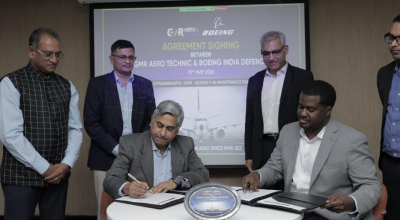
On 14 May 2026, GMR Aero Technic formalized a domestic aerospace partnership by signing an agreement with Boeing Defence India Private Limited to execute heavy maintenance checks for the Indian Navy’s P-8I long-range maritime patrol aircraft. The specialized servicing operations will be conducted at GMR Aero Technic’s advanced Maintenance, Repair, and Overhaul facility inside the GMR Aerospace Park Special Economic Zone in Hyderabad, Telangana. This marks the first major engagement where a domestic third-party commercial MRO provider handles a frontline military aviation platform. The contract aligns with a separate, depot-level maintenance contract valued at 413 crore Indian Rupees signed by the Ministry of Defence with Boeing India Defence Private Limited in March 2026 under the “Buy Indian” framework, emphasizing self-reliance in military sustainment.
Technical Scope of Phase-56 Heavy Maintenance Checks
Phase-56 checks represent the highest level of scheduled structural and systems maintenance for the P-8 aircraft platform, requiring deep technical intervention that cannot be performed at operational frontline naval air stations.
Structural Upgrades and Integrity Checks
- Airframe Disassembly and NDT: The aircraft undergoes partial skin removal and comprehensive Non-Destructive Testing (NDT) to identify micro-fractures, stress corrosion cracking, and material fatigue.
- Corrosion Control and Resurfacing: Complete stripping of maritime-grade external paint, chemical neutralization of saltwater corrosion pockets, and application of specialized anti-corrosive radar-absorbent coatings.
Avionics and System Modernization
- Mission System Enhancements: Upgrading the routing, computing hardware, and cooling blocks that support high-bandwidth maritime surveillance data links.
- Sensor Integration Checks: Calibration and testing of onboard acoustic processing suites, optical sensors, and electronic warfare modules to maintain full mission capability.
The P-8I Platform in the Indian Navy
The P-8I is a customized export variant of the Boeing P-8A Poseidon, built on a commercial Boeing 737-800 airframe but integrated with specialized Indian-made subsystems.
Fleet Strength and Basing Architecture
The Indian Navy operates a dedicated fleet of 12 P-8I aircraft. These platforms are strategically distributed across two primary naval air stations to cover the eastern and western seaboards:
| Naval Air Station | Location | Primary Operational Mandate |
| INS Rajali | Arakkonam, Tamil Nadu | Monitoring the Bay of Bengal, Malacca Strait choke points, and Eastern Indian Ocean region. |
| INS Hansa | Vasco da Gama, Goa | Securing the Arabian Sea, the Western Indian Ocean trade routes, and anti-submarine tracking. |
Core Operational Mission Profiles
- Anti-Submarine Warfare (ASW): Utilizing multi-static sonobuoys and an acoustic processing suite to track underwater foreign submarine incursions in the Indian Ocean Region.
- Anti-Surface Warfare (ASuW): Over-the-horizon targeting and capability to launch AGM-84 Harpoon anti-ship missiles and lightweight torpedoes against surface threats.
- Intelligence, Surveillance, and Reconnaissance (ISR): Long-range, high-altitude optical and radar mapping of maritime sea lanes of communication to counter piracy and unregulated fishing.
Tailored Indigenized Technology
The “I” variant sets itself apart from standard global Poseidon models by incorporating several critical Indian-made systems:
- Aft Radar System: Integrated with a Telephonics APS-143 OceanEye radar at the rear hull to provide 360-degree maritime surface search capabilities.
- Magnetic Anomaly Detector (MAD): Fixed to the tail cone to detect disruptions in the Earth’s magnetic field caused by submerged submarine hulls.
- Data Link II: Developed by Bharat Electronics Limited to allow secure, encrypted tactical data exchange between the aircraft, naval warships, and shore command centers.
- SATCOM & Secrecy Units: Integrated with Avantel satellite communication terminals and Electronics Corporation of India Limited speech secrecy devices for secure communication.
Strategic and Regulatory Framework of Indian Defence MROs
The transition of military aviation maintenance from foreign original equipment manufacturers to domestic private enterprises marks a structural shift in India’s defense economics.
Defence Acquisition Procedure (DAP) Guidelines
The March 2026 depot-level maintenance contract was executed under the “Buy Indian” category. This framework prioritizes domestic entities and mandates 100 percent in-country work share for servicing. It eliminates the need to fly strategic assets out of Indian territory for overhaul cycles, conserving foreign exchange reserves and protecting sensitive military hardware configurations from external exposure.
Tri-Sector Regulatory Approvals
To undertake complex military asset overhauls, the GMR Aero Technic facility maintains strict quality standards validated by multiple aviation authorities:
- DGCA (Directorate General of Civil Aviation): Ensures base airframe maintenance procedures meet rigorous domestic flight safety benchmarks.
- DGAQA (Directorate General of Aeronautical Quality Assurance): The regulatory body under the Ministry of Defence that audits, inspects, and certifies military standard airworthiness and engineering compliance.
- Global Certifications: Validated by both the European Union Aviation Safety Agency (EASA) and the Federal Aviation Administration (FAA) of the United States, allowing industrial flexibility such as passenger-to-freighter aircraft conversions.
IASPOINT Booster Facts for UPSC
- Depot-Level Maintenance: The highest tier of material maintenance. It involves completely rebuilding parts, assemblies, subassemblies, and end items, requiring specialized facilities and tooling beyond the scope of field or intermediate maintenance units.
- Performance-Based Logistics (PBL): A strategic management framework used in defense procurement where sustainment packages are contracted based on desired performance outcomes—such as platform mission-availability rates—rather than paying for individual spare parts or repair hours.
- Operation Sankalp: An ongoing Indian Navy maritime security deployment in the Gulf Region where P-8I aircraft and guided-missile destroyers provide surveillance and escort safety to Indian-flagged commercial shipping.
- Strategic Choke Points Monitored: The P-8I fleet routinely monitors key global maritime chokepoints including the Strait of Malacca, the Strait of Hormuz, and the Bab-el-Mandeb Strait to guarantee freedom of navigation.
- Aatmanirbhar Bharat in Defence: The Indian Government has instituted multiple positive indigenization lists banning the import of specific defense components while offering fiscal incentives to boost domestic private sector participation in defense manufacturing and MRO ecosystems.