
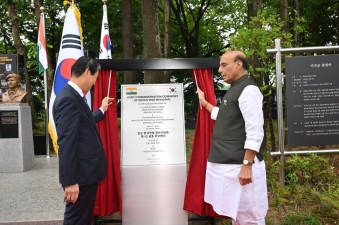
Defence Minister Rajnath Singh inaugurated the Indian War Memorial at Imjingak Park in Seoul, South Korea. The memorial honors India’s extensive medical and humanitarian contributions during the Korean War (1950–1953) and its subsequent diplomatic role in prisoner repatriation. This inauguration coincided with the 75th anniversary of the outbreak of the Korean War. Located at the historical site of “Hind Nagar,” where Indian forces managed prisoners of war, the memorial reinforces the Special Strategic Partnership between India and South Korea while highlighting India’s historical commitment to global peace under the United Nations mandate.
Historical Context of the Korean War
The Korean War began on June 25, 1950, when North Korean forces crossed the 38th Parallel to invade South Korea. The United Nations Security Council passed Resolution 83, calling for military assistance to South Korea. India chose a non-aligned diplomatic stance, declining to contribute combat troops to the UN Command. Instead, New Delhi committed to a humanitarian and medical mission to support the UN efforts, establishing a unique position as a neutral mediator throughout the conflict.
The 60 Parachute Field Ambulance
The 60 Parachute Field Ambulance was a specialized medical unit of the Indian Army dispatched to the Korean Peninsula in November 1950. Led by Lieutenant Colonel A.G. Rangaraj, the unit provided critical medical care to both UN troops and civilians.
Operational Highlights and Meritorious Service
- Integrated Support: The unit served alongside the 27th British Commonwealth Brigade and treated over 220,000 wounded personnel, including soldiers and civilians.
- Operation Tomahawk: In March 1951, the unit participated in a massive airborne operation behind enemy lines at Munsan-ni, establishing an advanced dressing station to perform emergency surgeries.
- Awards and Recognition: For its extraordinary gallantry and dedication, the unit received the President’s Trophy, two Maha Vir Chakras, and seven Vir Chakras. South Korea awarded them the Presidential Unit Citation.
Custodian Force of India and Post-War Repatriation
Following the July 1953 armistice agreement, India assumed the chairmanship of the Neutral Nations Repatriation Commission. The Custodian Force of India, comprising nearly 6,000 troops under Major General S.P.P. Thorat, was deployed to manage the complex prisoner of war repatriation process.
Operation Reconciliation at Hind Nagar
Indian troops established a temporary camp called “Hind Nagar” in the Demilitarized Zone. The Custodian Force took custody of over 23,000 prisoners of war from both sides who refused immediate repatriation. Indian forces provided a neutral, secure environment, allowing representatives from the opposing nations to explain their positions to the prisoners. This operation successfully resolved the prisoner deadlock without the use of force, earning international acclaim for its neutrality and discipline.
India-South Korea Bilateral Relations
The inauguration of the war memorial reflects the evolving dynamics of contemporary ties between New Delhi and Seoul.
| Dimension | Key Areas of Cooperation |
| Strategic Status | Upgraded to a Special Strategic Partnership in 2015, linking India’s Act East Policy with South Korea’s regional strategies. |
| Economic Engagement | Governed by the Comprehensive Economic Partnership Agreement signed in 2009, with a bilateral trade target of 50 billion USD. |
| Defence Ties | Focuses on co-production of military hardware, joint naval exercises, and high-level defense exchanges. |
IASPOINT Booster Facts for UPSC
- UN Resolution 82 and 83: India voted in favor of these UN resolutions that condemned North Korean aggression, though it maintained a non-combat role.
- Lieutenant Colonel A.G. Rangaraj: He was the first Indian officer to command a parachute unit in active combat and went on to receive the Maha Vir Chakra.
- Neutral Nations Repatriation Commission Members: India chaired the commission, which also included Sweden, Switzerland, Poland, and Czechoslovakia.
- The 38th Parallel: This line of latitude roughly demarcates North Korea and South Korea, established as the boundary after World War II and reinforced by the 1953 Armistice.
- Imjingak Park Location: The memorial is situated in Paju, South Korea, near the Imjin River, a region heavily associated with major battles during the Korean War.