
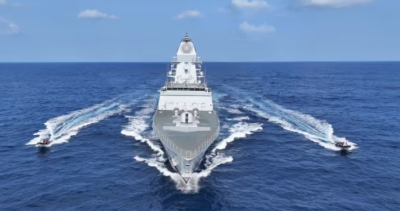
The Indian Navy achieved a major milestone in maritime indigenization with the delivery of Mahendragiri (Yard 12654) on April 30, 2026. Constructed by Mazagon Dock Shipbuilders Limited (MDL) in Mumbai, Mahendragiri is the sixth advanced stealth frigate delivered under the Project 17A Nilgiri-class program. The delivery occurred within 17 months of the first ship’s delivery, demonstrating an accelerated production cycle. Designed internally by the Warship Design Bureau (WDB), these warships replace older assets to build a blue-water fleet capable of multi-domain combat operations across the Indian Ocean Region.
Institutional Framework and Shipyards
Project 17A involves the construction of seven guided-missile stealth frigates. The Ministry of Defence divided the construction contract between two premier public sector shipyards to optimize industrial capacity and accelerate delivery schedules.
Industrial Workshare
- Mazagon Dock Shipbuilders Limited (MDL), Mumbai: Allocated four frigates (Nilgiri, Udaygiri, Taragiri, and Mahendragiri).
- Garden Reach Shipbuilders and Engineers (GRSE), Kolkata: Allocated three frigates (Himgiri, Dunagiri, and Vindhyagiri).
Modular Manufacturing Architecture
The program incorporates the “Integrated Construction” methodology. Hull sections are pre-assembled and fully outfitted with auxiliary machinery, piping, and electrical cabling in land-based workshops before final integration in the dry dock. This modular technique compressed the build period of later vessels like Dunagiri and Mahendragiri compared to the lead ship.
Design and Stealth Characteristics
Project 17A frigates are follow-on variants of the Project 17 Shivalik-class frigates. While the Shivalik-class laid the foundation for indigenous frigate design, the Nilgiri-class introduces structural and structural modifications to reduce radar signatures.
Structural Dimension Changes
The Nilgiri-class platforms are geometrically larger by 4.54% in displacement and volume compared to the Shivalik-class. The hull design integrates a low Radar Cross Section (RCS) layout. This is achieved through angled superstructure lines, flush-mounted weapon systems, and the application of specialized radar-absorbent paint coatings.
Signature Management
To maintain acoustic silence during anti-submarine operations, the hull structures incorporate advanced noise-isolation mountings for heavy machinery. The ship’s propellers are designed to delay the onset of cavitation at higher speeds, minimizing hydrodynamic noise that could be picked up by enemy sonar arrays.
Propulsion and Automation Systems
The frigates are configured with a high-end propulsion and automated platform control network to optimize fuel efficiency and crew survivability.
Combined Diesel or Gas (CODOG) Plant
The propulsion configuration allows the ship to switch between two distinct power sources based on operational requirements:
- Cruising Mode: Powered by two MAN Diesel 12V28/33D STC engines (6,000 kW each) to ensure long-range fuel economy.
- High-Speed Interception Mode: Powered by two General Electric LM2500 gas turbines to attain speeds exceeding 28 knots.
Integrated Platform Management System (IPMS)
The IPMS serves as the digitized nervous system of the warship. It centralizes the real-time monitoring and computerized control of propulsion machinery, auxiliary electrical grids, damage control systems, and onboard environmental units from a single combat station.
Weaponry and Sensor Architecture
The combat suite of Project 17A provides overlapping defensive and offensive capabilities covering air, surface, and sub-surface warfare domains.
Weapon Systems
- Anti-Surface/Land-Attack: Armed with two 4-cell Vertical Launch Systems (VLS) capable of firing 8 BrahMos supersonic cruise missiles.
- Anti-Air Defense: Equipped with four 8-cell VLS units loaded with 32 Barak-8 Medium-Range Surface-to-Air Missiles (MRSAM), providing a protective dome up to a range of 100 km.
- Artillery and CIWS: Features one 76 mm OTO Melara Super Rapid Gun Mount (SRGM) manufactured by Bharat Heavy Electricals Limited (BHEL) and two AK-630 Close-In Weapon Systems for terminal missile defense.
- Anti-Submarine Suite: Outfitted with two triple-tube launchers for Varunastra heavyweight torpedoes and two RBU-6000 anti-submarine rocket launchers.
Sensor and Radar Suite
- Primary Search Radar: Features the IAI EL/M-2248 MF-STAR S-band Active Phased Array Radar, which simultaneously tracks multiple airborne and surface targets.
- Surface Search: Backed by the Indra LTR-25 ‘Lanza’ L-band radar system.
- Sonar Array: Employs the indigenously developed BEL HUMSA-NG bow-mounted sonar for underwater surveillance.
Project Status and Indigenization
The program boasts a 75% indigenization content across components, raw materials, and weapon installations. The supply chain includes strategic partnerships with over 200 domestic Micro, Small, and Medium Enterprises (MSMEs), generating direct employment for 4,000 personnel.
| Ship Name | Yard Number | Builder | Delivery / Trial Status (As of May 2026) |
| INS Nilgiri | Yard 12651 | MDL | Delivered & Commissioned |
| INS Himgiri | Yard 3022 | GRSE | Undergoing Sea Trials |
| INS Udaygiri | Yard 12652 | MDL | Delivered & Commissioned |
| INS Dunagiri | Yard 3023 | GRSE | Delivered (March 30, 2026) |
| INS Taragiri | Yard 12653 | MDL | Commissioned (April 3, 2026) |
| INS Vindhyagiri | Yard 3024 | GRSE | Undergoing Sea Trials |
| INS Mahendragiri | Yard 12654 | MDL | Delivered (April 30, 2026) |
IASPOINT Booster Facts for UPSC
- Geographical Nomenclature: The Nilgiri-class frigates follow a strict naming convention based on prominent mountain ranges in India. For example, INS Mahendragiri is named after the mountain peak located in the Eastern Ghats of Odisha, while INS Vindhyagiri and INS Himgiri represent central and northern mountain ranges.
- Historical Namesakes: The modern Project 17A frigates inherit their names from the original Leander-class and modified Nilgiri-class frigates that served the Indian Navy from the early 1970s until the 2010s. The original INS Nilgiri (commissioned in 1972) was India’s first major indigenous warship project.
- Electronic Warfare Suite: The vessels are fitted with the ‘Shakti’ Electronic Warfare (EW) suite, designed by the Defence Electronics Research Laboratory (DLRL) and manufactured by Bharat Electronics Limited (BEL). It provides intercept capability and radar jamming against modern anti-ship missiles.
- Aviation Capabilities: The deck configuration includes an enclosed aviation hangar and a flight deck capable of operating two indigenous HAL Dhruv Advanced Light Helicopters (ALH Mk-III Maritime variant) or Sea King Mk. 42B anti-submarine helicopters.
- Controllable Pitch Propeller (CPP): Unlike fixed propellers, the CPP system allows the crew to change the pitch angle of the propeller blades while the shaft rotates at constant speeds. This enhances maneuverability and improves fuel consumption across different speeds.