
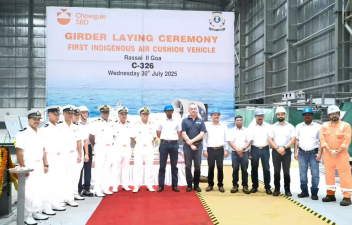
The Indian Coast Guard is advancing its indigenous Air Cushion Vehicle (ACV) programme at the Chowgule Shipyard in Goa. The Ministry of Defence signed a contract with Chowgule & Company Private Limited on October 24, 2024, for the fabrication and construction of six hovercraft. Construction of the first vehicle started on July 30, 2025, and subsequent girder-laying ceremonies concluded in May 2026. This project aims to replace aging platforms, boost maritime security, and enhance domestic defence manufacturing capabilities. The delivery of the first hovercraft is scheduled for May 2026.
Project Overview and Specifications
The ACV project focuses on building six high-speed hovercraft to perform diverse maritime operations along India’s vast coastline.
Design and Indigenisation
- Technology Partner: The vessels are based on designs from Griffon Hoverwork, United Kingdom.
- Domestic Adaptation: Indian engineers modified the British design to suit local operational requirements and tropical weather conditions.
- Indigenous Content: The hovercraft incorporate nearly 50 percent domestic components, supporting the vision of self-reliance in defence manufacturing.
Technical Performance
- Amphibious Capability: The craft operate over land, water, mudflats, and sandbanks, making them ideal for shallow water operations where traditional boats cannot navigate.
- Speed and Agility: The vehicles utilise a cushion of air trapped by a flexible skirt, reducing friction to achieve high speeds necessary for interception.
Operational Roles in Maritime Security
The Indian Coast Guard will deploy these six hovercraft to strengthen coastal surveillance and response mechanisms.
Core Responsibilities
- High-Speed Patrolling: Monitoring close-coast areas, creeks, and sandbars to prevent unauthorized entries.
- Maritime Interdiction: Tracking, chasing, and apprehending rogue vessels, smugglers, and infiltrators.
- Search and Rescue (SAR): Executing rapid-response missions during marine disasters, cyclones, and boat capsizes.
- Coastal Reconnaissance: Gathering real-time intelligence along sensitive maritime borders, particularly in regions like the Gulf of Kutch and the Sundarbans.
Infrastructure and Manufacturing Ecosystem
The execution of the ACV contract highlights the growing capability of private shipyards in India’s defence sector.
Role of Chowgule Shipyard
- Location: The construction takes place at the Chowgule facilities in Goa, a region with an established shipbuilding ecosystem.
- Milestones: The shipyard completed the girder-laying ceremonies for the fleet in May 2026, marking the transition from design to assembly phase.
- Economic Impact: The project generates local employment and builds a supply chain of domestic MSMEs providing marine-grade components.
Comparative Overview of Coast Guard Surface Assets
| Asset Type | Primary Operating Environment | Speed Range | Key Functions |
| Air Cushion Vehicles (ACV) | Shallow waters, marshlands, estuaries, beaches | 40–50 knots | Interdiction, shallow-water rescue, creek patrol |
| Interceptor Boats (IB) | Near-shore waters, Exclusive Economic Zone (EEZ) fringes | 35–45 knots | Coastal patrol, anti-smuggling, fishery protection |
| Fast Patrol Vessels (FPV) | Coastal waters up to 200 nautical miles | 25–35 knots | Anti-poaching, maritime surveillance, search and rescue |
| Offshore Patrol Vessels (OPV) | Deep ocean, Extended EEZ | 20–25 knots | Helicopter operations, long-range policing, pollution response |
IASPOINT Booster Facts for UPSC
- Air Cushion Vehicle Principle: Hovercraft operate on lift and propulsion. Lift fans force high-pressure air under the craft, contained by a flexible rubber “skirt,” creating an air cushion that lifts the hull above the surface. Aircraft-type propellers provide forward propulsion.
- Sir Christopher Cockerell: The British engineer who invented the modern hovercraft in the 1950s.
- Indian Coast Guard (ICG): Established on August 18, 1978, by the Coast Guard Act, 1978. It operates under the Ministry of Defence.
- Sir Creek Region: The disputed 96-km strip of water between India and Pakistan in the Rann of Kutch marshlands. ACVs are the primary assets used by Indian forces to patrol this marshy terrain.
- Territorial Waters vs EEZ: The ICG exercises jurisdiction over the Territorial Waters (up to 12 nautical miles from the baseline) and the Exclusive Economic Zone (up to 200 nautical miles from the baseline).