
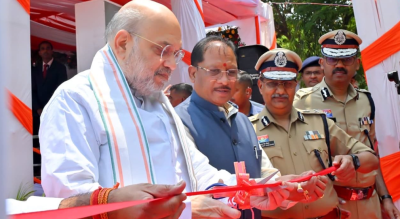
Union Home Minister Amit Shah launched Chhattisgarh’s next-generation CG Dial-112 emergency response service and 32 mobile forensic vans in Raipur to enhance emergency and forensic services. The upgraded Dial-112 system integrates police, fire, and medical services on a single platform with 400 advanced vehicles equipped with GPS, cameras, and real-time tracking for faster response. The mobile forensic vans enable on-site preliminary forensic examinations, reducing delays and contamination in evidence handling across all 32 districts. This initiative strengthens scientific investigation, ensures quicker justice, and builds public confidence in law enforcement.
Upgraded Emergency Response Support System (ERSS)
Integrated Platform Architecture
The next-generation CG Dial-112 operates as an integrated Emergency Response Support System (ERSS). It merges separate emergency helplines for police (100), fire (101), and medical services (108) into a unified single-number interface. The centralization eliminates the need for citizens to contact multiple departments during complex emergencies.
Technology and Fleet Upgrades
The state has deployed 400 new response vehicles equipped with modern digital tools. These vehicles contain Global Positioning System (GPS) trackers, dashboard cameras, and mobile data terminals. The central command and control center uses real-time tracking to dispatch the closest available vehicle to a distress location, minimizing response lag.
Mobile Forensic Vans and Evidence Management
On-Site Scientific Investigation
The introduction of 32 mobile forensic vans ensures that every district in Chhattisgarh has dedicated scientific investigation units. These vans act as mobile laboratories equipped with tools for the preliminary examination of crime scenes, collection of biological samples, fingerprint dusting, and digital evidence preservation.
Prevention of Evidence Contamination
Securing a crime scene quickly prevents the degradation or contamination of physical evidence. By conducting immediate on-site collection, these vans help law enforcement maintain a strict chain of custody, which increases the reliability of evidence when presented in courts of law.
Strategic Objectives in Law Enforcement
Transition to Scientific Investigation
The initiative supports India’s legislative shift toward scientific and forensics-driven criminal investigations. Incorporating mobile forensic units helps police rely on objective physical data rather than relying heavily on oral testimonies or confessions.
Quicker Justice Delivery
Faster dispatch through the Dial-112 system combined with rapid forensic processing accelerates the overall investigation timeline. This reduces delays in filing chargesheets, helps clear judicial backlogs, and improves the conviction rate for serious offenses.
Comparative Overview of Infrastructure Upgrades
| Feature | Legacy Emergency Systems | Next-Generation CG Dial-112 System |
| Helpline Numbers | Fragmented (100, 101, 108 separate) | Unified (Single 112 Platform) |
| Dispatch Basis | Manual jurisdiction-based assignment | GPS-based closest vehicle dispatch |
| Forensic Deployment | Delayed travel from district headquarters | Immediate dispatch via local mobile vans |
| Evidence Handling | Higher risk of exposure and contamination | On-site identification and digital logging |
| Tracking Capabilities | Voice-based radio communication | Real-time digital mapping and video feeds |
IASPOINT Booster Facts for UPSC
- National Emergency Response Support System (ERSS): The Union Ministry of Home Affairs conceptualized ERSS under the Nirbhaya Fund to create a pan-India, single emergency number (112) accessible via voice calls, SMS, panic buttons, and the ERSS mobile app.
- Nirbhaya Fund: Set up by the Central Government in 2013, this non-lapsable corpus fund supports initiatives specifically designed to enhance the safety and security of women across India.
- Bharatiya Nagarik Suraksha Sanhita (BNSS): The modern criminal procedural law mandates forensic examination for crimes punishable by seven years of imprisonment or more, making infrastructure like mobile forensic vans critical for statutory compliance.
- Directorate of Forensic Science Services (DFSS): A nodal administrative body under the Ministry of Home Affairs that assists in upgrading forensic science capabilities and maintaining uniform standards across state forensic laboratories.
- Geofencing Technology: The GPS systems in modern ERSS vehicles utilize geofencing, which creates virtual geographic boundaries to automatically alert dispatch centers when a vehicle enters or leaves a designated operational zone.