
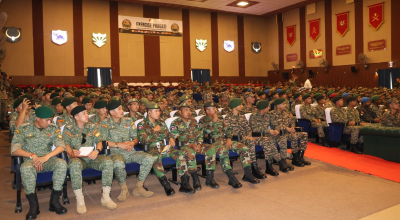
The multilateral military exercise PRAGATI 2026 commenced at the Umroi Military Station in Meghalaya, marking a key milestone in regional defense diplomacy. Bringing together land forces from 12 friendly foreign countries across the Indian Ocean Region and the wider Indo-Pacific, the two-week joint training event aims to enhance tactical interoperability and collective security capabilities. PRAGATI stands for Partnership of Regional Armies for Growth and Transformation in the Indian Ocean Region. This collaborative defense initiative focuses heavily on counter-terrorism operations, sharing specialized operational expertise, and displaying indigenous military technologies developed under India’s self-reliance frameworks.
Institutional Framework and Core Philosophy
The structure of Exercise PRAGATI 2026 relies on a multilateral defense framework to establish joint responses to unconventional security challenges.
Strategic Vision and Operational Nomenclature
The acronym PRAGATI embodies the objective of the military engagement. It addresses the growing need for synchronized security architecture among rim nations and immediate land neighbors. The exercise creates a cooperative domain based on institutional equality, mutual operational respect, and shared regional growth goals.
Command Structure and Opening Leadership
The opening ceremony was executed under senior leadership from the Indian Army. Major General Sunil Sheoran, Additional Director General of Infantry, served as the principal hosting dignitary. The command directives place emphasis on collective engagement, building collaborative intelligence sharing, and standardizing multinational field communication protocols.
Participant Profiles and Regional Footprint
The footprint of PRAGATI 2026 covers strategic sub-regions including South Asia, Southeast Asia, and the island territories of the Indian Ocean.
Participating Nations
The exercise includes armed forces contingents from 12 partner nations alongside the host country, India:
- South Asian Environs: Bhutan, Nepal, and Sri Lanka.
- Southeast Asian Littorals: Cambodia, Indonesia, Laos, Malaysia, Myanmar, Philippines, and Vietnam.
- Indian Ocean Island States: Maldives and Seychelles.
Geopolitical Grouping Dynamics
The participant breakdown demonstrates a diplomatic bridge between South Asian nations and member states of the Association of Southeast Asian Nations (ASEAN). It aligns directly with the core tenets of India’s Security and Growth for All in the Region (SAGAR) doctrine and the Act East Policy.
Tactical Core and Operational Drills
The physical phase of the two-week engagement uses the specialized geographical layout of northeastern India to simulate modern combat conditions.
Terrain-Specific Counter-Terrorism
The military curriculum concentrates on execution within semi-mountainous and dense jungle terrain. These environments present unique operational friction points, including line-of-sight communication breakdowns, rapid altitude adjustments, and restricted vehicular movement.
Specialized Training Components
- Joint Planning Exercises: Command staff work together to draft tactical orders, assess battlefield terrain data, and formulate quick-reaction deployment strategies.
- Tactical-Level Drills: Ground troops execute room intervention operations, fire-and-move coordination, and urban counter-ambush movements.
- Heliborne Operations: Air-insertion modules train soldiers in rapid deployment, vertical rappelling, and establishing security perimeters in remote drop zones.
- The 72-Hour Culmination Exercise: The training concludes with a continuous 72-hour simulated mission testing real-time intelligence analysis, physical endurance, and multinational command response under combat fatigue.
Infrastructure Capabilities of Joint Training Node Umroi
The selection of Umroi Military Station in the Ri-Bhoi district of Meghalaya highlights India’s dedicated infrastructure for multinational military testing.
Physical and Technological Assets
- Joint Warfare Centre: A computer-warfare facility that tracks simulated troop movements and tests decision-making loops for multi-nation field commanders.
- Reflex Shooting Ranges: Advanced target arenas designed to test situational reaction speeds and precision fire during close-quarter battle situations.
- Improvised Explosive Device (IED) Standard Rooms: Simulated training zones dedicated to identifying, neutralizing, and counteracting hidden explosive devices used by insurgent groups.
Defence Technology and Atmanirbhar Bharat Implementation
A core objective of PRAGATI 2026 is providing a platform to display domestic defense manufacturing capabilities.
Indigenous Equipment Exhibition
Indian technology and defense production firms use the event to demonstrate indigenous weaponry and logistical hardware to foreign delegates. The equipment displayed covers small-arms weapon systems, tactical drone networks, encrypted communication headsets, and mine-protected vehicles. This dual-purpose setup serves as an operational display and an export exposition, backing the goals of the Atmanirbhar Bharat initiative.
Comparative Matrix of Selected Indian Multilateral Exercises
| Exercise Name | Primary Domain | Geopolitical Focus | Primary Operational Mandate |
| PRAGATI | Land / Army | Indian Ocean Region & Southeast Asia | Counter-Terrorism, Jungle Warfare, Regional Transformation |
| MILAN | Maritime / Navy | Global Indo-Pacific Littorals | Anti-Submarine Warfare, Sea Lane Security, Humanitarian Aid |
| TARANG SHAKTI | Aerial / Air Force | Global Air Forces & Strategic Allies | Beyond-Visual-Range Combat, Air Defence Integration |
| MALABAR | Maritime / Navy | Quad Nations (India, US, Japan, Australia) | Interoperability, Fleet Maneuvers, High-Domain Maritime Security |
IASPOINT Booster Facts for UPSC
- SAGAR Doctrine: Launched in 2015, Security and Growth for All in the Region is India’s framework for maritime cooperation in the Indian Ocean Region, focusing on maritime security, capacity building, and disaster response.
- Umroi Training Node History: The Joint Training Node at Umroi became fully operational around 2017 to host foreign armies. It has previously accommodated exercises like EKUVERIN (with Maldives), SAMPRITI (with Bangladesh), and HARIMAU SHAKTI (with Malaysia).
- Militarily IMPRESSIVE Terrain: The Ri-Bhoi district features a sub-tropical climate with heavily forested, dissected plateau topographies, making it an ideal geographic analogue for Southeast Asian jungle ecosystems.
- Defense Export Target: The Government of India has established a defense export target of 50,000 crore rupees by the financial year 2028-29, driven by exporting indigenous platforms like the BrahMos missile, Akash missile systems, and Advanced Light Helicopters (ALH).
- Army Classification of Exercises: The Indian Army categorizes exercises into Command Post Exercises (CPX) focusing on staff planning, and Field Training Exercises (FTX) involving the physical movement of combat troops on the ground. PRAGATI 2026 combines elements of both variants.