
In 2025, India witnessed nearly 331 days of climate-linked disruptions, underscoring how extreme weather has shifted from anomaly to norm. The human cost was severe: over 4,000 deaths attributed to climate-induced disasters, with Himachal Pradesh and Uttarakhand emerging as epicentres of loss. Against this backdrop, the push for large-scale infrastructure in ecologically fragile Himalayan zones has ignited a critical debate on whether development policy is aligned with climate reality, scientific caution, and long-term national interest.
What the recent Himalayan disasters reveal
Towns such as Dharali, Harsil, Uttarkashi, Chamoli, Kullu, Mandi and Kishtwar faced repeated devastation from cloudbursts, landslides and avalanches that rapidly transformed into flash floods. These events were not isolated accidents but manifestations of a systemic vulnerability — steep terrain, unstable geology, retreating glaciers and intensifying rainfall patterns interacting with human interventions.
The Himalayas, already identified as one of the world’s most climate-sensitive regions, are warming significantly faster than the global average. This accelerates glacial melt, increases runoff volatility and raises the frequency of compound disasters, where one hazard triggers another.
Infrastructure expansion in a disaster-prone zone
Despite these warning signals, forest clearances were granted in November for the diversion of 43 hectares of forest land in Uttarakhand for the Char Dham road-widening project. Nearly 7,000 deodar (devdar) trees are proposed to be felled, with additional land earmarked for muck dumping.
The project relies on the DL-PS (double lane with paved shoulder) standard, requiring a 12-metre-wide paved surface. This design has been repeatedly questioned by geologists and environmental experts, particularly as the affected region lies north of the Main Central Thrust — a tectonically sensitive zone where large-scale infrastructure is explicitly discouraged.
Ecological value of deodar forests
Deodar forests are not merely tree cover; they are structural components of Himalayan stability. Their deep and widespread root systems bind fragile mountain soils, reduce landslide probability and act as natural buffers against avalanches and glacial debris flows. Removing them directly weakens slope integrity.
These forests also play a critical role in sustaining the upper reaches of the Ganga river system. Located within the Bhagirathi Eco-Sensitive Zone, they help regulate microclimates, maintain cooler stream temperatures and preserve dissolved oxygen levels essential for aquatic life. Their biochemical properties influence river ecology by shaping microbial balance, contributing to the self-purifying characteristics historically associated with the river’s upper stretches.
Why ‘tree translocation’ is scientifically flawed
Recent proposals to “translocate” mature deodar trees reflect a misunderstanding of forest ecology. Centuries-old trees are deeply embedded in site-specific soil, hydrological and microbial networks. Uprooting them is functionally equivalent to felling, as their ecological roles cannot be recreated elsewhere. No alternative terrain can replicate the precise climatic and geological conditions under which these forests evolved.
Recognising this, the Supreme Court has previously discouraged deodar felling in this region, stressing the irreplaceable nature of these forests in disaster mitigation.
Char Dham project and systemic planning failures
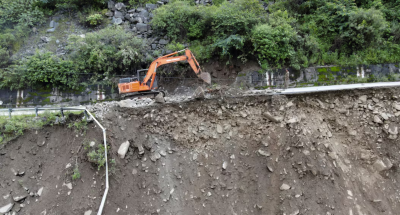
The Char Dham road-widening project illustrates how infrastructure expansion in the Himalayas has often bypassed scientific caution. Project fragmentation allowed avoidance of a comprehensive Environmental Impact Assessment. Excessive vertical hill-cutting violated the natural “angle of repose” of Himalayan geology, while indiscriminate muck dumping choked streams and destabilised slopes.
The outcome is visible on the ground: along nearly 700 km of widened roads, over 800 active landslide zones have been identified, and several strategic routes face repeated closures. Retrofitting slopes with bolts and wire mesh years later cannot compensate for foundational engineering decisions that ignored geological limits.
Policy contradiction: development versus stated climate goals
These actions sit uneasily with India’s own policy framework. The National Mission for Sustaining the Himalayan Ecosystem, approved under the National Action Plan on Climate Change, mandates glacier monitoring, biodiversity conservation, hazard mitigation and sustainable livelihoods in Himalayan states. Large-scale destabilising infrastructure runs counter to these objectives, raising questions about policy coherence and institutional accountability.
Repeated warnings from bodies such as the National Green Tribunal on unsafe land use, tunnel construction and hydropower expansion further underline this contradiction.
Climate change as a risk multiplier
While unsafe land use provides the trigger, climate change magnifies the damage. Erratic rainfall, intense cloudbursts and accelerated glacial retreat create a “water peak phase” marked by destructive floods. Once glaciers retreat beyond a threshold, this phase gives way to chronic water scarcity and drought, threatening both mountain communities and downstream populations.
Unregulated tourism, unchecked vehicular load and absence of carrying capacity assessments compound these risks, reflecting deeper governance challenges rather than isolated project-level failures.
Why the Himalayas matter to India’s future
The Himalayas are not a peripheral frontier but the ecological foundation of the subcontinent — shaping climate, river systems, agriculture and cultural identity. The recurring disasters offer a clear lesson in earth system science: resilience, not speed of construction, must guide development choices in fragile landscapes.
If national security, connectivity and economic growth are the stated goals, disaster-resilient planning rooted in scientific assessment is not optional; it is indispensable.
What to note for Prelims?
- Char Dham Road Project and DL-PS road standard.
- Main Central Thrust (MCT) and Himalayan geology.
- Bhagirathi Eco-Sensitive Zone.
- National Mission for Sustaining the Himalayan Ecosystem.
- Role of deodar forests in slope stability.
What to note for Mains?
- Analyse how infrastructure development can amplify disaster risk in the Himalayas.
- Discuss the role of forests in climate adaptation and disaster mitigation.
- Examine policy contradictions between development projects and India’s climate commitments.
- Evaluate climate change as a risk multiplier in mountain ecosystems.