
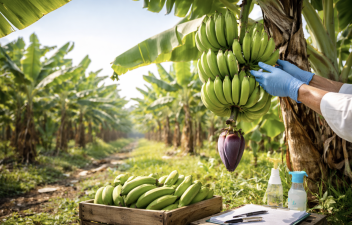
The banana — the world’s most consumed fruit — may finally have a scientific breakthrough against its most feared pathogen, Panama disease. A research team from the University of Queensland has identified a genomic region linked to resistance against Fusarium wilt Subtropical Race 4 (STR4), offering renewed hope for protecting the globally dominant Cavendish variety. The finding could be crucial for food security, as hundreds of millions depend on bananas as a staple source of calories.
Why Panama Disease Is a Global Threat
Fusarium wilt, commonly known as Panama disease, is caused by the soil-borne fungus Fusarium oxysporum f. sp. cubense (Foc). Its virulent Tropical Race 4 (TR4) and Subtropical Race 4 (STR4) strains attack banana plants by infecting their vascular system, leading to wilting and eventual death.
Key concerns include:
- The fungus persists in soil for decades
- No effective chemical cure exists
- It spreads through contaminated soil and planting material
- It devastates monoculture plantations
Most global banana exports are of the Cavendish variety, which is genetically uniform. This lack of diversity makes the crop especially vulnerable to fungal outbreaks.
The Science Behind the Breakthrough
Researchers Andrew Chen and Elizabeth Aitken led a five-year project combining advanced breeding and genomic tools. Their team used:
- Forward genetics and population development
- Genome sequencing
- Bulked segregant analysis
The scientists crossed a resistant wild diploid banana known as Calcutta 4 (Musa acuminata ssp. burmannica) with susceptible diploid varieties. After exposing the progeny to STR4, they compared DNA from resistant and susceptible plants.
The resistance trait was mapped to chromosome 5 in Calcutta 4. This quantitative trait locus (QTL) provides the genetic basis for STR4 resistance.
Why Calcutta 4 Is Important — and Limited
Calcutta 4 is a wild, highly fertile diploid banana with natural resistance to Fusarium wilt. However, it is unsuitable as a commercial fruit because it does not produce palatable bananas.
The research goal is not to commercialize Calcutta 4 directly but to transfer its resistance traits into edible, commercially viable varieties. The next step involves developing molecular markers that allow breeders to track the resistance gene efficiently in early seedlings.
This marker-assisted selection could:
- Reduce breeding time
- Lower research costs
- Accelerate deployment of resistant cultivars
Food Security and Economic Implications
According to a 2025 report by Christian Aid, over 400 million people rely on bananas for 15–27% of their daily caloric intake. Bananas are not only a commercial export commodity but also a subsistence crop in parts of Africa, Asia, and Latin America.
The Cavendish banana itself replaced the earlier Gros Michel variety in the mid-20th century after it succumbed to an earlier strain of Panama disease. A repeat of that crisis could severely disrupt global trade and food systems.
The Monoculture Problem in Global Agriculture
The vulnerability of Cavendish bananas illustrates a broader structural issue in global agriculture — genetic uniformity.
Monoculture systems:
- Maximize yield and uniformity
- Facilitate large-scale export logistics
- Reduce resilience to pests and diseases
The Panama disease crisis reinforces the importance of genetic diversity, conservation of wild relatives, and biotechnological innovation in crop improvement.
What to Note for Prelims?
- Panama disease is caused by Fusarium oxysporum f. sp. cubense.
- STR4 and TR4 are virulent strains affecting Cavendish bananas.
- Resistance gene identified in wild diploid banana Calcutta 4.
- Resistance mapped to chromosome 5.
- Research published in Horticulture Research journal.
What to Note for Mains?
- Discuss the impact of monoculture on global food security.
- Examine the role of biotechnology and genomics in crop disease resistance.
- Analyse the challenges posed by soil-borne fungal pathogens.
- Evaluate the importance of conserving wild crop relatives for agricultural sustainability.