
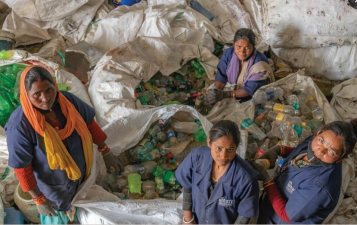
March 1 marked International Waste Pickers Day, drawing attention to challenges faced by these marginalized workers integral to waste management. Especially relevant as India plans Extended Producer Responsibility expansion, their socio-economic rights require urgent safeguarding.
India’s Marginalized Green Force
Key Statistics
- ~1.5 million urban waste pickers in India as per PLFS report (2017-18)
- Up to 60 kg average daily waste collected per person
- 50% women representation within waste picker community
Hazardous Working Conditions
- Lack safety gear, prone to injuries, cuts, dermatological issues
- Exposure to glass shards, Medical waste pose critical health hazards
- Income uncertainty due to irregular recoverable waste volumes
Work Type Classification
Women in Informal Employment categorizes waste pickers across:
- Scavengers: Extremely poor who sell to intermediaries
- Independent waste pickers: More agency regarding sale
- Itinerant waste buyers: Gather, sort out waste for small junk shops
- Municipal waste workers: Linked to government
Key Challenges
Health and Safety
- Absence of protective equipment or hygienic waste handling training
- Vulnerability to alcohol and tobacco addiction exacerbating risk factors
Children in workforce
- School dropouts eventually joining families in junk trade
- Early exposure restricts skills development avenues
Social Exclusion and Bias
- Associated caste based stigma, seen as rag pickers and thieves
Financial Struggles and Debt Traps
- Agents pay very low, accentuating cycle of poverty
- Dependency on money-lenders charging usurious rates
Statistics on Manual Scavenging Deaths
| Year | Total deaths | Sanitation related | Sewer, septic tank related |
| 2020 | 341 | 310 | 238 |
| 2021 | 327 | 97 | 86 |
| 2022 (Till Nov 10) | 246 | 122 | 110 |
The above table shows continuing cases of hazardous cleaning deaths including sanitation work like sewer descents, underscoring health risks.
Women Waste Pickers’ Situation
Poverty Risk
- Income volatility due to seasonal waste fluctuations
- No social security cover against income shocks w
Safety and Harassment
- High rates of sexual harassment at dump sites and during waste transportation
- Police crackdowns, corruption allegations rampant
Health Factors
- Gynaecological issues, prolapsed uterus cases widespread
- Carrying heavy loads while malnutritioned and anaemic
India’s Waste Management Policy Evolution
Municipal Solid Waste Management Rules
The Solid Waste Management Rules, 2016 made the following provisions:
- Mandates integration of waste pickers into municipal waste handling
- Requires implementing waste picker welfare schemes on health, safety
- Fixes minimum support price for waste sold to urban local bodies
Draft Uniform Framework for EPR released
Positives
- Formal integration of the informal sector by mandating companies to collect and channelize recyclable material waste only throughwaste pickers
Gaps
- No detailed operational plan to actualize proposed integration
- Lack of consultation during formulation stage with pickers groups or NGOs working closely with them
Resultant Concerns
- Will integration happen only on paper or extend to ground reality?
- Can promises counter corporatization challenges?
India’s Informal Waste Sector
Vital Statistics
As per a Centre for Science and Environment study:
- Waste pickers recover 15-20% of total municipal solid waste in India
- Recycle almost 60% of all polyethylene terephthalate (PET)
- Supply almost 50% recycled paper industry requirements
Ownership Structures
India’s informal waste recycling sector features:
- Individual waste collectors and sorters
- Micro-enterprises buying segregated waste
- Small processing units engaged in recycling waste
This decentralized structure handles over 4 million tons annually comprising high calorific recyclables.
Circular Economy Contribution
- Informal waste workers relieve burden on municipal bodies running at 115% capacity
- Offer inexpensive waste solutions
EPR Policy Recalibration Required
Core Challenges with EPR Structure
The EPR model shifts responsibility of waste processing from municipalities to producers. This features positives but also some concerns for informal waste workers.
- Formalizing waste sector can threaten centuries old informal occupation
- Transition risks being extractive rather than empowering
Way Forward Principles
Inclusive Consultation
- Actively engage grassroot waste picker groups during policy design to reflect on-ground realities.
Women’s Participation
- Bring gender lens while designing integration to address safety, health risks women waste pickers face
Support Structures and Social Security
- Enable self-help collectives providing welfare services like microfinance access, life and health insurance
- Reskilling avenues to improve socio-economic mobility
Robust Integration Metrics
- Develop well-defined metrics around worker absorption, income stability etc rather than symbolic quotas to monitor EPR performance
India’s waste pickers are the invisible environmentalists securing resource sustainability. But the lack of agency in evolving waste management policy threatens their livelihood even while transitioning toward formal structures. Correcting this asymmetry is vital through worker-centric integration initiatives securing transparency and welfare.
Last Modified: March 2, 2024