
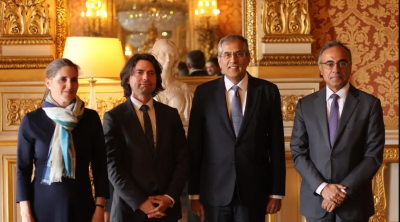
India and France held the 8th Maritime Cooperation Dialogue in Paris on May 20, 2026, to reinforce their shared commitment to maritime security and operational coordination across the Indo-Pacific region. Co-chaired by India’s Deputy National Security Advisor Pavan Kapoor and French defense and foreign affairs directors, the high-level dialogue focused on establishing a coordinated mechanism to counter non-traditional security threats, including piracy, maritime terrorism, narcotics smuggling, and illegal fishing. The two nations emphasized their mutual alignment toward maintaining a free, open, and inclusive rules-based maritime order that respects international law, territorial sovereignty, and the freedom of navigation.
Strategic Framework of Bilateral Maritime Ties
The Special Global Strategic Partnership
- Elevation of Status: In February 2026, India and France officially elevated their bilateral relations from a Strategic Partnership, established in 1998, to a Special Global Strategic Partnership.
- Institutional Dialogues: The maritime dialogue acts as a functional follow-up to the 38th Strategic Dialogue led by National Security Advisor Ajit Doval in January 2026, ensuring regular bureaucratic and operational assessment of shared goals.
- Horizon 2047 Roadmap: Adopted to define the long-term bilateral vision up to the centenary year of India’s independence and Indo-French diplomatic relations. It prioritizes maritime security, blue economy initiatives, and digital sovereignty.
Geopolitical Drivers in the Indo-Pacific
- Resident Power Status: Unlike other Western nations, France is a resident power in the Indo-Pacific, possessing island territories like Réunion and Mayotte in the Indian Ocean, and New Caledonia and French Polynesia in the Pacific Ocean.
- Exclusive Economic Zones (EEZ): France commands the second-largest EEZ globally, with over 90% of it located in the Indo-Pacific, creating an immediate overlap with India’s security interests in the Indian Ocean Region (IOR).
Core Focus Areas of the 8th Maritime Dialogue
Countering Illicit Maritime Activities
- Maritime Transgressions: Both nations finalized plans for coordinated monitoring to suppress Illegal, Unreported, and Unregulated (IUU) fishing, which depletes regional marine resources and alters economic security.
- Transnational Crime: Coordinated maritime protocols were assessed to curb drug trafficking routes and choke points utilized for contraband smuggling and maritime terrorism in the Western Indian Ocean.
- Hybrid Threats: The dialogue evaluated defensive sharing measures against grey-zone tactics, underwater espionage, and cyber threats targeting critical maritime infrastructure like subsea cables.
Enhancing Operational Interoperability
- Logistics Sharing: The implementation of the Joint Strategic Vision of India-France Cooperation in the Indian Ocean Region allows reciprocal access to military logistics facilities. Indian naval assets utilize French bases in Réunion and Djibouti to sustain long-range deployments.
- Information Fusion: France maintains a permanent liaison officer at the Information Fusion Centre-Indian Ocean Region (IFC-IOR) based in Gurugram, India, ensuring real-time maritime domain awareness (MDA) tracking.
Defense Industrial and Multilateral Integration
Naval Procurement and Technology Transfer
- Rafale-M Fighter Jets: India finalized an agreement to procure 26 Rafale-M (Marine) fighter jets for the Indian Navy’s indigenous aircraft carriers, featuring technology transfers for integrating indigenous weapon systems.
- Submarine Construction: Ongoing joint manufacturing initiatives support India’s Project-75 program, enhancing industrial capacity for conventional submarine maintenance, repair, and overhaul (MRO) facilities in India.
Multilateral and Trilateral Joint Operations
| Exercise / Initiative | Nature of Cooperation | Key Elements and Strategic Objective |
| Varuna | Bilateral Naval Exercise | Conducted annually since 1993; involves advanced anti-submarine warfare, fleet maneuvers, and tactical live-firing. |
| La Pérouse | Multilateral Maritime Exercise | French-led naval exercise in the Bay of Bengal involving India, Australia, Japan, and the United States. |
| India-UAE-France | Trilateral Dialogue | Launched in 2023; focuses on maritime security, combatting climate change, and protecting biodiversity in the IOR. |
| Indo-Pacific Oceans Initiative (IPOI) | Regional Framework | Launched by India; France joined in 2021 and co-leads the Maritime Resources Pillar alongside Indonesia. |
IASPOINT Booster Facts for UPSC
- First Western Partner: France was the first Western nation with which India signed a Strategic Partnership Agreement in January 1998.
- Joint Satellite System: ISRO and the French space agency CNES operate joint satellite missions, including Megha-Tropiques and SARAL, which monitor tropical climate conditions and ocean surface heights.
- International Solar Alliance (ISA): Co-founded by India and France in 2015 at the UN Climate Change Conference (COP21) in Paris, it is headquartered in Gurugram, Haryana.
- UNCLOS Compliance: Both countries explicitly anchor their Indo-Pacific strategies on compliance with the United Nations Convention on the Law of the Sea (UNCLOS), opposing unilateral changes to maritime boundaries.
- Indian Ocean Rim Association (IORA): France became a full member of IORA in December 2020, representing its overseas territory of Réunion Island, a move heavily supported by India.