
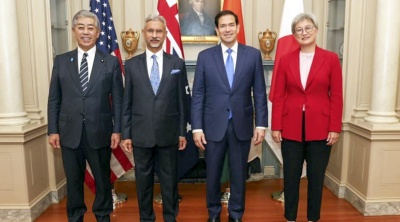
India will host the Quad Foreign Ministers’ Meeting in New Delhi on May 26, 2026, bringing together foreign ministers from Australia, Japan, and the United States. Chaired by India’s External Affairs Minister Dr. S. Jaishankar, the high-level meeting will include Australian Foreign Minister Penny Wong, Japanese Foreign Minister Toshimitsu Motegi, and US Secretary of State Marco Rubio. The diplomatic gathering focuses on strengthening strategic cooperation in the Indo-Pacific region, evaluating ongoing Quad commitments, and addressing global security developments. The dialogue builds upon the previous ministerial framework held in Washington, D.C., on July 1, 2025, to advance the shared vision of a Free and Open Indo-Pacific. The visiting dignitaries will also hold bilateral consultations with Indian officials and call on Prime Minister Narendra Modi.
Core Agenda and Strategic Focus Areas
Advancing the Free and Open Indo-Pacific Vision
The primary objective of the meeting is to reinforce a rules-based international order in the Indo-Pacific region. The ministers will review measures to ensure freedom of navigation, overflight, and the peaceful resolution of maritime disputes. Discussions will address the preservation of territorial integrity and sovereignty across critical regional waterways.
Maritime Security and Domain Awareness
The meeting will evaluate the operational progress of the Indo-Pacific Maritime Domain Awareness (IPMDA) partnership. IPMDA provides real-time, satellite-based maritime tracking data to nations in the Indian Ocean, Southeast Asia, and the Pacific Islands. This tracking mechanism helps regional partners monitor their exclusive economic zones (EEZs) and combat non-traditional threats such as:
- Illegal, Unreported, and Unregulated (IUU) fishing
- Maritime smuggling and transnational contraband trafficking
- Grey-zone maritime activities and naval encroachments
Critical and Emerging Technologies
The four nations will review coordination on secure tech supply chains, telecommunication standards, and open-source radio access networks. The agenda includes securing critical mineral supply chains to reduce industrial vulnerabilities in semiconductor manufacturing and clean energy technologies.
Humanitarian Assistance and Infrastructure Resiliency
The leaders will assess the performance of the Quad Partnership on Humanitarian Assistance and Disaster Relief (HADR) in the Indo-Pacific. This framework coordinates joint deployment guidelines for disaster response, climate resilience mapping, and high-standard infrastructure investments across developing island nations.
Evolution and Institutional Matrix of the Quad
Historical Trajectory of the Grouping
The Quadrilateral Security Dialogue originated as an ad-hoc coordination mechanism during the 2004 Indian Ocean Tsunami relief operations. It was formally proposed as a diplomatic grouping in 2007 but remained dormant for a decade. The framework was resuscitated in 2017 on the sidelines of the ASEAN Summit in Manila, expanding from official-level talks to ministerial and leader-level summits.
Dual Interaction Formats
| Engagement Level | Operational Mandate | Frequency and Role |
| Foreign Ministers’ Meetings | Practical implementation, agenda-setting, geopolitical communiqués, and working group reviews. | Convened regularly; the 2026 New Delhi assembly is the first ministerial hosted by India since 2023. |
| Leaders’ Summits | Highest political commitment, declaration of major defense or economic pacts, and long-term vision alignment. | Initiated as virtual summits in 2021, followed by in-person summits alternating between member capitals. |
Broad Geopolitical Context of the 2026 New Delhi Meet
Shifting Administrative Postures in Washington
The meeting follows political shifts in the United States, including the return of President Donald Trump to the White House. The presence of Secretary of State Marco Rubio serves to clarify Washington’s strategic commitment to minilateral architectures like the Quad alongside other frameworks like AUKUS (Australia-UK-US) and the Squad (US-Japan-Australia-Philippines).
Regional Security and Energy Vulnerabilities
The four foreign ministers will evaluate economic and security disruptions beyond the immediate Pacific theater. Key focus areas include security developments in West Asia and maritime tensions around the Strait of Hormuz. The dialogue will address the impact of potential maritime tolling or blockades on global energy security and commercial trade routes.
IASPOINT Booster Facts for UPSC
- First In-Person Leader Summit: The first in-person Quad Leaders’ Summit was hosted by US President Joe Biden at the White House, Washington, D.C., in September 2021.
- The Spirit of the Quad: The first joint statement issued by the grouping was titled “The Spirit of the Quad,” released during the virtual summit in March 2021.
- Malabar Exercise: While separate from the official Quad diplomatic structure, the Malabar naval exercise serves as the primary military intersection for all four Quad members. It expanded to include Australia in 2020.
- Quad Working Groups: The grouping operates through specific functional working groups, including the Quad Vaccine Experts Group, the Critical and Emerging Technology Working Group, and the Quad Climate Working Group.
- Quad Fellowship: A dedicated educational initiative that sponsors master’s and doctoral degrees in STEM fields for students from the four member nations at universities in the United States.