
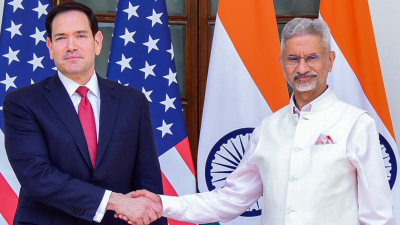
India and the United States signed a landmark bilateral framework agreement to deepen cooperation in mining, processing, and recycling critical minerals and rare earth elements. Finalized in New Delhi during a visit by the US Secretary of State, the “Framework on Securing of Supply in the Mining and Processing of Critical Minerals and Rare Earths” acts to shield essential industrial pipelines from unilateral export bans and single-source market monopolies. This agreement directly builds upon diplomatic commitments from the February 2025 bilateral summit and advances India’s integration into allied technology networks like Pax Silica and the Forum on Resource Geostrategic Engagement (FORGE).
Core Objectives and Operational Pillars
Supply Chain Resilience and Processing
The framework focuses on securing the entire value chain of critical minerals, transitioning from raw extraction to advanced refining. China currently controls nearly 90% of global rare earth processing and major shares of graphite, manganese, cobalt, and lithium refining. The agreement establishes collaborative channels to scale up processing capacities within India and the US, ensuring that foundational elements for green energy, semiconductors, and defense remain within a trusted network.
Financial and Scrap Management Collaboration
To match the high capital expenditure required for mineral processing, the framework sets up institutional mechanisms for joint financing and investment. This includes co-investments from public and private sectors to establish commercial mining and refining facilities. A major focus is the extraction of valuable materials from scrap through industrial recycling, promoting “urban mining” to recover lithium, cobalt, and rare earths from heavy industrial waste in aluminum, coal, and oil sectors.
Interoperability and Multilateral Alignment
The bilateral pact works in tandem with the Quad Critical Minerals Initiative, which aims to mobilize up to $20 billion through loans, guarantees, and subsidies among India, the US, Japan, and Australia. The partnership establishes uniform regulatory, technical, and licensing standards across the Indo-Pacific region to prevent market vulnerabilities.
Strategic Plurilateral Integrations
Pax Silica Initiative
India joined this US-led coalition of twelve participating nations to secure the artificial intelligence (AI) technological stack. Pax Silica links mineral processing directly with hardware infrastructure, semiconductor fabrication, and data center logistics.
Forum on Resource Geostrategic Engagement (FORGE)
Launched in Washington, FORGE serves as a project-level international platform where partner countries coordinate policy and deploy capital. It aims to fix failures in the international mineral market by building alternative commercial supply routes outside single-country dominance.
| Strategic Initiative | Launch / India’s Entry | Core Mandate | Financial / Project Target |
| Pax Silica | Launched Dec 2025; India joined Feb 2026 | Secure the full AI stack (minerals, chips, 6G, hardware) | $250 Million Pax Silica Fund for processing assets |
| FORGE | Established Feb 2026 | Plurilateral policy coordination and marketplace creation | Part of a $30 Billion US mineral mobilization pool |
| Quad Critical Minerals Initiative | Formed July 2025 | Joint tracking of unfair trade practices and recycling | $20 Billion combined public-private investment target |
Domestic Capacity and Resource Profiles
The National Critical Minerals Mission (NCMM)
To match international frameworks, India operates the National Critical Minerals Mission with an allocation of ₹16,300 crore spanning from FY25 to FY31. The mission targets self-reliance by funding domestic exploration, processing incentives, and deep-tech recycling clusters.
Rare Earth Corridors
India has introduced dedicated rare earth corridors across four coastal states:
- Odisha
- Kerala
- Andhra Pradesh
- Tamil Nadu
These corridors optimize the processing of monazite sands to manufacture high-performance permanent magnets used in electric vehicles (EVs) and wind turbines. Currently, India possesses over 13 million tonnes of monazite reserves but produces only four primary critical minerals at scale: copper, graphite, phosphorous, and titanium. The US framework intends to bridge this technology gap.
IASPOINT Booster Facts for UPSC
- Mineral Security Partnership (MSP): India joined the US-led 14-nation MSP coalition in 2023. The new 2026 Critical Minerals Framework is a legally separate bilateral agreement that accelerates project-specific executions between New Delhi and Washington.
- Geopolitical Trigger: The conclusion of this framework follows systemic supply chain strains caused when China imposed a strict licensing regime and choked the export of rare earth magnets.
- Domestic Identification: The Ministry of Mines officially recognizes a list of 30 critical minerals essential for India’s economic growth and national defense, including lithium, beryllium, niobium, and tantalum.
- Strategic Mineral Recovery Initiative: Launched under the bilateral TRUST (Transforming the Relationship Utilising Strategic Technology) framework, this specific sub-program focuses on extracting tech-critical elements out of industrial byproducts.
- FDI Policy Calibrations: India fast-tracked its investment regulations by creating a 60-day clearance window for specified high-tech sectors, including polysilicon and rare earth magnets, coming from Land Bordering Countries (LBCs) to attract transparent global processing capital.