
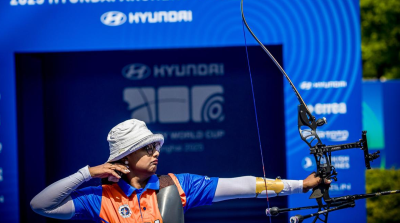
The Indian women’s recurve archery team advanced to the final of the Archery World Cup 2026 Stage 2 in Shanghai after registering a dominant 5-1 victory over global powerhouse South Korea in the semi-finals. The Indian trio consisting of Deepika Kumari, Ankita Bhakat, and Kumkum Mohod secured the country’s first medal of the tournament. Following this historic semi-final performance, the team faced hosts China in the gold medal match on May 10, 2026, where they clinched the gold medal in a dramatic shoot-off. Conversely, the Indian men’s recurve campaign faced an early setback with a 2-6 opening-round defeat against Bangladesh.
India’s Historic Campaign at Shanghai 2026
The Indian women’s recurve team delivered a historic performance by conquering the world’s most successful archery nations sequentially to secure the pinnacle podium finish.
Semi-Final Triumph Over South Korea
- The Victory: India defeated top-seeded South Korea with a definitive 5-1 scoreline.
- The Opposition: South Korea is the most dominant nation in Olympic archery history, holding ten consecutive Olympic gold medals in the women’s team discipline.
- Korean Line-up: The squad combined veteran world champion Kang Chaeyoung alongside emerging debutants Lee Yunji and Oh Yejin.
Gold Medal Match Against China
- The Final: India clashed with second-seeded China on May 10, 2026.
- Match Progression: The four-set regulation ended in a 4-4 tie, forcing a high-pressure shoot-off.
- The Shoot-off: The Indian trio held their nerve to win the tie-breaker 28-26, securing India’s first women’s recurve team World Cup gold medal since 2021.
- Individual Milestones: The victory marked the 39th World Cup medal for Deepika Kumari, the eighth for Ankita Bhakat, and the maiden international medal for 17-year-old Kumkum Mohod.
Core Disciplines in International Archery
International events governed by World Archery feature distinct technical categories, with recurve being the sole format included in the Olympic Games program.
| Feature / Metric | Recurve Archery (Olympic Discipline) | Compound Archery (Non-Olympic Discipline) |
| Bow Mechanics | Limbs curve away from the archer when unstrung; manual draw weight. | Utilizes a system of pulleys, cams, and cables to reduce hold weight. |
| Target Distance | Standardized at 70 meters. | Standardized at 50 meters. |
| Target Face Size | 122 cm diameter with a 10-ring of 12.2 cm. | 80 cm diameter; outer rings are often removed in finals. |
| Release Mechanism | Manual finger release using a finger tab. | Mechanical release aid triggered by thumb or wrist. |
| Sighting System | Simple open sight without magnification or peep sights. | Magnifying scope lens and a peep sight embedded in the string. |
Institutional Framework of Global Archery
The systematic execution of international archery events relies on a tiered tournament structure managed by the global apex body.
World Archery Federation
World Archery is the international governing body for the sport of archery. Headquartered in Lausanne, Switzerland, it regulates both Olympic and non-Olympic disciplines, establishes technical rules, and manages global ranking systems.
The Archery World Cup Structure
The Archery World Cup is an annual circuit comprising four distinct stages hosted across different nations, culminating in a grand World Cup Final.
- Stage Venues: The 2026 circuit scheduled key stages in world-class sporting hubs including Shanghai (China), Antalya (Türkiye), and Madrid (Spain).
- Qualification Rules: Individual stage winners in both compound and recurve categories earn direct qualification berths for the season-ending World Cup Final.
International Match Format
Team events utilize a set system where squads of three archers shoot six arrows per set (two per archer). The team with the higher score in a set receives two points, while a tie awards one point to each. The first team to accumulate five set points wins the match. If tied at 4-4, a three-arrow shoot-off determines the winner.
IASPOINT Booster Facts for UPSC
- National Governing Body: Archery in India is administered by the Archery Association of India (AAI), which is recognized by the Ministry of Youth Affairs and Sports.
- Deepika Kumari’s Milestone: With this gold medal, Deepika Kumari equaled compound archer Jyothi Surekha Vennam’s national record for the most World Cup titles won by an Indian archer.
- Olympic Inclusion History: Archery made its debut at the Paris 1900 Olympic Games. It was removed after 1920 but was permanently reintroduced to the Olympic program at the Munich 1972 Games.
- Target Ring Dimensions: The standard 122 cm recurve target consists of 10 concentric scoring rings divided into five colors: Gold (9-10 points), Red (7-8 points), Blue (5-6 points), Black (3-4 points), and White (1-2 points). The dead-center ring is designated as the ‘X’ ring, used primarily to break ties.