
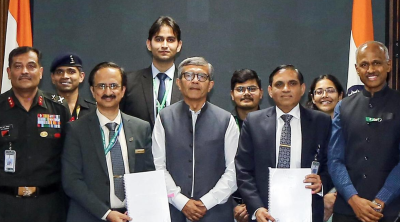
The Ministry of Defence signed a ₹1,476 crore contract with Bharat Electronics Limited on 5 May 2026 for the procurement of five ground-based Mobile Electronic Systems for the Indian Army. Designed and developed indigenously by the Defence Electronics Research Laboratory in Hyderabad, these systems will modernize the electronic warfare, surveillance, and communication interception capabilities of the armed forces. The procurement follows the Buy (Indian–Indigenously Designed, Developed and Manufactured) category rules, requiring a minimum of 72 percent indigenous content. The contract was signed at Kartavya Bhawan-2 in New Delhi in the presence of Defence Secretary Rajesh Kumar Singh, supporting national self-reliance initiatives.
Ground-Based Mobile Electronic Systems
The newly contracted Ground-Based Mobile Electronic Systems (GBMES) operate as vehicle-mounted electronic intelligence platforms. These systems analyze and counter threat vectors across the electromagnetic spectrum.
Key Technical Functions
- Radar Detection and Tracking: Scans, intercepts, and identifies electromagnetic emissions from enemy air defence units, missile batteries, and surveillance radars.
- Signal Interception: Intercepts and decodes communication signals to gather tactical intelligence in real time.
- Direction Finding and Mapping: Uses advanced digital receivers for precise direction finding and creates 3D situational awareness maps.
- Radar Fingerprinting: Identifies specific radar emitters by analyzing unique signal signatures and logs this information for future tactical use.
Operational Architecture
The GBMES functions through a networked infrastructure to maintain continuous operations during combat:
- Receiving Stations (RS): Comprises three units tasked with signal collection and interception. One unit serves as a backup control center.
- Control Station (CS): Consists of one central node that processes gathered intelligence and manages the network.
- Radio Links: Uses repeater radio links to extend operational range and maintain network connectivity across diverse terrains.
Defence Procurement Framework
The contract adheres strictly to the guidelines established under the Defence Acquisition Procedure (DAP).
Capital Acquisition Categorization
The procurement falls under the Buy (Indian-IDDM) category, which occupies the highest priority in the defence procurement hierarchy.
| Parameter | Specifications |
| Procuring Agency | Ministry of Defence, Government of India |
| Manufacturing Agency | Bharat Electronics Limited (BEL), Hyderabad |
| Designing Agency | Defence Electronics Research Laboratory (DLRL) |
| Total Project Value | ₹1,476 crore |
| Quantity Ordered | 5 Systems |
| Indigenous Content Mandate | Minimum 72 percent |
| Primary Beneficiary | Indian Army |
Institutional Ecosystem
The development and production of these electronic warfare systems involve specialized public sector and research institutions.
Defence Electronics Research Laboratory (DLRL)
- Established in 1961 in Hyderabad under the Defence Research and Development Organisation (DRDO).
- Mandated with the primary responsibility to design and develop Electronic Warfare (EW) suites, including Electronic Support Measures (ESM) and Electronic Counter Measures (ECM).
- Covers both radar and communication frequency bands for the tri-services (Army, Navy, and Air Force).
Bharat Electronics Limited (BEL)
- A Navratna Defence Public Sector Undertaking (DPSU) under the Ministry of Defence.
- Acts as the primary production agency for advanced radar systems, tactical communication units, and electronic intelligence platforms.
- Engages domestic micro, small, and medium enterprises (MSMEs) within its component supply chain to manufacture the final systems.
IASPOINT Booster Facts for UPSC
- Electronic Intelligence (ELINT): Refers to the collection and analysis of non-communication electromagnetic radiations, primarily from enemy radar systems.
- Electronic Support Measures (ESM): The division of electronic warfare involving actions taken to search for, intercept, identify, and locate sources of intentional and unintentional radiated electromagnetic energy for immediate threat recognition.
- Buy (Indian-IDDM): This category requires products to be designed, developed, and manufactured indigenously with at least 50% Indigenous Content (IC) on an indigenous design, or at least 60% IC if the design is not indigenously developed. The GBMES contract exceeds this minimum by mandating 72% IC.
- Navratna Status: BEL holds Navratna status, granting the public sector enterprise financial autonomy to invest up to ₹1,000 crore or 15% of its net worth on a single project without prior central government approval.
- Other Recent BEL Orders: In March 2026, the Ministry of Defence signed a separate ₹1,950 crore capital acquisition contract with BEL to procure two Mountain Radars for the Indian Air Force to improve surveillance along mountainous borders.