
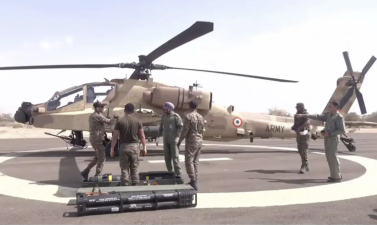
The Indian Army recently demonstrated the combat capabilities of its Apache attack helicopters during the Brahmastra exercise held in Jaisalmer. This exercise marked a significant milestone in integrating advanced aerial firepower into the Army’s operational framework. The Brahmastra exercise aimed to validate the synergy between different military arms and enhance combat readiness along the western frontier.
Apache Helicopters: Features and Capabilities
The Apache attack helicopter is a state-of-the-art combat platform equipped with advanced avionics, sensors, and weaponry. It is capable of precision strikes against ground targets, including tanks, bunkers, and enemy personnel. The helicopter is armed with Hellfire missiles, Hydra rockets, and a 30mm chain gun, making it a formidable asset in both offensive and defensive operations. Its night vision and targeting systems allow for effective operations in all weather conditions.
Significance of Brahmastra Exercise
The Brahmastra exercise is designed to test the integration of new technologies and tactics in a simulated combat environment. The inclusion of Apache helicopters adds a new dimension to the Indian Army’s strike capabilities. The exercise emphasised joint operations between ground forces and aerial units, improving coordination and communication. It also provided an opportunity to assess the helicopters’ performance in desert terrain, which is crucial for operations in the western border areas.
Strategic Importance for India’s Defence
The deployment of Apache helicopters enhances India’s deterrence posture along the western borders with Pakistan. These helicopters provide a rapid response capability and can neutralise enemy threats before they escalate. Their presence complements existing artillery and armoured units, creating a multi-layered defence system. The Brahmastra exercise underlines India’s focus on modernising its armed forces with cutting-edge technology to maintain operational superiority.
Future Prospects and Induction Plans
The Indian Army plans to induct more Apache helicopters in the coming years to bolster its attack helicopter fleet. Training programmes are being expanded to familiarise pilots and ground crews with the complex systems onboard. Continued exercises like Brahmastra will help refine tactics and ensure the effective utilisation of Apache firepower. This move aligns with India’s broader defence modernisation strategy aimed at enhancing rapid deployment and precision strike capabilities.
What to Study for UPSC Exams?
- Attack Helicopter Technologies
- Joint Military Exercises in India
- India-Pakistan Border Security
- Defence Modernisation Policies
- Desert Warfare Tactics
Attack Helicopter Technologies
Attack helicopters combine advanced avionics, targeting systems, and weaponry like Hellfire missiles and 30mm chain guns for precision strikes. They feature night vision and all-weather capabilities. The first dedicated attack helicopter was the Bell AH-1 Cobra, introduced during the Vietnam War. Modern models emphasize agility, survivability, and network-centric warfare integration, enabling simultaneous multi-target engagement and real-time battlefield data sharing.
Joint Military Exercises in India
India conducts joint exercises with various countries, including the US (Yudh Abhyas), Russia (Indra), and Japan (Dharma Guardian). These exercises enhance interoperability, tactical coordination, and strategic partnerships. India also runs large-scale domestic exercises like Brahmastra to integrate army, air force, and navy capabilities. Joint drills often simulate counterterrorism, amphibious assault, and high-altitude warfare scenarios.
India-Pakistan Border Security
The India-Pakistan border spans approximately 3,323 km, including the Line of Control (LoC) in Kashmir. It is one of the most militarized borders globally, featuring fencing, surveillance systems, and frequent troop deployments. Cross-border ceasefire agreements have been intermittently observed since 2003. The border sees regular infiltration attempts and artillery exchanges, especially in Jammu and Kashmir’s conflict zones.
Defence Modernisation Policies
India’s defence modernisation focuses on indigenization under initiatives like Make in India and Atmanirbhar Bharat. It aims to upgrade technology, enhance domestic production, and reduce import dependency. The Defence Acquisition Procedure (DAP) governs procurement processes emphasizing transparency and efficiency. Investments target advanced weaponry, cyber warfare, space capabilities, and network-centric operations.
Desert Warfare Tactics
Desert warfare involves combat in arid, sandy environments with extreme temperatures and limited water. Tactics emphasize mobility, camouflage, and rapid maneuvering to exploit terrain openness. Forces use specialized vehicles and equipment to handle sand, dust, and heat. Historically, desert warfare saw innovations in logistics and mechanized units, notably during World War II’s North African Campaign.
Last Modified: April 10, 2026