
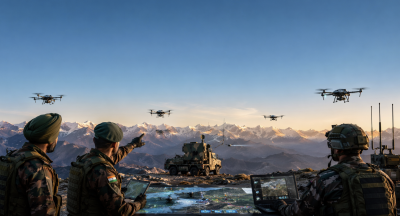
The Indian Army has released a comprehensive Technology Roadmap for Unmanned Aerial Systems (UAS) and Loitering Munitions (LM) to enhance its operational capabilities. This strategic document outlines the army’s long-term requirements for drone technology, reflecting the growing importance of unmanned systems in modern warfare. The roadmap aims to align the efforts of industry, research institutions, and academia with the army’s operational needs, promoting indigenous development and innovation in defence technology.
Key Objectives of the Technology Roadmap
The roadmap seeks to expand the use of drones in both combat and support roles. Combat applications include countering hostile drones, deploying loitering munitions for persistent strikes, and employing helicopter-launched littoral systems for coastal defence. Other combat roles involve bomb delivery drones for precision attacks and mine-laying drones for remote area denial. On the support side, drones will be used for reconnaissance, land surveying, electromagnetic jamming, radio relay to extend communication, and long-range logistics for supply and resupply missions. The document emphasises adapting these technologies for diverse terrains, from the Himalayas to the Andaman and Nicobar Islands.
Integration with Domestic Defence Industry
A significant focus of the roadmap is to boost the domestic defence ecosystem, particularly the drone manufacturing sector. The Indian Army aims to foster collaboration among micro, small, and medium enterprises (MSMEs), start-ups, and established defence firms. By providing clear guidance on priority areas, the roadmap intends to channel investments and research efforts towards indigenous solutions that meet the army’s operational requirements. This approach supports the government’s broader goal of self-reliance in defence technology under the Atmanirbhar Bharat initiative.
UPSC Exam Oriented Topics
- Unmanned Aerial Systems in Modern Warfare
- Defence Industrial Corridors in India
- Electronic Warfare and Spectrum Management
- Geostrategic Importance of Andaman & Nicobar Islands
- Role of MSMEs in Defence Manufacturing
Operational Challenges and Future Prospects
The deployment of UAS and loitering munitions presents challenges such as ensuring secure communication links, countering enemy electronic warfare, and adapting technology for extreme environments. The roadmap highlights the need for robust research and development to overcome these challenges. Future prospects include integrating artificial intelligence for autonomous operations and enhancing interoperability with other branches of the armed forces. The Indian Army’s initiative marks a significant step towards modernising its combat capabilities and strengthening India’s position in drone warfare technology.
UPSC Exam Oriented Topics
Unmanned Aerial Systems in Modern Warfare
Unmanned Aerial Systems (UAS) are remotely piloted or autonomous aircraft used for surveillance, reconnaissance, and combat roles. They include drones and loitering munitions capable of precision strikes and persistent area denial. UAS enhance battlefield awareness, reduce soldier risk, and enable long-range logistics. Modern warfare increasingly relies on UAS for electronic warfare, communication relay, and mine-laying. Challenges include secure communication, countering enemy jamming, and operation in diverse terrains. Integration with AI is advancing autonomy and decision-making capabilities. Countries worldwide are investing heavily in UAS to maintain strategic and tactical advantages.
Defence Industrial Corridors in India
Defence Industrial Corridors are designated zones promoting defence manufacturing through infrastructure, investment, and innovation. India has established corridors in Uttar Pradesh and Tamil Nadu to boost indigenous defence production. These corridors aim to attract domestic and foreign investments, foster MSMEs and startups, and reduce import dependence. They facilitate technology transfer and create employment while supporting the Atmanirbhar Bharat initiative. The corridors integrate with broader industrial policies and defense R&D institutions to enhance self-reliance. They are key to achieving strategic autonomy in defence capabilities.
Electronic Warfare and Spectrum Management
Electronic Warfare (EW) involves using the electromagnetic spectrum to disrupt enemy communication, radar, and sensors while protecting friendly systems. EW includes jamming, electronic deception, and electronic protection measures. Spectrum management ensures optimal allocation and use of frequencies for military and civilian applications. Modern EW faces challenges from sophisticated enemy countermeasures and requires secure, resilient communication links. Integration with unmanned systems enhances battlefield control. National policies regulate spectrum use to prevent interference and ensure cybersecurity. EW is critical in modern multi-domain operations.
Geostrategic Importance of Andaman & Nicobar Islands
The Andaman & Nicobar Islands are a strategic archipelago in the Bay of Bengal, near key maritime routes like the Malacca Strait. They provide India with a forward military presence to monitor Indo-Pacific shipping lanes. The islands host naval and air bases crucial for surveillance, anti-piracy, and maritime security. Their location enables power projection and rapid response in the Indian Ocean Region. The terrain and weather pose operational challenges but also offer strategic depth. The islands are central to India’s Act East policy and regional security partnerships.
Role of MSMEs in Defence Manufacturing
Micro, Small, and Medium Enterprises (MSMEs) contribute significantly to defence manufacturing by supplying components, sub-systems, and innovative technologies. MSMEs enhance agility, cost-effectiveness, and localized production. They collaborate with large defence firms, startups, and research institutions. Government initiatives promote MSME participation through funding, technology support, and priority sector status under Atmanirbhar Bharat. MSMEs help diversify the defence industrial base and reduce import dependence. Challenges include access to capital, technology, and quality certification. Strengthening MSMEs is vital for sustainable defence ecosystem growth.
Last Modified: April 7, 2026