
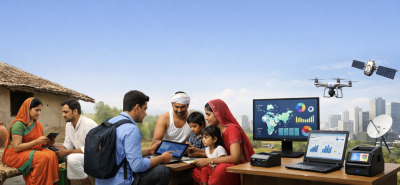
The Union Home Minister Amit Shah recently soft-launched digital tools and two mascots for India’s Census 2027. This census will be the first fully digital enumeration exercise in India. It is also expected to be the world’s largest census. The event marked step in modernising census operations using advanced technology.
Digital Innovations in Census 2027
Four new digital platforms were revealed to streamline the census process. These include a web-mapping tool for creating houselisting blocks using satellite imagery. A mobile app will help enumerators collect data offline and upload it securely. Citizens can now self-enumerate their household data online in 16 languages before field visits. A centralised dashboard will enable real-time monitoring of census activities at all administrative levels. These tools aim to reduce paperwork, improve efficiency and increase transparency.
Two-Phase Census Process
The census will be conducted in two phases. Phase 1, from April to September 2026, will focus on housing and household amenities. It includes a 15-day window for voluntary online self-enumeration before door-to-door surveys begin. Phase 2, scheduled for February 2027, will collect detailed demographic, social and economic information. In snow-bound regions like Ladakh and parts of Jammu and Kashmir, enumeration will be earlier, in September 2026. The census will also include a caste-related question. The reference date is March 1, 2027, except for snow-bound areas where it is October 1, 2026.
Mascots and Public Awareness
Two mascots named Pragati and Vikas were introduced as symbols of equal participation of women and men in the census. Pragati represents a female enumerator and Vikas a male enumerator. They will be used in campaigns to raise public awareness about the census and its importance for India’s development goals by 2047.
Significance of the Digital Census
This census marks a leap towards digital governance. It will involve over three million officials across India. The use of digital platforms is expected to speed up data collection and improve accuracy. It also empowers citizens by allowing self-reporting. The Census 2027 sets a precedent for future large-scale data collection exercises in India and globally.
Topics for Prelims:
Digital Tools for Census
- Houselisting Block Creator uses satellite imagery for mapping.
- HLO Mobile App collects offline data securely.
- Self-Enumeration Portal allows online data submission in 16 languages.
- Census Management and Monitoring System provides real-time activity tracking.
- Tools reduce paperwork and enhance transparency.
Mascots Pragati and Vikas
- Pragati represents female enumerators.
- Vikas represents male enumerators.
- Symbols of gender equality in census work.
- Used in public awareness campaigns.
- Promote census participation for India’s development.
Census 2027 Phases and Dates
- Phase 1 – Houselisting and housing data, April-Sept 2026.
- Phase 2 – Population enumeration, February 2027.
- Snow-bound areas enumerated in Sept 2026.
- Reference date March 1, 2027, or Oct 1, 2026 for snow areas.
- Includes caste-related questions in Phase 2.
Questions for Mains:
- Critically analyse the impact of digital technology on large-scale government data collection exercises like Census 2027 in India. [GS-III-Science & Technology]
- Comment on the role of gender representation symbols such as mascots in public awareness campaigns for national missions, with examples from Census 2027. [GS-II-Governance]
- Explain the challenges and advantages of conducting a two-phase census in diverse geographic and climatic conditions, citing Census 2027 as a case study. [GS-I-World & Physical Geography]
- What are the implications of including caste-related questions in the Census 2027 for social justice and policy formulation in India? How can census data support inclusive development? [GS-II-Social Justice]
Answer Hints:
1. Critically analyse the impact of digital technology on large-scale government data collection exercises like Census 2027 in India. [GS-III-Science & Technology]
- Introduction of digital tools (web-mapping, mobile app, self-enumeration portal, monitoring dashboard) modernises data collection.
- Enhances accuracy and real-time monitoring, reducing human errors and delays in data processing.
- Self-enumeration empowers citizens, improves data authenticity, and reduces enumerator workload.
- Challenges include digital divide, data security concerns, and training of millions of officials.
- Reduction in paperwork leads to environmental benefits and administrative efficiency.
- Sets precedent for future digital governance initiatives and large-scale data exercises globally.
2. Comment on the role of gender representation symbols such as mascots in public awareness campaigns for national missions, with examples from Census 2027. [GS-II-Governance]
- Mascots Pragati (female) and Vikas (male) symbolize gender equality and inclusive participation.
- Humanize and personalize government campaigns, making them relatable and memorable.
- Promote awareness and motivate participation across diverse demographics.
- Help break stereotypes by showcasing equal roles of women and men in national missions.
- Serve as effective tools in outreach, especially in rural and semi-urban areas.
- Reflect government’s commitment to gender sensitization in governance initiatives.
3. Explain the challenges and advantages of conducting a two-phase census in diverse geographic and climatic conditions, citing Census 2027 as a case study. [GS-I-World & Physical Geography]
- Two phases – Phase 1 (housing data) and Phase 2 (population data) allow focused data collection and better resource allocation.
- Accommodates diverse climatic conditions by scheduling snow-bound areas earlier (Sept 2026) than rest of India (Feb 2027).
- Challenges include logistical complexity, coordination across states, and ensuring data consistency across phases.
- Phased approach enables use of self-enumeration before door-to-door surveys, improving efficiency.
- Improves data quality by allowing verification and cross-checking between phases.
- Addresses geographic diversity ensuring no region is excluded due to weather or terrain.
4. What are the implications of including caste-related questions in the Census 2027 for social justice and policy formulation in India? How can census data support inclusive development? [GS-II-Social Justice]
- Provides updated, comprehensive data on caste demographics after decades, aiding evidence-based policy making.
- Enables targeted welfare schemes and affirmative action for marginalized communities.
- Helps identify socio-economic disparities and monitor progress on social justice goals.
- May raise concerns about privacy and potential misuse; requires strict data protection measures.
- Supports inclusive development by informing resource allocation and social reforms.
- Facilitates better understanding of social dynamics, aiding conflict resolution and social cohesion.