
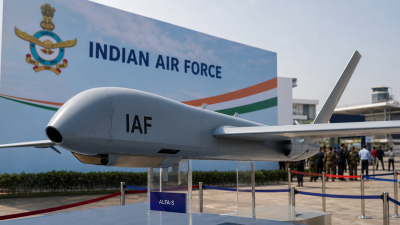
On 17 June 2026 the Indian Air Force launched a project to jointly develop indigenous long‑range kamikaze drones (one‑way attack unmanned aerial systems) with domestic industry.
Project Overview
- Platform type: Fixed‑wing, self‑sacrificing unmanned aerial systems (OWA‑UAS/loitering munitions).
- Objective: Establish fully indigenous ecosystem for design, development, manufacturing and sustainment.
- Tendering: Limited tender issued to select Indian companies for development contracts.
- Intellectual Property: IAF intends to retain platform IPR to enable in‑service upgrades and operational customisation.
Key Technical Requirements
- Operating envelope: Capable of operations up to 16,000 ft and in day‑and‑night conditions.
- Payload: Modular payload capacity of at least 30 kg supporting precision‑strike and sensor configurations.
- Mission modes: Multiple mission configurations envisaged — precision‑strike, sensor/ISR and plug‑and‑play payloads.
Procurement, Industry & Security
- Nodal agency: 5 Base Repair Depot (5 BRD), Sulur (near Coimbatore, Tamil Nadu) designated nodal agency.
- Supply‑chain constraint: Project mandates exclusion of Chinese‑origin technology, components and materials.
- Acquisition model: IAF direct role in design/development marks a shift from conventional buy‑and‑fit procurement.
IASPOINT Booster Facts
- Terminology: Loitering munitions ≡ one‑way attack UAS; combine target search, identification and terminal attack in a single expendable platform.
- Fixed‑wing vs rotary‑wing: Fixed‑wing designs generally offer higher range and endurance suitable for long‑range strike.