
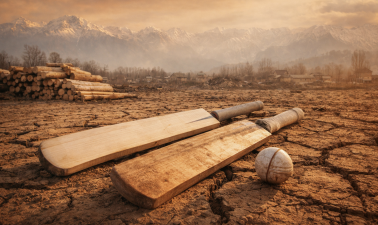
The Kashmir cricket bat industry is facing a severe threat due to climate change and environmental degradation. Traditionally reliant on willow plantations along streams and wetlands, the sector now struggles with declining raw material supplies. Reduced snowfall and water scarcity have led to drying of natural habitats, impacting willow growth and bat production.
Impact of Climate Change on Willow
Kashmir’s willow trees (Salix alba) require moist soil and moderate temperatures. Rising temperatures and reduced precipitation have caused drying of streams and wetlands. This has led to a sharp decline in natural willow plantations, especially in south Kashmir. The lack of snowfall during winters has disrupted the natural water cycle, worsening the situation. Willow wood quality deteriorates when grown on dry land, making it unsuitable for bat manufacturing.
Economic and Social Consequences
The bat industry employs around 1.5 lakh people directly or indirectly. Declining willow availability has reduced production capacity and employment. Many units now operate with fewer workers. The shortage of raw material risks shutting down numerous manufacturing units within a few years. The crisis threatens the livelihoods of craftsmen, traders, and labourers linked to this traditional industry.
Comparison with English Willow and Industry Challenges
English willow is cultivated in farms with controlled conditions, producing consistent and high-quality wood. Kashmir willow grows naturally with varied grain patterns and lacks professional seasoning facilities. Despite this, Kashmir willow bats are affordable and have gained international recognition. However, shrinking plantation areas and preference for faster-growing species like poplar have further reduced willow cultivation.
Need for Policy and Environmental Intervention
Experts call for a plantation policy to protect and restore willow habitats. Legal protection similar to other indigenous trees is suggested. Financial incentives and long-term support are essential for farmers to invest in willow cultivation. Experimental irrigation methods show promise but require scale and policy backing. Willow also plays an ecological role as a carbon sink, linking economic and environmental benefits.
Topics for Prelims:
Salix Alba (Willow)
- Primary wood used in Kashmir cricket bats.
- Requires moist soil and moderate temperatures (20-25°C).
- Grows naturally along streams and wetlands.
- Has a shallow root system dependent on surface water.
- Functions as an effective carbon sink over 20-30 years.
Kashmir Cricket Bat Industry
- Produces about 3 million bats annually.
- Employs around 1.5 lakh people directly or indirectly.
- Centre located in Sangam, south Kashmir.
- Facing raw material shortage due to climate change.
- GR8 is the only ICC-approved bat manufacturer in Kashmir.
Climate Change Effects in Kashmir
- Reduced snowfall and rainfall in recent winters.
- Increase in average temperature by 2.5°C over 25 years.
- Drying of streams and wetlands.
- Shift from willow to drought-resistant species like poplar.
- Impact on traditional livelihoods and local economy.
Questions for Mains:
- Discuss in the light of climate change how traditional industries dependent on natural resources are vulnerable, taking the example of Kashmir’s cricket bat industry. [GS-III-Economic Development]
- Analyse the role of indigenous tree species like Salix alba in ecological balance and livelihood support, and examine the challenges in their conservation in the context of Kashmir. [GS-III-Environment & Disaster Management]
- With suitable examples, discuss the impact of changing climatic patterns on water resources and agricultural practices in mountainous regions. Critically discuss policy measures needed to mitigate these effects. [GS-III-Environment & Disaster Management]
- Examine the socio-economic consequences of declining traditional crafts in India due to environmental degradation and globalisation, and discuss strategies for sustainable revival. [GS-I-Indian Society]
Answer Hints:
1. Discuss in the light of climate change how traditional industries dependent on natural resources are vulnerable, taking the example of Kashmir’s cricket bat industry. [GS-III-Economic Development]
- Dependence on natural resources – Kashmir bat industry relies on Salix alba willow from moist stream banks and wetlands.
- Climate change impacts – Reduced snowfall, rainfall, and rising temperatures causing drying of streams and decline in willow plantations.
- Raw material shortage – 75% decline in willow supply over 4 years, forcing units to reduce workforce or shut down.
- Economic vulnerability – Industry employs 1.5 lakh people; livelihoods threatened by resource depletion.
- Adaptation challenges – Lack of plantation policy, farmers shifting to fast-growing species like poplar for quicker returns.
- Need for intervention – Policy support, sustainable resource management, and climate-resilient cultivation techniques essential.
2. Analyse the role of indigenous tree species like Salix alba in ecological balance and livelihood support, and examine the challenges in their conservation in the context of Kashmir. [GS-III-Environment & Disaster Management]
- Ecological role – Salix alba acts as a carbon sink over 20-30 years, supports water retention and biodiversity in riparian zones.
- Livelihood support – Primary raw material for Kashmir’s cricket bat industry, sustaining 1.5 lakh people directly or indirectly.
- Conservation challenges – Declining natural habitats due to climate change (temperature rise, water scarcity), land fragmentation, and preference for other species.
- Legal protection gap – Unlike walnut/chinar, willow lacks regulatory safeguards against felling and encroachment.
- Economic disincentives – Long maturation period (~20 years) without assured water or financial support deters farmers.
- Potential solutions – Plantation policies, delineation of cultivation zones, financial incentives, irrigation support, and NGO involvement.
3. With suitable examples, discuss the impact of changing climatic patterns on water resources and agricultural practices in mountainous regions. Critically discuss policy measures needed to mitigate these effects. [GS-III-Environment & Disaster Management]
- Impact on water resources – Reduced snowfall and rainfall causing drying of streams, wetlands, and groundwater depletion (e.g., Kashmir’s willow plantations).
- Agricultural shifts – Farmers abandoning water-intensive crops (willow) for drought-resistant, fast-growing species like poplar due to water scarcity.
- Economic consequences – Decline in traditional agro-based industries; loss of quality produce (willow wood) affecting livelihoods.
- Examples – Kashmir’s cricket bat industry crisis; Himalayan farming communities facing altered crop patterns.
- Policy measures – Integrated watershed management, promotion of climate-resilient crops, financial incentives for sustainable practices, and investment in irrigation (e.g., drip irrigation experiments in Kashmir).
- Need for long-term planning – Land-use regulation, afforestation, community participation, and climate adaptation frameworks.
4. Examine the socio-economic consequences of declining traditional crafts in India due to environmental degradation and globalisation, and discuss strategies for sustainable revival. [GS-I-Indian Society]
- Socio-economic consequences – Loss of livelihoods for artisans and associated workers; cultural erosion; migration and unemployment (e.g., Kashmir bat industry losing jobs due to willow shortage).
- Environmental degradation – Decline in raw materials from natural habitats due to climate change, deforestation, and unsustainable land use.
- Globalisation impacts – Competition from mass-produced goods, changing consumer preferences, and market access challenges.
- Revival strategies – Policy support for resource conservation, skill development, branding and Geographical Indications (GI) for traditional crafts.
- Market interventions – Promotion of eco-friendly products, linking artisans to global value chains, and financial/institutional support.
- Community and government role – Awareness campaigns, infrastructure for quality improvement (e.g., seasoning facilities for Kashmir willow), and sustainable resource management.