
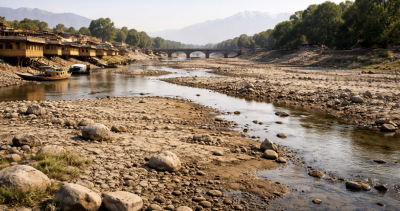
Recent reports from early 2026 reveal an unprecedented environmental situation in Kashmir. The Jhelum River, vital for the region’s ecology and agriculture, has fallen below its zero-gauge level in early March. Simultaneously, temperatures soared to record highs, disrupting the usual seasonal patterns. This combination of low water levels and unusual heat poses serious challenges for Kashmir’s water resources and farming.
Unusual Weather Patterns in Kashmir
The Kashmir Valley experienced one of its warmest early springs in decades. Srinagar recorded temperatures nearly 12°C above normal while Gulmarg hit its highest March temperature ever at 17.2°C. Despite the heat, precipitation was drastically low. Kashmir saw its seventh consecutive winter with rainfall below normal by nearly 65%. February was among the driest in over a century. The lack of snow and rain has disrupted the natural water cycle.
Impact on Jhelum River and Water Resources
The Jhelum River’s water level dropped to minus 0.86 feet at Sangam, an unusual early March occurrence. Normally, snowmelt raises river levels during this time. Scientists noted that snowpack in the mountains is very low. This reduces meltwater flow into the river. The shift from snowfall to rain in winter months further weakens glacier recharge. Rising temperatures increase evaporation, further reducing water availability.
Effects on Agriculture and Local Livelihoods
Kashmir’s agriculture, especially paddy farming, depends heavily on river water. Farmers report shifts in planting seasons and irrigation challenges due to low river flows. Sand mining along the river has worsened water access by damaging embankments and deepening riverbeds. Agricultural experts advise shifting from water-intensive crops to more resilient varieties and adopting water-saving techniques like drip irrigation and mulching to conserve soil moisture.
Scientific Observations and Future Concerns
Long-term studies confirm glacier retreat in Kashmir, with an 18% loss in glaciated area from 1980 to 2013. Experts warn that the altered hydrological cycle will continue to affect water availability. Increased evaporation and reduced snowfall threaten the region’s water security. Researchers are investigating why meltwater is not fully reaching rivers, suspecting heat-driven evaporation. Adaptation strategies are urgently needed for sustainable water and crop management.
Topics for Prelims:
Jhelum River
- Flows through Kashmir Valley and is a major water source.
- Depends on snowmelt and glaciers for seasonal flow.
- Water level dropped below zero-gauge in March 2026.
- River affected by sand mining and embankment damage.
- Vital for irrigation and local livelihoods.
Kashmir Climate Changes
- Experiencing record high temperatures in early spring.
- Seven consecutive winters with rainfall deficit.
- Shift from snowfall to rain in winter months.
- Increased evaporation due to heatwaves.
- Glacier retreat observed over decades.
Agricultural Impact
- Paddy cultivation threatened by water scarcity.
- Farmers advised to adopt drought-resistant crops.
- Use of drip irrigation and mulching recommended.
- Late rains and floods also disrupt farming cycles.
- Changing cropping patterns suggested for sustainability.
Questions for Mains:
- Critically analyse the impact of climate change on Himalayan river systems with examples from the Jhelum River. [GS-III-Environment & DM]
- Explain the challenges faced by traditional agriculture in Kashmir due to changing precipitation patterns and suggest adaptive strategies. [GS-III-Economic Development]
- With suitable examples, comment on the role of glaciers as natural water reservoirs and the consequences of their retreat in South Asia. [GS-I-World & Physical Geography]
- Underline the socio-economic effects of environmental degradation such as sand mining on river ecosystems and local communities, and how governance can address these issues. [GS-II-Governance]
Answer Hints:
1. Critically analyse the impact of climate change on Himalayan river systems with examples from the Jhelum River. [GS-III-Environment & DM]
- Climate change causes rising temperatures leading to altered precipitation patterns—less snowfall, more rain in winter affecting snowpack recharge.
- Jhelum River water level fell below zero-gauge in early March due to reduced snowmelt, a rare event indicating hydrological disruption.
- Glacier retreat (18% loss from 1980-2013) reduces long-term water availability and seasonal flow stability in Himalayan rivers.
- Increased evaporation from heatwaves further reduces river discharge despite glacier melting.
- Changing river flows impact agriculture, ecology, and water security in downstream communities.
- Overall, climate change disrupts the Himalayan hydrological cycle, threatening sustainable water resources.
2. Explain the challenges faced by traditional agriculture in Kashmir due to changing precipitation patterns and suggest adaptive strategies. [GS-III-Economic Development]
- Seven consecutive winters with rainfall deficits (~65%) cause water scarcity affecting irrigation-dependent paddy cultivation.
- Delayed rains and floods disrupt planting and harvesting cycles, reducing crop yields.
- Low river water levels hinder irrigation; sand mining worsens water accessibility by damaging embankments and riverbeds.
- Adaptive strategies include shifting from water-intensive crops (paddy) to drought-resistant crops like maize and pulses.
- Adoption of water-saving techniques such as drip irrigation, mulching, and soil moisture conservation advised.
- Agro-meteorological advisories recommend timing irrigation during cooler hours and protecting nurseries from heat stress.
3. With suitable examples, comment on the role of glaciers as natural water reservoirs and the consequences of their retreat in South Asia. [GS-I-World & Physical Geography]
- Glaciers store winter snowfall as ice, releasing meltwater gradually in spring and summer, sustaining river flows during dry periods.
- In Kashmir, glaciers and snowmelt are primary sources for the Jhelum River’s seasonal flow and irrigation water supply.
- Retreat of glaciers (e.g., 18% area loss in Kashmir glaciers since 1980) reduces meltwater availability, threatening water security.
- Glacier retreat leads to altered river discharge patterns—increased short-term flow but long-term reduction causing drought risks.
- Consequences include reduced agricultural productivity, hydropower challenges, and increased vulnerability to climate extremes.
- Similar patterns observed across South Asia’s Himalayan region affecting millions dependent on glacial-fed rivers.
4. Underline the socio-economic effects of environmental degradation such as sand mining on river ecosystems and local communities, and how governance can address these issues. [GS-II-Governance]
- Sand mining deepens riverbeds and damages embankments, disrupting natural water flow and reducing irrigation water availability.
- Damaged embankments increase flood risk and degrade river ecosystems, affecting biodiversity and livelihoods dependent on the river.
- Local farmers face irrigation failures and crop losses, threatening food security and income stability.
- Environmental degradation exacerbates vulnerability to climate change impacts and disrupts traditional farming practices.
- Governance measures needed – strict regulation and monitoring of sand mining activities, enforcement of sustainable extraction limits.
- Community participation, awareness programs, and alternative livelihood support can improve river ecosystem management and resilience.